Our Products
LEADING SENSOR-BASED OPTICAL SORTING SOLUTIONS PROVIDER
Purify The World
What is the Rice Color Sorter Machine?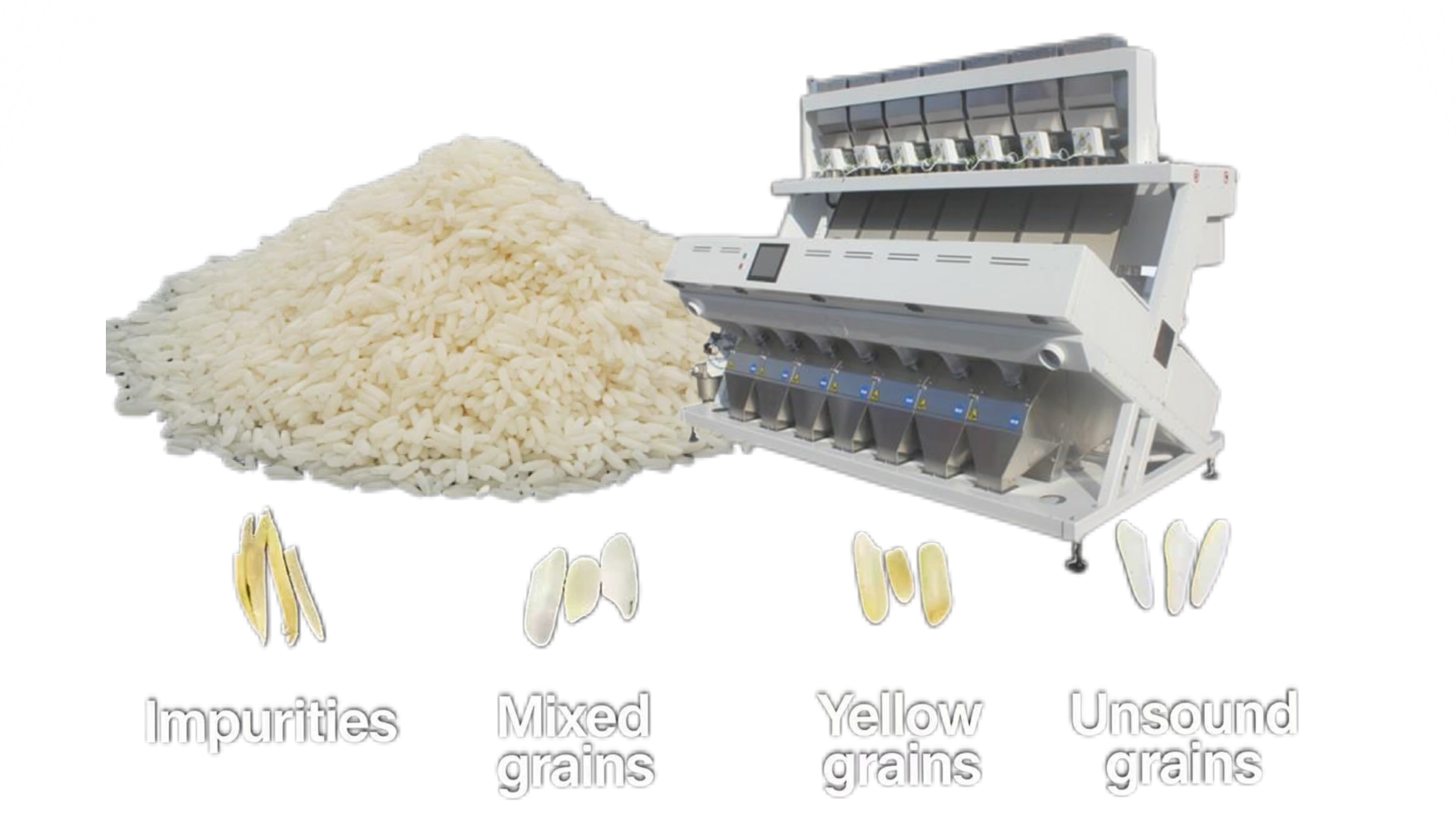
The Rice Color Sorter Machine is an advanced technological system engineered to significantly enhance both the quality and operational efficiency in rice processing plants. It utilizes state-of-the-art optical sorting technology to precisely separate rice grains based on color, effectively removing defective grains and various impurities.
By integrating a Rice Color Sorter Machine into the production line, rice millers and processors can achieve a superior final product, simultaneously minimizing waste and maximizing overall throughput and profitability.
How Does the Rice Color Sorter Machine Work?
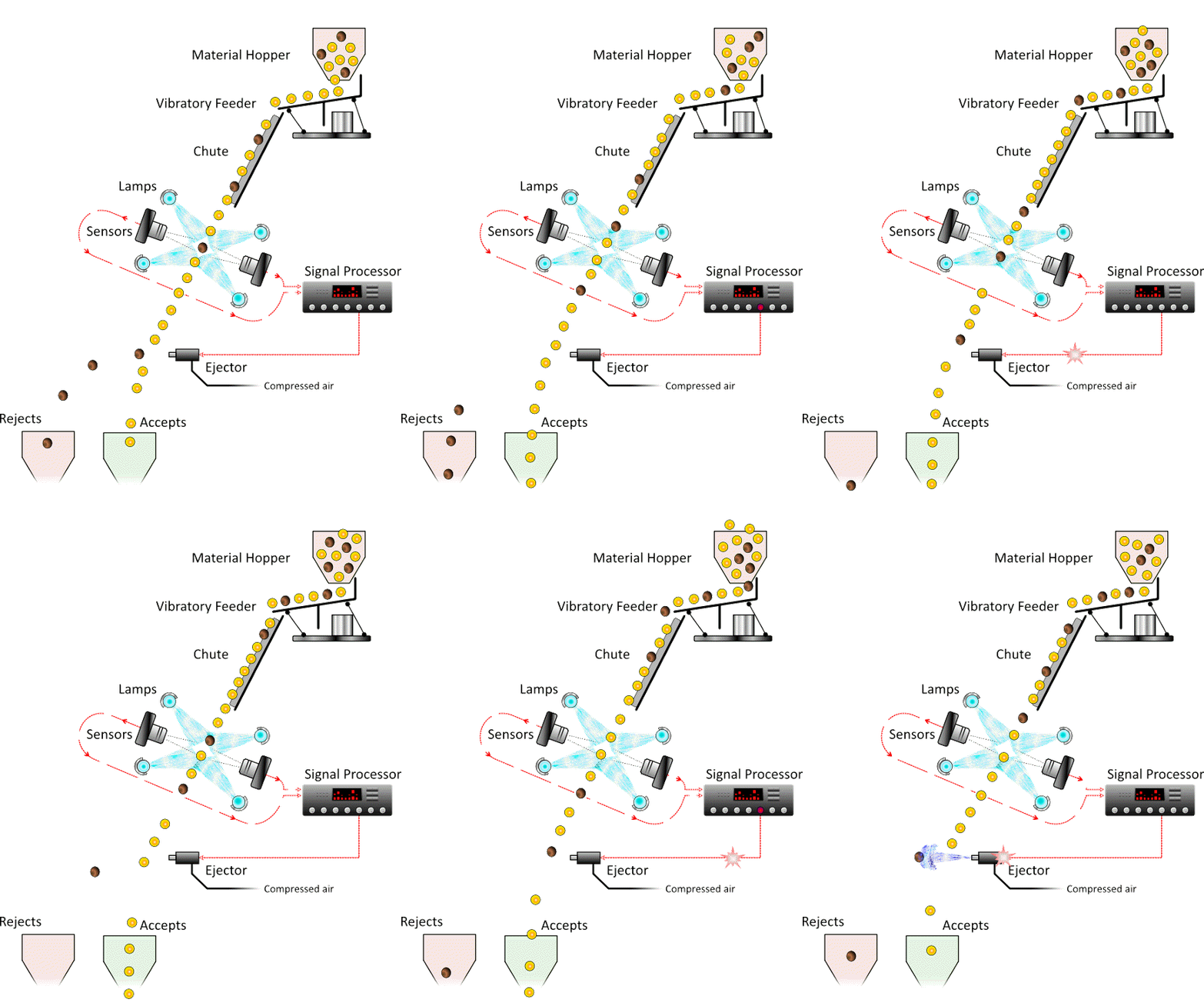
The Rice Color Sorter Machine employs high-resolution cameras and sophisticated image processing software to detect the slightest color variations in individual rice grains. As grains cascade through the optical chamber, the system captures detailed images of each grain. Powerful algorithms then analyze these images in real-time to identify discolored, damaged, or foreign materials.
Upon detection, the Rice Color Sorter Machine activates a precise ejection system, typically using high-speed air jets, to remove the identified substandard grains and impurities. This ensures that only premium, high-quality rice grains advance to the next stage of packaging or further processing.
🎥 See the Rice Color Sorter in Action
Watch the video below to observe how high-resolution cameras and AI-powered sorting technology work in real time. You'll see the machine accurately detecting and ejecting defective grains, ensuring only premium-quality rice moves forward. This demonstration highlights the speed, precision, and reliability that make the Rice Color Sorter an essential investment for modern mills.
Key Benefits of the Rice Color Sorter Machine
Superior Final Product Quality
The Rice Color Sorter Machine guarantees a consistently high-quality output by meticulously removing stained, immature, yellow, or broken grains, ensuring compliance with international market standards.
Enhanced Processing Efficiency
Automating the inspection and sorting process with a Rice Color Sorter Machine dramatically increases processing speed, allowing for higher volumes to be handled with greater accuracy and less manual labor.
Reduction in Product Waste
By accurately ejecting only defective material, the Rice Color Sorter Machine directly increases the usable yield from raw paddy, leading to significant cost savings and improved resource utilization.
Strengthened Food Safety Protocols
The Rice Color Sorter Machine plays a critical role in food safety by eliminating non-rice materials, glass, stones, black specs, and biologically contaminated grains, enhancing the hygiene and safety of the packaged rice.
How to Choose the Right Rice Color Sorter Machine
Selecting the ideal Rice Color Sorter Machine is a critical decision that directly impacts your plant’s efficiency, product consistency, and long-term profitability. With a wide range of models and technologies available, focusing on the following key factors will help you make a confident investment.
1. Throughput Capacity and Scalability
Evaluate your daily processing volume and future expansion plans. A machine with appropriate capacity ensures seamless integration into your existing line without becoming a bottleneck. Look for systems that offer flexibility to handle varying input volumes while maintaining sorting accuracy.
2. Sensor and Camera Technology
The heart of any color sorter lies in its optical system. High-resolution cameras with advanced CCD or CMOS sensors, combined with multi-spectral capabilities (such as infrared or visible light), enable precise detection of subtle defects. Machines equipped with AI-powered image recognition deliver superior performance, especially when sorting challenging varieties like parboiled or glutinous rice.
3. Ejection Precision and Reliability
High-speed air ejection systems determine how accurately defective grains are removed. Models with precisely controlled nozzles and optimized ejection algorithms minimize good grain carryover, preserving yield while achieving the desired purity level.
4. Ease of Operation and Maintenance
User-friendly touchscreen interfaces, intelligent self-diagnostic features, and easy-access cleaning panels reduce downtime and simplify operator training. A machine that is intuitive to maintain translates directly into lower operating costs and higher uptime.
5. After-Sales Support and Spare Parts Availability
Reliable technical support, responsive service networks, and readily available spare parts are essential for maintaining continuous operation. Partnering with a reputable manufacturer ensures long-term peace of mind and protects your production schedule.
Actual Case Comparison: Traditional vs. Advanced Rice Color Sorter
To better illustrate the tangible advantages of upgrading to a modern Rice Color Sorter Machine, the following table presents a side-by-side comparison of two rice processing facilities with similar daily throughput. Facility A continues using a conventional optical sorter with basic CCD technology, while Facility B has adopted an advanced AI-driven model featuring multi-spectral cameras and intelligent ejection control.
| Comparison Metric | Facility A (Traditional Color Sorter) | Facility B (Advanced AI-Powered Sorter) |
|---|---|---|
| Sorting Accuracy | ≈ 98.2% (defect removal rate) | ≈ 99.7% (defect removal rate) |
| Good Grain Carryover | 3–5% of quality grains rejected with defects | < 1% (minimal yield loss) |
| Processing Capacity | 5–8 tons per hour (varies with impurity level) | 12–15 tons per hour (stable throughput) |
| Labor Requirement | 2–3 operators per shift for constant adjustment | 1 operator per shift (automated calibration) |
| Energy Consumption | Baseline (1.0x) | 0.75x per ton processed |
| Annual ROI Improvement | — | +22% (through increased yield and reduced waste) |
As the comparison illustrates, upgrading to an advanced Rice Color Sorter Machine delivers measurable gains across key performance indicators—from higher accuracy and throughput to lower operating costs and better yield retention. These real-world outcomes translate directly into improved profitability and stronger market competitiveness.
Primary Applications of the Rice Color Sorter Machine
Polished Rice Sorting
Final quality check after milling and polishing, ensuring a flawless appearance and consistent texture.
Paddy Rice Sorting
Removing defective paddy before hulling to improve overall mill recovery and reduce downstream waste.
Parboiled Rice Sorting
Effective for sorting parboiled rice where color differences indicate processing variations and ensure uniformity.
Grading Operations
Classifying rice into different quality grades based on color purity, enabling premium pricing for superior lots.
Conclusion
The Rice Color Sorter Machine stands as a pivotal innovation in agricultural processing technology. By integrating high-resolution optical sensors, AI-powered image recognition, and precision ejection systems, it transforms traditional rice milling into a highly automated, data-driven operation. Its ability to deliver enhanced product quality, boost processing efficiency, reduce waste, and fortify food safety makes it a fundamental investment for any forward-thinking rice processing operation.
As consumer expectations for premium, defect-free rice continue to rise—and as global markets demand stricter quality and safety standards—the role of advanced sorting technology becomes not just advantageous, but essential. From paddy pre-sorting to final polished rice grading, the Rice Color Sorter Machine ensures consistency at every stage, helping millers minimize losses, maximize yield, and confidently meet export-grade specifications.
Adopting the Rice Color Sorter Machine is a strategic step toward achieving excellence in production and securing a stronger position in the global rice industry. It represents a commitment to quality, efficiency, and long-term competitiveness—delivering measurable returns that extend far beyond the sorting room.

World Leading Color Sorter Manufacturing Center

Leading Sensor-Based Optical Sorting Solutions Provider
Focus on optical sorting technology innovation. the pursuit of comprehensive, professional, timely and enthusiastic service to win the trust of customers, growing together with customers.
CSG relies on the technical team who from University of Science and Technology of China and National University of Defense Technology. and based on himself research and manufacturing experiences accumulated over the past 30 years. Created China's first optical sorting technology research center. Manufacturing center is located in Hefei High-tech Development Zone of China, have an annual production capacity of 5000 sets of sensor-based color sorter and have an annual sales 50 million USA dollar.