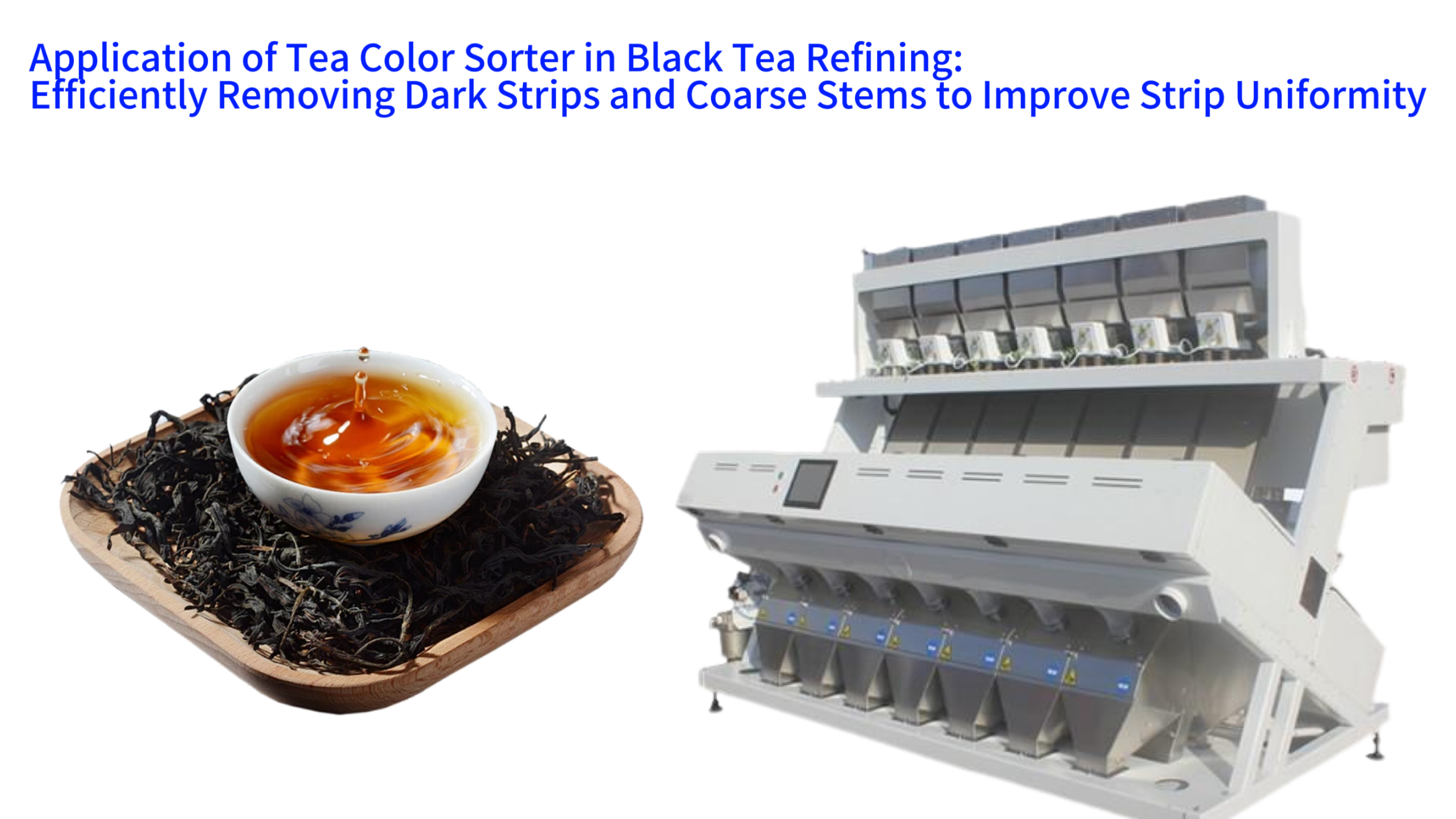
The production of premium black tea requires meticulous attention to detail throughout the refining process, with visual uniformity being a critical marker of quality. Dark strips, which are over-fermented or improperly processed leaves, and coarse stems disrupt the desired neat appearance and can negatively impact infusion characteristics. The integration of specialized optical sorting technology, specifically designed for tea, addresses these quality control challenges with precision and efficiency. This examination explores the application of the Tea Color Sorter within black tea refining lines, detailing its operational principles and the measurable benefits it delivers. We will analyze how this technology functions to identify and segregate substandard material based on optical properties, thereby elevating the overall standard of the finished product. The discussion extends to the specific challenges posed by black tea's varied morphology and color spectrum, illustrating why traditional manual sorting is increasingly insufficient for modern production scales and quality expectations.
The Quality Imperative in Black Tea Refining
Black tea refining represents a critical stage where the raw, dried leaves are transformed into a market-ready commodity. The primary objectives during this phase extend beyond mere size grading; they encompass the removal of any element that detracts from the tea's visual appeal, flavor purity, and consistency. Dark strips, often a result of uneven withering or fermentation, introduce bitter notes and an unattractive appearance. Coarse stems, being woody and less aromatic, dilute the tea's flavor profile and are considered a defect in high-grade offerings. The presence of these elements directly correlates with a lower market grade and reduced economic value, creating a compelling financial incentive for their removal.
Manual sorting, while traditional, presents significant limitations in terms of speed, consistency, and labor cost. Human sorters experience fatigue, leading to variable accuracy over time, and cannot match the throughput required by large-scale operations. Consequently, the industry has increasingly adopted automated solutions. The technological shift towards optical sorting is not merely a replacement of labor but a fundamental enhancement of quality control capabilities. These systems provide a consistent, objective, and high-speed assessment of every leaf, ensuring that the stringent standards for premium black tea are reliably met, batch after batch. This transition is essential for producers aiming to compete in global markets where consumers and distributors demand guaranteed uniformity and purity.
Defining the Targets: Optical Characteristics of Defects
The effectiveness of an optical sorter hinges on its ability to distinguish between acceptable tea leaves and specific defects based on their visual signatures. In the context of black tea, two primary categories of defects are targeted. Dark strips exhibit a distinct chromatic profile, typically showing a deeper, duller brown or blackish hue compared to the vibrant coppery-brown or black of properly fermented leaves. This color difference is detectable by high-resolution cameras. Furthermore, these strips may have a different surface texture or shape, sometimes appearing more twisted or irregular, which can be analyzed through advanced shape-detection algorithms.
Coarse stems present a different challenge. Their color is often lighter, more woody, or grayer than the tea leaves. More importantly, their morphology is distinct: they are elongated, cylindrical, and possess a different structural integrity. An optical sorter equipped with intelligent software can be trained to recognize this elongated shape and different light reflectance pattern. By combining color analysis with shape and size recognition, the system builds a comprehensive digital model of what constitutes a defect, allowing it to make accurate ejection decisions at speeds surpassing human capability. This multi-parameter analysis is key to achieving high selectivity without excessive loss of good product.
Economic and Sensory Impact of Impurity Removal
The removal of dark strips and coarse stems yields significant economic and qualitative advantages. From a commercial perspective, the purity of the tea directly influences its grading and, consequently, its price point. A batch with uniform color and minimal stem content can qualify for a higher grade, commanding a premium in the marketplace. Moreover, automated sorting maximizes yield by ensuring that good leaves are not accidentally discarded with the waste, a common issue in manual processes. The reduction in labor costs and the increase in processing throughput further contribute to an improved bottom line, making the investment in sorting technology financially justifiable.
On a sensory level, the impact is equally profound. Dark strips can impart unwanted astringency or bitterness to the brew, masking the tea's desired malty, sweet, or fruity notes. Coarse stems contribute little to no flavor and can create a "woody" or "hay-like" taste, diluting the overall experience. By eliminating these elements, the Tea Color Sorter Optical Sorting Machine helps preserve and highlight the authentic flavor and aroma profile of the black tea. This results in a cleaner, more consistent cup that meets consumer expectations for premium quality, enhancing brand reputation and customer satisfaction in a highly competitive industry.
Core Technology: Optical Detection Systems for Tea
The operational heart of a tea color sorter is its sophisticated optical detection system, a suite of components engineered to perceive and analyze minute visual details under industrial conditions. This system must function reliably despite potential environmental variables like ambient light changes or dust. It begins with controlled illumination. High-intensity, strobed LED arrays provide consistent lighting across specific wavelengths, often tailored to enhance the contrast between the rich colors of good black tea and the divergent hues of defects. This stable lighting environment is crucial, as it eliminates shadows and highlights that could obscure true color or texture, ensuring the cameras capture accurate and reproducible data for analysis.
Following illumination, the tea leaves pass through the field of view of one or more high-resolution digital cameras. These are not ordinary cameras but industrial-grade line-scan or area-scan devices capable of capturing thousands of detailed images per second. For comprehensive inspection, multiple cameras are frequently employed to view the product from different angles—top, bottom, and sides. This multi-angle approach is vital for black tea, where a stem might be concealed under a leaf from one perspective but visible from another. The cameras convert the optical information of each passing leaf and stem into a stream of digital pixel data, which forms the raw material for the subsequent real-time computational analysis that drives the sorting decision.
High-Resolution Imaging and Color Differentiation
The imaging sensors within a tea sorter are designed for exceptional clarity and color fidelity. Utilizing advanced CCD or CMOS technology, these sensors possess high pixel densities, enabling them to resolve fine details and subtle color gradations that might be imperceptible to the human eye. They operate with extremely fast shutter speeds, effectively freezing the motion of rapidly moving tea leaves to prevent image blur. When synchronized with precise LED strobes, they capture crisp, well-defined images of each individual component within the product stream. The sensitivity of these sensors can be electronically tuned to emphasize the specific color contrasts relevant to black tea sorting, such as the difference between a healthy dark brown leaf and an undesired blackish strip.
This granular image data is fundamental to the sorting process. In advanced systems, particularly those leveraging artificial intelligence, the camera feed supplies information to a processing unit that employs complex algorithms. These algorithms perform more than a simple color check; they analyze patterns, textures, and spatial relationships within the image. By comparing the captured data against a learned model of "good" and "bad" characteristics, the system can identify a stem based on its elongated shape and lighter color, or a dark strip based on its atypical hue and potentially shriveled texture, even amidst a flowing mass of similar-looking leaves.
The Critical Role of Intelligent Lighting
Consistent and specialized lighting is not a passive component but an active enabler of accurate sorting. The choice of illumination directly affects the camera's ability to distinguish defects. Standard full-spectrum white LEDs are commonly used to accurately render color. However, for particularly challenging separations—where the color difference between a stem and a dark leaf is minimal—alternative lighting strategies may be deployed. Near-Infrared (NIR) lighting, for instance, can reveal differences in the molecular composition and moisture content between a leaf and a stem, which reflect NIR light in distinct ways, providing a secondary data point for identification.
Some systems incorporate structured lighting or specific backlighting techniques to better highlight the silhouette and structural properties of particles, making shape recognition more reliable. This focus on optimal illumination ensures that the maximum amount of relevant visual information is extracted from each tea leaf. By creating ideal viewing conditions, the lighting system works in concert with the cameras to feed high-quality data to the processor, which is a prerequisite for achieving the high ejection accuracy rates—often cited as exceeding 99%—that modern tea sorters can deliver. This technological synergy is what allows for the reliable detection of subtle defects that compromise black tea quality.
The Sorting Decision and Ejection Process
Once the optical system captures and digitizes an image, the central processing unit executes a rapid series of analytical operations to determine the fate of each particle. This decision-making process occurs in milliseconds, a necessity given the high throughput of industrial refining lines. The software analyzes the digital image data, evaluating multiple parameters such as chromatic values (hue, saturation, brightness), geometric shape, size, and sometimes surface texture. Each particle is compared against predefined or learned acceptance thresholds. For a black tea leaf, it must fall within an acceptable range of brown/black color and exhibit the typical morphology of a curled or broken leaf. Any particle deviating from these parameters, such as a pale, cylindrical stem or an anomalously dark, misshapen strip, is flagged for rejection.
The sophistication of this processing stage dictates the machine's flexibility and accuracy. Traditional systems may rely on fixed, hard-coded thresholds. In contrast, modern intelligent systems, which may incorporate principles from AI Ore Sorter technology adapted for agricultural use, utilize machine learning models. These models are trained on vast libraries of tea images, learning to recognize the complex visual signatures of defects through pattern recognition. This allows for nuanced decision-making that can adapt to natural variations in tea from different regions or harvests, maintaining high performance without constant manual recalibration by operators, thereby ensuring consistent quality output.
Algorithmic Analysis and Real-Time Computation
The algorithms constitute the cognitive core of the sorter. In their most advanced implementations, they employ techniques from artificial intelligence, including deep learning and neural networks. Rather than being explicitly programmed with rules like "eject all dark objects," an AI-powered sorter is trained. Engineers present it with thousands of pre-labeled images: "premium leaf," "dark strip," "coarse stem." The algorithm iteratively learns the distinguishing features of each category. Over time, it develops a robust internal model capable of generalizing to new, unseen leaves, correctly identifying defects based on learned patterns. This self-optimizing capability is particularly valuable in tea processing, where raw material characteristics can fluctuate with season, cultivar, and processing methods upstream.
This computational power also facilitates complex sorting strategies. The system can be configured not merely for a binary good/bad separation but for multi-tiered grading. For example, it could sort tea into several quality channels: premium whole leaves in one, smaller broken leaves in another, while ejecting all stems and dark strips. The software typically provides an intuitive operator interface, often a touchscreen, where sensitivity settings can be adjusted, real-time performance metrics can be monitored, and rejection rates can be viewed. This places a high degree of control in the hands of the operator, allowing for fine-tuning based on the specific batch of tea being processed.
High-Speed Pneumatic Ejection Mechanism
The final, physical action of sorting is performed by a high-speed ejection system. Upon identifying a defect, the processor calculates the exact moment the particle will reach a bank of ejection nozzles. It then triggers a specific solenoid valve with a precisely timed electrical signal. This valve, characterized by an ultra-fast response time—often measured in fractions of a millisecond—opens momentarily to release a focused blast of compressed air. This air jet strikes the defective stem or dark strip, knocking it out of the main product flow and into a separate reject channel, while leaving the surrounding good tea leaves undisturbed.
The precision of this ejection is critical to the machine's overall efficiency. The system must account for the particle's velocity, trajectory, and the minute delay between detection and valve actuation. The valves are arranged in a dense array to cover the entire width of the falling tea curtain. The timing and air pressure are meticulously calibrated: sufficient force to deflect a dense stem, but not so strong as to scatter adjacent good leaves or create turbulent air currents that could pull valuable product into the reject stream. This high-speed ejection mechanism is the actuator that translates digital intelligence into a tangible quality improvement, directly determining the purity level of the refined black tea.
Integration into Black Tea Production Lines
The effective deployment of a color sorter within a black tea refinery requires careful consideration of its placement and integration with existing machinery. The sorter does not operate in isolation but is a key node in a sequential processing chain. Typically, it is positioned after primary drying and bulk sorting stages but before final grading and packaging. At this point, the tea has been largely stabilized and sized, but still contains the color-based and morphological impurities that the optical sorter is designed to remove. The feeding system must present a consistent, monolayer stream of tea to the detection area. For black tea, which can range from large whole leaves (Orthodox style) to smaller broken grains (CTC style), this often involves a vibratory feeder or a specialized belt system that spreads the tea evenly.
Integration also involves managing the output streams. The machine separates the inflow into at least two distinct pathways: the accepted product, which continues down the main processing line for further handling or packaging, and the rejected material, which is collected for disposal, secondary processing, or lower-grade blending. In more complex setups, multiple acceptance channels may be used for inline grading. Furthermore, the sorter's control system can often be networked with other factory systems, providing valuable production data on throughput, rejection rates by defect type, and overall line efficiency. This allows plant managers to monitor performance in real-time and make data-driven decisions to optimize the entire refining operation.
Configuring for Orthodox vs. CTC Black Tea
The configuration of the sorter must be adapted to the specific type of black tea being produced. Orthodox tea, characterized by its long, twisted whole leaves, presents a different sorting challenge compared to Crush, Tear, Curl (CTC) tea, which consists of small, uniform granules or "grades." For Orthodox tea, the focus is often on removing long, coarse stems and distinctly dark, poorly twisted leaves without breaking the delicate whole leaves. A sorter with gentle handling, perhaps a Belt-Type Color Sorter, might be preferred to minimize leaf damage, and the software parameters would be tuned to identify the specific shape and color of stems amidst the longer leaf particles.
For CTC tea, the particles are smaller and more uniform in size, but the issues of dark strips (small, over-fermented particles) and tiny stem fragments remain. Here, a high-speed chute-type sorter might be optimal for its superior throughput on free-flowing granular materials. The detection algorithms would be set to identify subtle color variations within a mass of similarly sized particles. The ejection system requires finer control to target tiny defects without affecting the surrounding granules. Understanding these distinctions is crucial for selecting and configuring the right optical sorting solution to maximize quality and yield for each black tea production style.
Synergy with Upstream and Downstream Processes
The benefits of optical sorting extend beyond its immediate function, creating positive synergies throughout the production line. Upstream, consistent feedback from the sorter's performance data can inform earlier processing stages. For instance, a persistently high rate of dark strips may indicate issues with fermentation control or withering uniformity, prompting adjustments in those areas. Downstream, delivering a cleaner, more uniform product to grading sieves, electrostatic separators, and packaging machines improves their efficiency. Packaging equipment, in particular, runs more smoothly with uniform product, reducing jams and ensuring consistent fill weights.
Moreover, by reliably removing hard stems and other dense impurities, the sorter reduces wear and tear on grinding or cutting equipment if further processing is required. This leads to lower maintenance costs and less unplanned downtime. The integration of a color sorter, therefore, elevates the performance of the entire refinery. It transforms a linear sequence of steps into an interconnected, feedback-informed system. This holistic improvement, where each stage is optimized by the performance of the others, is a key driver behind the widespread adoption of this technology in modern, competitive tea processing facilities aiming for superior quality and operational excellence.
Quality Outcomes and Market Advantages
The implementation of a dedicated tea color sorter yields definitive and measurable improvements in the final black tea product. The most immediately apparent outcome is enhanced visual uniformity. The processed batch exhibits a consistent, appealing color devoid of the contrasting dark strips and pale stems that signify poor refinement. This visual purity is not merely cosmetic; it serves as a primary indicator of quality for buyers and consumers, directly influencing grading and perceived value. In international commodity markets and specialty tea auctions, appearance is a critical factor in determining price, making this visual consistency a direct contributor to profitability.
Beyond aesthetics, the sorting process safeguards the sensory integrity of the tea. As previously noted, the removal of impurities eliminates sources of off-flavors and diluting elements. This ensures that the characteristic malty sweetness, briskness, and aroma of a high-quality black tea are fully expressed in the cup. Consistency from batch to batch becomes achievable, allowing brands to build a reputation for reliable flavor. This is paramount for both consumer-facing retail brands and for large-scale blenders who supply consistent tea to global beverage chains, where any deviation in taste can impact the end product and brand loyalty.
Meeting Stringent International Standards
Global trade in tea is governed by rigorous standards regarding purity and the absence of foreign matter. Regulatory bodies and major food safety schemes impose strict limits on allowable extraneous material, including stem content and other plant parts. Manual inspection struggles to guarantee compliance with these limits consistently. An automated optical sorting machine, however, provides an objective, auditable, and highly reliable method for meeting these standards. Its performance can be validated and documented, providing crucial assurance to international buyers and helping to streamline export processes.
For markets with particularly discerning consumers, such as Japan, Germany, or the United Kingdom, the expectations for tea cleanliness are exceptionally high. The presence of even a single visible stem in a retail package can lead to consumer complaints and damage a brand's reputation. The precision of modern color sorters acts as a critical control point in a Hazard Analysis and Critical Control Points (HACCP) plan or similar food safety management system. By effectively eliminating physical hazards and quality defects, the technology helps producers not only access but also excel in these premium and highly regulated market segments, opening doors to greater economic opportunity.
Data-Driven Optimization and Traceability
Modern optical sorters are data-generating assets. They continuously log information on processing rates, ejection percentages categorized by defect type (e.g., stems vs. dark strips), and overall machine performance. This data stream is a powerful tool for continuous improvement. Production managers can analyze trends to identify inefficiencies. For example, a sudden increase in stem content might trace back to a specific supplier or harvest period, informing procurement decisions. Long-term data can reveal correlations between initial tea quality and final yield, enabling more accurate forecasting and pricing.
This data capability also enhances traceability, an increasingly important aspect of food production. By linking sorting data to specific batches of tea, producers can provide verifiable evidence of the quality control steps applied. This supports claims of product purity and consistent standards, which are valuable in marketing to quality-conscious consumers and in business-to-business relationships. In essence, the sorter transitions from being a simple filtering device to an intelligent node in a smart factory ecosystem, contributing to overall operational transparency, efficiency, and market confidence in the brand's commitment to quality.