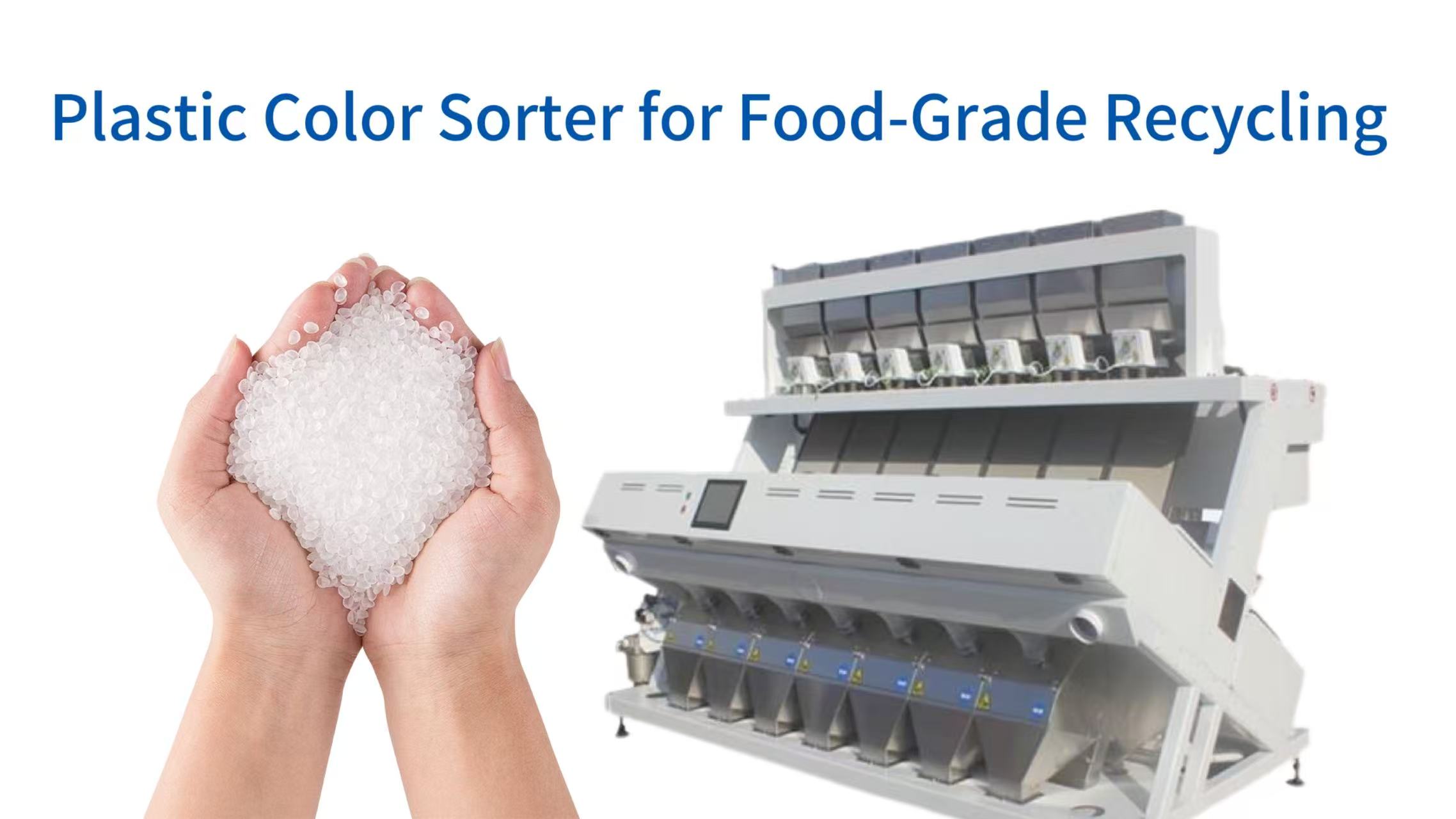
This page explains how plastic color sorting machines work in the production of food-grade recycled plastics. The text covers the basic definition, core technology, main types, key functions, and practical value of these machines. Readers will learn about the specific challenges in recycling plastics for food contact and how optical sorting technology offers a reliable solution. The guide also discusses technical principles, common application scenarios, and the return on investment for recycling businesses. All information is presented in clear language suitable for a wide audience.
The Growing Need for High-Purity Recycled Plastics in Food Packaging
Figure 1: Manual vs. Optical Sorting Efficiency Comparison
Key Data Points
Manual sorting speed: 20-30 defective pieces per minute
Optical sorter speed: Up to 200,000 particles per second
Labor replacement: 1 machine = 10-20 human sorters
Purity achievement: <50 ppm color contamination
Source: Industry standard performance data for food-grade plastic recycling
The global food industry depends heavily on plastic packaging for preserving products and ensuring safety. In recent years, stricter rules have been introduced to control what materials can touch food. Recycled plastics used in food packaging must meet very high standards for cleanliness and chemical safety. This demand has pushed recycling companies to improve their processes. They must now remove not only dirt and labels but also any plastic particles that are the wrong color or type. A single off-color piece can ruin an entire batch. As a result, market pressure is driving the need for more precise sorting technologies.
Traditional recycling methods often rely on manual sorting or basic gravity separation. These approaches cannot reliably achieve the purity levels required for food-grade applications. Manual sorting is slow, tiring, and inconsistent. Human eyes can miss small defects or become fatigued. Furthermore, older mechanical sorters lack the ability to distinguish subtle color differences. This limitation leads to higher rejection rates and material waste. To meet modern safety standards, the recycling industry requires automated systems that can inspect and separate plastic pieces with speed and accuracy. This is where the plastic color sorter machine becomes essential.
Basic Definition and Core Technology of a Plastic Color Sorter
Figure 2: Three-Step Working Principle of a Plastic Color Sorter
Feeding
Vibrating feeder spreads flakes into single layer
Detection
Cameras & LED lights capture color data
Separation
Air jets eject off-color particles
A plastic color sorter is an automated industrial device that uses optical sensors to identify and separate plastic particles based on their color. The machine processes a stream of material, captures images of each piece, and then uses air jets to remove unwanted items. This equipment is widely used in plastic recycling lines, especially for producing materials that will later be turned into food containers or packaging. The technology allows recyclers to achieve a level of purity that is impossible with manual methods. The machine operates at high speed, processing several tons of material per hour while maintaining consistent accuracy.
The core principle behind a color sorting machine involves three main steps: feeding, detection, and separation. First, plastic flakes are spread into a single layer using a vibrating feeder. They then fall past a line of high-resolution cameras and LED lights. These sensors capture color data from every piece. A computer processor compares this data against preset color thresholds. If a particle falls outside the acceptable color range, the system triggers a precise air nozzle. A short burst of compressed air deflects the rejected particle from its path. Good material continues into the accept bin. This whole cycle happens in milliseconds.
Optical Detection with High-Resolution Cameras
The detection system is the most critical part of the sorter. Modern machines use full-color CMOS cameras with resolution reaching up to 12,000 pixels per line. These cameras capture images of each plastic fragment from multiple angles. The system also includes specialized LED lighting that provides consistent, shadow-free illumination. This lighting is important because it ensures that color measurements remain stable regardless of ambient light changes. The camera can detect color differences as small as one to two percent in RGB values. This sensitivity allows the machine to separate plastics that appear nearly identical to the human eye.
Compared to older sensor systems, these high-resolution cameras offer significant advantages. Traditional systems using photodiodes could only sort by basic color intensity, not by specific shades. This limitation made them useless for food-grade applications where subtle color variations matter. The new cameras can distinguish between different grades of white, off-white, and lightly colored plastics. For example, the machine can separate natural HDPE from light blue or yellow contaminants. This level of precision directly supports the production of clear, colorless recycled pellets suitable for food contact. The camera data also feeds into the machine's intelligence system, allowing it to learn and adapt over time.
High-Speed Air Ejection Mechanism
Once the camera identifies a defective particle, the machine must remove it from the material stream instantly. This task is performed by a bank of air nozzles located below the detection zone. Each nozzle is very small, typically two to four millimeters in diameter, and can fire up to one thousand times per second. The ejection system uses compressed air at pressures between 0.4 and 0.6 MPa. When the processor sends a signal, a fast-acting solenoid valve opens, releasing a burst of air. This burst is directed precisely at the unwanted particle. The force of the air pushes the particle out of its natural trajectory and into a separate reject collection area.
The speed and precision of the air ejection system directly determine the machine's throughput and efficiency. To achieve high purity, the system must hit the correct particle without disturbing its neighbors. Modern sorters use advanced algorithms to calculate the exact timing and duration of each air burst. This calculation takes into account the particle's size, speed, and position. A well-tuned ejection system can achieve a removal efficiency of over ninety-nine percent for targeted defects. Furthermore, the nozzle spacing is designed to cover the full width of the material flow. Multiple nozzles can fire simultaneously to remove clusters of bad material. This design minimizes waste of good product while ensuring thorough cleaning of the plastic stream.
Intelligent Control and Image Processing
The brain of the plastic color sorter is its industrial computer and image processing software. This system receives raw data from the cameras and converts it into sorting decisions in real time. The software applies complex algorithms to analyze each pixel. It looks not only at color but also at shape, size, and surface texture. Operators can set multiple sorting criteria through a touchscreen interface. For food-grade recycling, typical criteria might include removing yellowed, browned, or opaque particles. The system can store up to one hundred different sorting recipes, allowing quick changeover between different plastic types or quality requirements.
Intelligent control brings several practical benefits to recycling operations. First, the machine can self-adjust to changes in material feed rate or lighting conditions. Second, it can generate detailed production reports showing input tonnage, reject rates, and purity levels. This data helps managers track performance and optimize their processes. Third, some advanced models offer remote monitoring capabilities. A technician can log in from another location to diagnose issues or update software. This feature reduces downtime and maintenance costs. Overall, the intelligent control system transforms a simple optical sorter into a smart production tool that supports consistent, high-quality output. For more technical details, see our page on technical parameters of color sorter machines.
Modular Design for Easy Maintenance
Industrial recycling lines operate continuously, often twenty-four hours a day. Any unplanned stoppage can be very costly. To address this, modern plastic color sorters feature a modular design. Key components like camera modules, LED light bars, and nozzle plates can be removed and replaced individually. This design means that if one part fails, an operator can swap in a spare in minutes rather than hours. The machine does not need to be completely disassembled. Regular cleaning is also simplified. Access panels provide easy entry to the interior glass shields and inspection windows. Keeping these surfaces clean is essential for accurate optical detection.
The modular approach also benefits long-term ownership costs. Instead of buying a whole new machine when technology improves, operators can upgrade specific modules. For example, installing higher-resolution camera modules or more efficient LED lights can boost performance without replacing the entire chassis. The control software is similarly modular, with updateable algorithms and sorting libraries. Manufacturers provide documentation and training for basic maintenance tasks. This support allows in-house maintenance teams to handle most routine work. As a result, the machine offers high availability and low cost per operating hour, making it a practical investment for recyclers of all sizes.
Main Types of Plastic Color Sorters and Their Applications
Table 1: Chute-Type vs. Belt-Type Color Sorter Comparison
Data based on standard industrial configurations
Plastic color sorters come in several configurations to suit different production environments. The two main categories are chute-type sorters and belt-type sorters. Chute-type machines use gravity to slide material past the cameras. They are ideal for free-flowing, granular materials like plastic flakes. Belt-type sorters carry material on a conveyor belt. These are better for larger pieces or materials that do not flow easily. Some machines are designed for fixed installation in a factory, while others are mobile for use at multiple sites. Choosing the correct type depends on your material size, required throughput, and facility layout.
Within these categories, manufacturers offer machines with different channel counts. A channel refers to one sorting lane. A two-chute machine has two lanes, a four-chute has four, and so on. Higher channel counts allow more material to be processed simultaneously, increasing total throughput. For example, a ten-chute six hundred forty-channel color sorting machine can handle very high volumes. However, the best choice for a given plant depends on the specific application. A small recycler producing specialty food-grade pellets might need a more precise machine with fewer lanes. A large municipal recycling facility will prioritize raw throughput. The following sections describe common configurations in more detail.
Chute-Type Gravity Sorters for Plastic Flakes
Chute-type sorters are the most common choice for processing shredded plastic. In these machines, material slides down a smooth, inclined chute. The chute accelerates the particles to a consistent speed before they pass the camera. This consistent speed is important for accurate sorting. The chute surface is made of a low-friction material, often stainless steel or a special polymer. The angle of the chute can be adjusted to control the speed. For plastic flakes, a typical speed is two to three meters per second. At this speed, a single machine can process between two and six tons per hour, depending on the channel width and flake size.
This design works very well for plastic that has been washed and dried. The flakes should be relatively uniform in size, generally between three and twenty millimeters. Larger flakes can tumble, which reduces sorting accuracy. Smaller flakes may stick together due to static electricity. To prevent these issues, many systems include a pre-screening step. This step separates oversized and undersized material before sorting. Chute-type sorters are also relatively compact. A four-chute machine may occupy only two square meters of floor space. This small footprint is valuable in crowded recycling plants. For these reasons, chute-type sorters are the standard equipment in most food-grade plastic recycling lines.
Belt-Type Sorters for Large or Irregular Pieces
Belt-type sorters use a rubber conveyor belt to carry material through the detection zone. The belt provides a stable, flat surface. This stability is beneficial for sorting larger plastic pieces, such as whole bottles or coarse shreds up to one hundred millimeters in size. The belt speed can be adjusted, typically from one to three meters per second. Slower speeds allow more inspection time for complex items. The belt also allows the camera to view the material from below as well as above. This dual-view capability is useful for sorting bottle caps or other parts with color on multiple surfaces.
One major advantage of belt-type sorters is their gentler material handling. Gravity chutes can cause fragile or sticky materials to bounce or smear. A belt conveyor moves the material smoothly, preserving particle integrity. This characteristic is important when sorting post-consumer plastics that may have labels or adhesives. The belt itself is designed for easy cleaning and replacement. Some belts include textured surfaces to prevent material from sliding sideways. However, belt-type sorters generally have a lower throughput per machine width compared to chute types. They also consume more electricity due to the drive motor. Therefore, they are typically used for specific applications where gravity sorting is not effective.
Multi-Channel High-Capacity Sorters
For large-scale recycling operations, multi-channel sorters offer the highest productivity. These machines combine eight, ten, or even twelve chutes in a single frame. Each chute operates independently with its own set of cameras and nozzles. A twelve-chute seven hundred sixty-eight-channel color sorting machine can process over fifteen tons of plastic flakes per hour. Despite the high throughput, the sorting accuracy remains very high. Each channel processes a narrow stream of material, preventing particles from overlapping. This design ensures that every particle is seen and evaluated individually.
Operating a multi-channel sorter requires careful attention to material distribution. The feeding system must divide the incoming material evenly across all chutes. If one chute receives too much material, its sorting performance will drop. Modern sorters include intelligent feed control that monitors each chute's load. The system can adjust feed rates in real time to maintain balance. Multi-channel machines also have higher compressed air demands. A large sorter might use two to four cubic meters of air per minute. An appropriately sized air compressor is a necessary part of the installation. Despite these requirements, the high throughput makes multi-channel sorters the most economical choice for large recycling facilities.
Core Functions of Plastic Color Sorters in Recycling Lines
Figure 3: Key Performance Metrics of a Plastic Color Sorter
Removal Efficiency
For targeted color defects
Air Savings
Compared to older models
Yield Improvement
Reduced good material loss
Energy Use
~1 kWh per ton processed
A plastic color sorter performs several essential functions that directly impact final product quality. The most obvious function is defect removal: taking out off-color particles, discolored pieces, and foreign materials. Beyond this, the sorter also ensures uniformity. By creating a stream of plastic where every piece meets the same color standard, the sorter enables downstream processes to run smoothly. The machine also functions as a quality control checkpoint. It can be placed at the end of a cleaning line to verify that previous steps have done their job. If the sorter rejects a high percentage of material, it signals that upstream cleaning may need adjustment.
These functions translate into concrete benefits for the recycler. First, the sorter increases the value of the output. Food-grade recycled plastic pellets sell for a premium compared to lower-grade materials. Second, the sorter reduces waste. By precisely targeting only defective particles, it minimizes the loss of good plastic. Third, the sorter improves production consistency. Once the machine is set up, it operates the same way hour after hour. This reliability is important for meeting customer specifications. The following subsections explore specific functions in more detail, including their technical basis and practical impact on recycling operations.
High-Precision Color-Based Separation
The primary function of the machine is to separate plastic particles by color. The system can distinguish between a wide range of shades, including whites, transparents, light blues, greens, yellows, and reds. For food-grade applications, the most common target is to remove all colored particles from a stream of natural plastic. Natural plastic is preferred for food containers because it can be dyed any color later. Even a single dark particle in a batch of natural flakes will cause the whole batch to be downgraded. The sorter solves this problem by reliably finding and ejecting those dark particles. Typical results achieve less than fifty parts per million of color contamination.
This high precision is achieved through a combination of hardware and software. The cameras use a wide dynamic range to see both very dark and very light objects in the same image. The LED lights are tuned to specific wavelengths that highlight color differences. The software allows operators to define accept and reject zones in color space. For instance, natural plastic might be defined as having hue values between forty and sixty, saturation below ten percent, and brightness above eighty percent. Any particle outside these thresholds is ejected. Operators can adjust these thresholds to become stricter or looser depending on the target market. This flexibility allows one machine to produce different grades of recycled plastic.
Removal of Foreign Materials and Mixed Polymers
In addition to color sorting, modern machines can help remove certain foreign materials. Plastics from post-consumer waste often contain small pieces of metal, wood, paper, or glass. While some of these materials are removed by magnets and air classifiers, some persist to the optical sorting stage. A color sorter can identify these materials by their distinct optical properties. For example, paper and wood have different reflectivity than plastic. Glass particles often have sharp edges and unique light transmission. The software can be trained to recognize these characteristics. When detected, the air jets eject the foreign material along with off-color plastic.
Removing mixed polymers is more challenging but possible in some cases. Different plastic types can have similar colors but different chemical properties. For food-grade recycling, polymer purity is as important as color purity. Advanced sorters using near-infrared sensors can identify polymer types. However, a standard color sorter cannot do this. For facilities that need polymer sorting, the solution is to combine a color sorter with a separate NIR sorter. The color sorter goes first to remove off-color pieces, then the NIR sorter separates by polymer type. Many food-grade recycling lines use this two-step approach. You can learn more about this technology on our NIR sorting technology page.
Real-Time Quality Monitoring and Reporting
A valuable function of modern plastic color sorters is their ability to monitor output quality in real time. The machine counts both accepted and rejected particles. It can calculate the percentage of reject material and the estimated purity of the accept stream. This information is displayed on the operator screen and can be logged for later analysis. If the reject rate suddenly increases, the operator knows that something has changed upstream. The cause could be a new batch of dirty feedstock or a malfunction in a washing step. By catching these issues early, the recycler can take corrective action before producing large amounts of off-spec material.
The reporting function also supports continuous improvement. Over time, a recycling plant can collect data linking sorter performance to final product quality. Managers can use this data to optimize settings and identify best practices. For example, data might show that slowing the feed rate by ten percent improves purity by twenty percent but reduces throughput by only five percent. This trade-off might be worthwhile for high-value food-grade products. The reports can also be shared with customers as evidence of quality control. A customer buying food-grade recycled plastic wants assurance that it meets specifications. Providing sorter log data builds trust and can justify a higher selling price.
Energy-Efficient Operation with Low Compressed Air Use
Plastic color sorters are designed with energy efficiency in mind. The largest energy consumer is typically the compressed air system. Manufacturers have worked to reduce air consumption through better nozzle design and intelligent firing algorithms. Modern nozzles produce a focused, high-velocity jet that uses less air per pulse. The control system also avoids firing multiple nozzles for the same particle. Some machines include an air saver mode that reduces air pressure when the reject rate is low. These features can cut compressed air use by thirty to fifty percent compared to older models. Since an air compressor is a major operating cost, these savings add up quickly.
Other components are also energy efficient. The LED lighting uses much less power than older halogen or fluorescent systems. A full set of LED bars for a four-chute machine may consume only two to three hundred watts. The industrial computer and electronics draw another few hundred watts. The vibratory feeder motor is usually a small, efficient design. The total electrical consumption of a typical plastic color sorter is between two and five kilowatts. For a machine processing five tons per hour, this translates to less than one kilowatt-hour per ton. This low energy footprint makes the sorter an environmentally friendly addition to a recycling line. It also keeps operating costs low, improving the overall economics of food-grade plastic recycling.
User-Friendly Interface for Quick Recipe Changes
Recycling plants often process different types of plastics at different times. A facility might run natural HDPE one shift and clear PET the next. Changing the sorting criteria between runs must be fast and error-free. Modern plastic color sorters address this need with a touchscreen user interface. The operator can select from a list of stored recipes. Each recipe contains all the settings: color thresholds, feed rate, air pressure, and camera parameters. Changing a recipe takes about thirty seconds. The machine then automatically adjusts all its systems to the new settings. This speed reduces changeover downtime and allows smaller production runs to be economical.
The user interface also simplifies training for new operators. The screens use clear graphics and plain language. Common tasks, such as calibrating the cameras or cleaning the chutes, are presented as step-by-step procedures. The system includes help text that explains each setting. For more advanced users, there is a diagnostic mode showing real-time camera images and nozzle test patterns. This design allows the machine to be operated by general production staff, not just specialized technicians. For detailed instructions on daily operation, refer to our installation and commissioning guide for color sorters. Easy operation leads to fewer mistakes and more consistent output.
Processable Plastic Types and Application Scenarios
Figure 4: Typical Purity Achievements for Different Plastic Types
Data represent typical industrial results under optimal operating conditions
A plastic color sorter can handle a wide variety of recycled plastic materials. The most common types in food-grade applications are PET from beverage bottles, HDPE from milk jugs and detergent bottles, and PP from food containers. These plastics can be recycled into new food packaging if they meet purity standards. The sorter processes the plastic after it has been shredded, washed, and dried. The input material is typically in the form of flakes ranging from two to twenty millimeters. The machine works best with free-flowing flakes that have a consistent size distribution. Very dusty or wet material can reduce sorting accuracy because dust and water droplets scatter light.
Different plastic types and colors present different sorting challenges. Clear PET flakes are relatively easy to sort because any colored particle stands out. White HDPE flakes are also straightforward. However, sorting a mixed stream of various light colors requires more precise calibration. The machine can be adjusted to keep one specific color while rejecting all others. Some recyclers use multiple sorters in series. The first sorter removes dark contaminants. The second sorter separates colors into individual streams, such as green, blue, and natural. This approach produces single-color fractions that have higher market value. The following subsections describe typical application scenarios in more detail.
Sorting Natural HDPE from Colored Milk Bottles
Milk jugs are typically made of natural HDPE, which is translucent and off-white. However, many milk jugs have colored caps or labels. Small pieces of these colored components often mix with the natural flakes during shredding. A color sorter can effectively remove these colored contaminants. In a typical installation, the sorter processes HDPE flakes at three to four tons per hour. The machine is set to accept only flakes within a defined color range of light, translucent shades. Any flake that is darker, more opaque, or clearly colored is ejected. The result is a natural HDPE stream with less than 0.1 percent color contamination.
This sorted natural HDPE is valuable for food-contact applications. After additional cleaning and pelletizing, it can be made into new milk jugs or other food containers. The sorting process also recovers the colored flakes as a separate stream. This stream can be sold for lower-value applications such as plastic lumber or non-food containers. Thus, the sorter helps maximize the value of the entire input material. The key to success is ensuring that the HDPE flakes are dry and free-flowing. Wet flakes tend to stick to the chute, causing erratic trajectories and missed ejections. Therefore, a high-performance dryer is an important companion to the sorter in this application.
Removing PVC Contaminants from PET Flakes
One of the most difficult challenges in PET recycling is removing PVC particles. PET and PVC are both clear plastics and look very similar to a color camera. However, PVC contaminates the PET melt during extrusion, causing discoloration and weak spots. For food-grade PET recycling, the PVC content must be below fifty parts per million. A standard color sorter cannot directly identify PVC. However, there is a solution using a special dye and UV light. The plastic is treated with a dye that fluoresces under UV light only when in contact with PVC. A color sorter equipped with UV cameras can then detect and eject the marked PVC particles.
This technique requires an additional step in the recycling line. After washing, the PET flakes pass through a bath containing the dye solution. The flakes then go to a dryer and finally to the UV sorter. The UV sorter works similarly to a color sorter but uses different wavelengths of light. It identifies fluorescent particles and ejects them. This system can reduce PVC contamination from hundreds of parts per million down to below ten parts per million. The cost of the dye and UV sorter is justified by the high value of food-grade PET. This application shows how optical sorting technology can be extended beyond simple color sorting to solve specific chemical purity problems.
Cleaning Post-Consumer PP from Mixed Containers
Polypropylene is widely used for yogurt cups, bottle caps, and food trays. Post-consumer PP waste is often mixed with other plastics and contains many colored pieces. Producing food-grade recycled PP requires removing all non-PP materials and all colored PP particles. The color sorter's role is to remove the colored PP. A typical PP recycling line uses a color sorter after washing and drying. The machine is calibrated to accept only the specific color range of the desired product. For a clear or natural PP product, the sorter rejects any opaque or dark flakes. The sorting efficiency can reach ninety-eight to ninety-nine percent for removal of colored contaminants.
One challenge with PP is that it often becomes yellowed or gray due to aging and UV exposure. These slightly discolored particles can be difficult to separate from natural PP. To address this, operators can set very tight color thresholds. This approach will reject more material, including some good but slightly discolored PP. The rejected material can sometimes be used in lower-grade applications. Alternatively, the recycler can use a two-pass sorting method. The first pass uses a broad setting to remove obvious contaminants. The second pass uses a strict setting to produce a premium fraction. This method maximizes the yield of high-quality output while still producing a usable secondary fraction.
Sorting Opaque and Transparent Plastic Mixes
Some recycling streams contain a mixture of transparent and opaque plastics of the same base polymer. For example, a clear PET bottle and a white opaque PET tray are both PET but have different optical properties. A standard color sorter can distinguish these based on light transmission. Transparent particles allow most light to pass through. Opaque particles block light. The camera system measures not only color but also the intensity of light coming from behind the particle. By setting a threshold for transparency, the machine can separate transparent from opaque pieces. This capability is useful when producing a transparent product for packaging where clarity is important.
Separating by transparency requires careful calibration of the lighting and camera sensitivity. The background behind the particle must be controlled. Many sorters use a backlight in addition to the front lights. The backlight shines through transparent particles but is blocked by opaque ones. The camera compares the image from the front lights with the image from the backlight. The software then classifies each particle as transparent, translucent, or opaque. The user can decide which classes to accept and which to reject. This technique is also useful for removing black particles that are actually very dark but still somewhat transparent. It gives the recycler additional control over final product appearance.
Technical Principles Behind Plastic Color Sorting
Figure 5: Real-Time Processing Sequence from Detection to Ejection
Camera Capture
12,000 pixels/line
FPGA/GPU Processing
Microsecond analysis
Nozzle Firing
±0.5ms accuracy
Total delay from detection to ejection: Fixed & calibrated per machine (typically 5-15 milliseconds)
The reliable performance of a plastic color sorter depends on several scientific and engineering principles. At the most basic level, the machine uses optics to measure the light reflected from each particle. Different materials and colors absorb and reflect different wavelengths of light. The machine's cameras and lights are designed to capture these differences. The second principle is high-speed computation. The image data from the cameras must be processed in microseconds to allow the ejectors to act in time. This requires specialized processors and efficient algorithms. The third principle is fluid dynamics. The air jets must create a precise impulse that changes the particle's path without breaking it or affecting nearby particles.
Beyond these core principles, practical sorter design also incorporates knowledge of material handling. The feeding system must spread particles into a single layer without gaps or overlaps. The chute or belt must accelerate them to a uniform speed. The collection system must separate accepted and rejected particles without mixing. All these subsystems must work together in a coordinated way. When they do, the result is a machine that can process several tons per hour with near-perfect accuracy. The following subsections explain specific technical principles in more detail, including how they contribute to the overall sorting performance. For a more general overview, see our page on what is a color sorter machine.
Full-Spectrum LED Lighting and Camera Sensitivity
Accurate color measurement starts with consistent, stable lighting. Plastic color sorters use high-intensity LED arrays that produce a full spectrum of visible light. The LEDs are arranged around the camera lens to illuminate the particle from multiple directions. This arrangement eliminates shadows that could be mistaken for color variations. The LEDs are pulse-width modulated to maintain constant brightness over time. They also have a very long life, typically fifty thousand hours or more. This long life reduces maintenance and ensures that the lighting conditions do not drift over months of operation. Consistent lighting is the foundation of repeatable sorting performance.
The cameras used in these machines are specialized industrial sensors. They have a global shutter, meaning they capture the entire image at exactly the same moment. This feature is important because the particles are moving quickly. A rolling shutter would cause distortion. The cameras also have high dynamic range, allowing them to see details in both bright and dark areas of the same image. The raw image data is sent to the processor as twenty-four-bit color, with eight bits per red, green, and blue channel. Some advanced machines use thirty-six-bit color for even finer discrimination. The combination of high-quality lighting and sensitive cameras gives the sorter its ability to see subtle color differences that matter for food-grade applications.
Real-Time Image Processing Algorithms
The image processor must analyze every particle in the material stream. For a machine processing five tons per hour of five-millimeter flakes, the camera sees roughly two hundred thousand particles per second. The processor has only a few microseconds to analyze each particle and decide whether to reject it. This speed is achieved using hardware acceleration. Many sorters use field-programmable gate arrays or graphics processing units to run the color sorting algorithms. These chips are optimized for parallel processing. They can evaluate hundreds of pixels simultaneously. The algorithms themselves are relatively simple: they compare each pixel's color coordinates to a predefined acceptance region in color space.
The acceptance region can be a simple rectangle or a more complex polygon. Operators define this region through the user interface. The software then translates the region into a set of mathematical rules. During operation, the processor calculates whether each particle's average color falls inside or outside the region. Particles on the boundary can be handled in different ways. Some systems use a soft threshold where particles near the boundary are ejected only if they also have other defects. Others use a strict threshold for maximum purity. The processor also compensates for variations in particle size and speed. Larger particles produce more total reflected light, so the color calculation must be normalized by particle area. These adjustments happen automatically in real time.
Precision Air Nozzle Timing and Calibration
The final step in the sorting process is the ejection. The air nozzles must fire at exactly the right time to hit a particle that is falling at several meters per second. The delay between the camera seeing the particle and the nozzle firing is fixed. It includes the time for image processing, signal transmission, and solenoid valve opening. The system calculates the particle's position when the air burst will arrive. This calculation uses the particle's measured speed and the known delay. If the calculation is off by even two milliseconds, the air burst will miss the particle. Therefore, precision timing is critical. Modern sorters achieve timing accuracy within 0.5 milliseconds.
Calibration is also important. Over time, nozzles can become partially blocked or misaligned. The solenoid valves can wear, changing their opening time. To maintain accuracy, sorters have built-in calibration routines. The operator can run a test where the machine ejects a stream of known particles. The system analyzes where the particles land. If they are not centered in the reject bin, the software adjusts the timing offsets. Some machines automatically perform this calibration periodically. Others require manual initiation but provide step-by-step guidance. Regular calibration ensures that the sorter continues to perform at its specified accuracy. It is a simple but essential maintenance task for any recycling operation using optical sorters.
Dust and Moisture Protection for Optical Components
Recycling environments are dirty. Dust, moisture, and fine plastic particles are everywhere. These contaminants can coat the camera lenses, LED windows, and chute surfaces. A dirty chute causes particles to tumble instead of slide smoothly. Dirty windows reduce light transmission and cause false color readings. To combat this, plastic color sorters are built with sealed optical compartments. The cameras and LEDs are behind glass or acrylic windows. Clean, dry air is blown across the outside of these windows to keep dust from settling. This air curtain system operates continuously. It uses filtered air from the plant's compressed air system. The air flow also helps cool the electronics.
For the chute, the solution is different. The chute must be cleaned regularly by the operator. However, some sorters include a self-cleaning feature. A small brush or wiper runs across the chute surface at set intervals. This wiper pushes off any stuck particles. Other designs use a chute coating that reduces static charge. Static causes fine dust to cling to the surface. By reducing static, the chute stays cleaner for longer periods. Despite these features, routine manual cleaning is still necessary. The frequency depends on how dusty the material is. For clean, washed plastic flakes, cleaning once per shift may be enough. For dirtier material, more frequent cleaning is required. Following a regular cleaning schedule is key to maintaining sorting performance.
Economic Value and Return on Investment for Recyclers
Table 2: Return on Investment Analysis for a Typical Plastic Color Sorter
Note: Actual ROI depends on local labor costs, material throughput, and target market prices.
Investing in a plastic color sorter involves a significant upfront cost. However, for a recycler targeting the food-grade market, the return on investment is typically strong. The main source of return is the higher selling price of food-grade recycled plastic. This material can sell for thirty to fifty percent more than lower-grade recycled plastic. Even a modest increase in purity can open the door to this premium market. A color sorter is often the key piece of equipment that allows a recycler to make the upgrade from industrial grade to food grade. The payback period for a sorter in this application is often twelve to twenty-four months.
Beyond the price premium, a sorter reduces operating costs in several ways. It replaces manual sorting labor. One machine can do the work of ten to twenty human sorters. It reduces waste by accurately targeting only defective particles. It lowers the risk of producing off-spec material that must be sold at a loss. It also improves production consistency, which builds customer trust and repeat business. When these factors are combined, the economic case for a color sorter is very strong. The following subsections break down the specific value drivers in more detail, including quantitative examples of cost savings and revenue increases.
Replacing Manual Sorting Labor
Manual sorting of plastic flakes is slow and expensive. A human sorter working at a conveyor belt can typically pick out twenty to thirty defective pieces per minute. Over an eight-hour shift, a person might process one to two tons of material, depending on contamination levels. The labor cost per ton is high. In addition, manual sorting quality varies. A tired worker will miss more defects. The work is also repetitive and can lead to injuries. By contrast, a plastic color sorter operates at five tons per hour with no breaks and consistent accuracy. One machine can replace a team of fifteen to twenty manual sorters. The annual cost savings in labor alone can be hundreds of thousands of currency units.
These savings are realized quickly. The purchase price of a typical industrial color sorter is often equal to one or two years of the replaced labor costs. After that, the machine continues to operate with minimal ongoing costs. The labor that was freed up can be redeployed to other tasks, such as maintenance, quality testing, or operating additional equipment. In many recycling plants, finding enough manual sorters is a challenge due to labor shortages. Automating the sorting process removes this hiring difficulty. It also improves worker safety by removing people from the dusty, noisy environment of the sorting line. For all these reasons, labor replacement is a major driver of the return on investment.
Increasing Product Value Through Higher Purity
The price of recycled plastic varies significantly with purity and color quality. For example, natural HDPE pellets suitable for food contact might sell for 1.5 times the price of mixed-color HDPE pellets. Clear PET pellets for bottle-to-bottle recycling command an even larger premium. The difference is due to the cost and difficulty of achieving high purity. A color sorter provides a reliable way to achieve that purity. In many cases, installing a sorter allows a recycler to move from selling industrial-grade material to selling food-grade material. This upgrade can increase revenue by thirty to fifty percent on the sorted fraction. For a plant processing ten thousand tons per year, this increase represents a substantial amount of additional income.
The exact revenue gain depends on the starting purity and the target market. A plant that already has good basic sorting might see a smaller gain. However, even a five percent price increase can justify the sorter investment. Additionally, the sorter can help a recycler maintain consistent quality over time. Customers are willing to pay a premium for reliable supply. Once a recycler builds a reputation for consistent food-grade material, they can command higher prices and secure long-term contracts. The sorter is not just a cost-saving device. It is a tool for business development and market positioning. For these reasons, many recyclers consider a color sorter a strategic investment rather than just an equipment purchase.
Reducing Waste and Increasing Yield
Every piece of good plastic that ends up in the reject stream represents lost revenue. Manual sorting often throws away good material along with bad material. This happens because human sorters cannot make split-second precise judgments. They tend to reject a wide margin around defects to be safe. A color sorter, by contrast, can target defects with millimeter precision. It can reject a single dark flake while allowing a good flake right next to it to pass. This precision reduces the amount of good material lost. Typical yield improvements range from two to five percent of total throughput. For a large recycler, this gain can cover the cost of the sorter within a year.
Reducing waste also has environmental benefits. Every ton of plastic that is recovered and recycled saves resources compared to producing virgin plastic. It also reduces the amount of material sent to landfill or incineration. For companies with sustainability goals, these environmental benefits are important. Some food brands require their packaging suppliers to demonstrate low waste and high recovery rates. A color sorter helps a recycler meet these requirements. The machine's data reporting can provide proof of recovery rates. This documentation supports sustainability claims and can be used in marketing materials. Thus, the waste reduction function of a sorter delivers both economic and environmental value.
Lowering Risk of Product Recalls and Quality Penalties
In the food packaging industry, quality failures are expensive. If a batch of recycled plastic contains a contaminant, the customer may reject the entire shipment. The recycler then bears the cost of disposal or re-processing. In a worst-case scenario, contaminated plastic could make its way into food packaging and cause a recall. Recalls are extremely costly and can damage a company's reputation for years. A color sorter acts as a final barrier against such events. By ensuring that only in-spec material leaves the plant, it greatly reduces the risk of quality failures. Many food packaging companies require their recycled plastic suppliers to use optical sorting as a condition of doing business.
The risk reduction value of a sorter is difficult to quantify but very real. One major quality incident can wipe out the profits from many months of operation. The sorter's cost is small compared to the potential liability. In addition to avoiding failures, the sorter provides documented quality assurance. The machine logs every batch's reject rate and estimated purity. This log provides evidence that the material was properly sorted. If a customer questions the quality, the recycler can provide data to support their claim. This traceability is increasingly required in regulated markets. For food-grade applications, the ability to demonstrate due diligence is a competitive advantage. The sorter delivers this advantage at a modest cost.