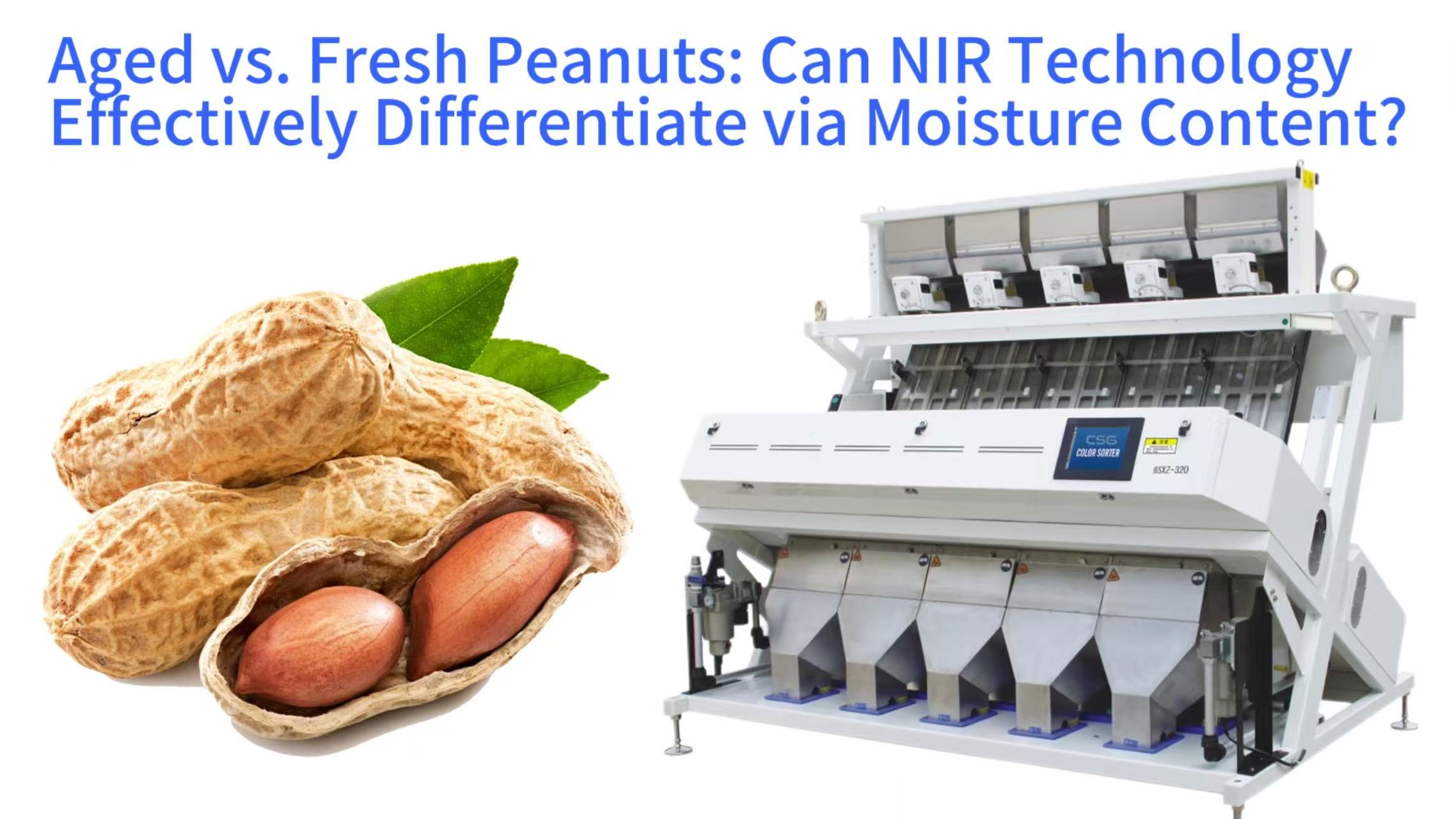
This page provides a detailed investigation into the capacity of near-infrared (NIR) optical systems to distinguish between aged and freshly harvested groundnuts. The core scientific question explored here is whether moisture content variation, a primary indicator of peanut age and storage duration, can serve as a reliable physical parameter for machine-based separation. Readers will gain an understanding of the electromagnetic principles behind NIR moisture detection, the mechanical workflow of integrating such sensors into an industrial 64 channels sorting machine, and the practical limitations faced when processing large volumes. This discussion connects fundamental food science with applied optical engineering, offering a clear view of what current technology can and cannot achieve in differentiating post-harvest age in legumes.
Peanut Moisture Content by Storage Duration
| Storage Period | Average Moisture Content | Moisture Gradient (Core vs Surface) | Key Spectral Feature |
|---|---|---|---|
| Fresh (0-1 month) | 20-30% | 8-12% difference | Strong 1450/1940 nm absorption |
| 6-10 months | 6-8% | 1-2% difference | Reduced water band absorption |
| Aged (>1 year) | 5-7% | Flat (0-1% difference) | Increased 1210 nm C-H band |
| Artificially Dried | 6-8% | 5-7% difference | Asymmetric water absorption |
The Relationship Between Groundnut Storage Time and Internal Moisture Equilibrium
Freshly harvested groundnuts typically possess an internal moisture concentration ranging from 20 percent to 30 percent depending on regional drying practices and environmental humidity at the time of collection. This moisture is not distributed uniformly; the kernel center retains higher water activity compared to the outer layers immediately after shelling. Over time, this internal water migrates toward the surface and eventually evaporates into the surrounding storage atmosphere. The rate of this migration is influenced by storage temperature, relative humidity, and the integrity of the kernel skin.
After six to ten months of storage under standard warehouse conditions, the average moisture content of unshelled groundnuts stabilizes between 6 percent and 8 percent. This equilibrium point represents the point at which the kernel’s water vapor pressure matches that of the ambient air. Aged peanuts, defined here as crops held for over one year post-harvest, exhibit not only lower total moisture but also a flattened moisture gradient across the kernel structure. This flattened profile means the surface and the interior reach similar dryness, altering how light interacts with the cellular matrix.
The Dielectric Property Shift in Dehydrated Cotyledons
Water molecules possess a high dipole moment, meaning they respond strongly to alternating electromagnetic fields. When moisture leaves the peanut cotyledon, the dielectric constant of the tissue decreases substantially. This reduction influences how electromagnetic radiation, particularly in the microwave and infrared bands, is absorbed and reflected. NIR sensors detect this shift by measuring the absorption bands specific to O-H bonds, which are abundant in water.
Dry tissue exhibits lower absorbance at wavelengths centered near 1450 nanometers and 1940 nanometers, both of which correspond to vibrational overtones of the water molecule. Consequently, an aged peanut with 6 percent moisture displays a significantly different spectral signature than a fresh peanut with 25 percent moisture. However, the challenge arises when comparing peanuts dried artificially shortly after harvest with naturally aged peanuts. Both may present similar absolute moisture values, making age determination solely by moisture content ambiguous without additional reference data.
Surface Texture Modification and Its Effect on Light Scattering
Extended storage does not only remove water; it also physically alters the peanut surface. The skin becomes more brittle, and microscopic cracking occurs due to repeated cycles of slight humidity changes. These microfissures increase the surface roughness, which in turn increases diffuse reflectance. When NIR light strikes a fresh peanut with a relatively smooth, moist skin, specular reflection dominates. On an aged peanut, the same wavelength undergoes multiple scattering events before re-emerging.
This scattering phenomenon can be misinterpreted by optical sensors as color desaturation or as a shift in hue. Some advanced Spare Parts of Color Sorter systems, specifically those equipped with NIR capabilities, utilize algorithms that separate diffuse from specular components to better characterize surface condition. The scattering pattern provides indirect evidence of age, complementing the direct moisture measurement.
Correlating Moisture Loss with Biochemical Degradation Products
As groundnuts age, lipids within the kernel undergo slow oxidation, producing volatile organic compounds and altering the refractive index of the oil bodies. These biochemical changes do not directly equate to moisture loss but occur in parallel with it. NIR spectroscopy captures overtones from C-H and N-H bonds present in these oxidation byproducts. Therefore, the spectral difference between fresh and aged peanuts is a composite signal of reduced water content and increased oxidized lipid concentration.
Researchers have identified specific wavelength ratios, such as the 1210 nanometer to 1750 nanometer absorbance ratio, that correlate strongly with storage duration. This ratio increases as the product ages because the 1210 nm band, associated with the second overtone of C-H stretching, becomes more prominent relative to the water band. Commercial sorters implementing such multi-wavelength analysis achieve higher classification accuracy than those relying solely on single-band moisture detection.
Integration of NIR Sensor Arrays into High-Speed Groundnut Processing Lines
Translating laboratory spectroscopy into industrial-scale sorting requires overcoming significant engineering constraints. Industrial sorters process material at flow rates exceeding five metric tons per hour, with individual kernels traveling at speeds near three meters per second through the inspection zone. In this environment, each peanut remains within the sensor field of view for only a few milliseconds. During this brief window, the system must illuminate the product, collect reflected radiation across multiple wavelengths, process the spectral data, and execute a decision to either accept or reject.
Industrial NIR Peanut Sorting Workflow
Modern machines achieve this through parallel processing architectures. Linear sensor arrays, typically comprising indium gallium arsenide detectors sensitive to the 900 to 1700 nanometer range, scan the falling product stream line by line. Each line scan captures spectral information from hundreds of kernels simultaneously. The resulting data volume exceeds one gigabyte per minute, requiring field-programmable gate arrays to perform real-time feature extraction. These hardware accelerators compare each kernel’s spectral fingerprint against thresholds established during calibration with known fresh and aged reference samples.
Calibration Protocols for Moisture-Based Discrimination
Establishing the decision boundary between fresh and aged categories is not a trivial exercise. The operator must first collect representative samples of both classes and measure their reference moisture content using oven-drying methods standardized by industry associations. These samples are then presented to the NIR sorter under controlled lighting and feeding conditions. The system records the average reflectance at each wavelength band for thousands of individual kernels, building a statistical distribution model.
A common approach employs partial least squares discriminant analysis to identify the spectral regions possessing the highest discriminatory power. For groundnuts, the 1400 to 1500 nanometer water absorption region typically receives the highest weighting coefficient. However, ambient temperature influences the shape of this absorption band; warmer kernels exhibit broader, less intense peaks. Therefore, calibration datasets must span the expected operating temperature range of the processing facility. Seasonal variations between summer and winter operations necessitate periodic model updating to maintain consistent rejection accuracy for aged lots.
Air Ejection Timing and Trajectory Compensation for Variable Mass Kernels
Once the optical system identifies a kernel as aged based on its moisture-correlated spectral signature, a pneumatic ejection mechanism must physically remove it from the product stream. Drier, aged kernels weigh less than fresh kernels of equivalent size. This reduced mass means they respond more rapidly to the directed air pulse and travel a different ballistic trajectory. If the ejector timing is calibrated using average fresh kernel mass, lighter aged kernels may be over-deflected, potentially missing the reject chute entirely or colliding with adjacent acceptable product.
Advanced systems compensate for this by incorporating mass estimation algorithms. Since NIR absorption depth correlates with both moisture and kernel thickness, the system can approximate the dry matter weight. This estimation informs the solenoid valve control logic, adjusting the ejection pulse duration or delay time to direct the aged kernel accurately into the designated waste channel. Such precision reduces the volume of fresh product mistakenly rejected due to proximity to an aged kernel during ejection.
False Positive Sources in High-Throughput Moisture Sorting
Despite sophisticated algorithms, moisture-based age sorting is susceptible to several classes of error. Immature kernels harvested green possess naturally lower dry matter accumulation and may exhibit moisture readings similar to properly stored aged kernels. These immatures are not necessarily old, but their spectral signature triggers rejection. Conversely, aged kernels that have reabsorbed moisture due to high-humidity storage conditions or condensation within the silo may appear spectrally similar to fresh stock.
Another significant error source arises from kernel orientation. The NIR beam penetrates deeper when incident upon the flatter, lateral surface of the cotyledon compared to the curved dorsal surface. This variable path length alters the absolute absorbance value independent of moisture concentration. Multi-angle illumination or the integration of 12 chutes 768 channels AI sorter systems with dual-sided sensors mitigates this orientation bias, but adds considerable cost and computational load to the sorting infrastructure.
Sensing Technology Comparison for Peanut Age Differentiation
| Technology | Detection Principle | Accuracy for Age | Capital Cost | Throughput Compatibility | Key Limitation |
|---|---|---|---|---|---|
| NIR Spectroscopy | Moisture + chemical bonds | 85-92% | Medium-High | Excellent (5+ t/h) | Affected by artificial drying |
| Visible Color Sorting | Surface discoloration | 65-75% | Low-Medium | Excellent (5+ t/h) | Misses non-discolored aged kernels |
| X-Ray Transmission | Density + internal structure | 75-80% | Very High | Good (3-4 t/h) | Small density difference (2-4%) |
| Hyperspectral Imaging | Full spectral fingerprint | 95+% | Extremely High | Poor (<1 t/h) | Not feasible for industrial throughput |
Comparative Performance of NIR against Alternative Sensing Modalities
Near-infrared technology does not represent the sole method for differentiating aged groundnuts from fresh material. Visible spectrum color sorters, which form the backbone of most peanut processing lines, detect surface discoloration associated with prolonged storage. Aging often induces a darkening of the testa due to enzymatic browning and polyphenol oxidation. These chromatic changes are readily detectable by standard CCD cameras operating in the red, green, and blue channels without requiring specialized NIR sensors.
However, color-based sorting suffers from a critical limitation. Not all aged peanuts exhibit obvious surface discoloration, particularly if stored under cool, dark, low-oxygen conditions. Conversely, fresh peanuts may develop superficial staining from contact with wet soil or from mechanical abrasion during harvesting. This staining triggers false rejection. NIR provides complementary information originating from the internal tissue, which is less influenced by superficial blemishes. The optimal configuration for many processors is a tandem arrangement where a visible-spectrum Peanut Color Sorter Optical Sorting Machine removes grossly discolored units while an NIR module screens the remaining visually acceptable stream for internally aged kernels.
X-Ray Transmission and Density Correlation with Storage Duration
X-ray transmission systems measure material density and atomic composition. As groundnuts age and lose moisture, their overall density increases slightly because the solid density of the cotyledon material exceeds that of the water being displaced. X-ray systems can detect this density shift. Furthermore, aged kernels occasionally develop internal cavities resulting from embryonic desiccation or insect damage, features clearly visible in radiographic images.
Despite this capability, X-ray equipment carries higher capital cost and necessitates stringent radiation safety protocols not required for optical systems. Additionally, the density difference between a fully hydrated fresh peanut and a properly dried aged peanut may be as small as 2 percent to 4 percent, pushing the resolution limits of cost-effective industrial X-ray instruments. Consequently, NIR remains the more widely adopted technology for age differentiation specifically linked to moisture content.
Hyperspectral Imaging as a Research Precursor to Industrial Sorting
Hyperspectral imaging systems acquire contiguous spectral data across hundreds of wavelength bands for every spatial pixel in the image. These laboratory instruments generate detailed spectral libraries mapping the evolution of peanut properties over storage time. Analysis of hyperspectral cubes reveals that the 970 nanometer water absorption band, the 1200 nanometer second overtone C-H band, and the 1720 nanometer first overtone C-H band collectively encode age-related information with higher fidelity than any single band.
The transition from hyperspectral research to industrial implementation involves band reduction. Commercial sorters typically select between four and twelve discrete wavelengths using interference filters or tunable laser sources. This dimensionality reduction inevitably loses some discriminatory power but achieves the processing speed necessary for commercial throughput. Continued advances in high-power, spectrally stable supercontinuum lasers may eventually permit expanded spectral sampling without sacrificing line speed.
Economic Feasibility of NIR Peanut Age Sorting
NIR Module Cost Premium: 20-35% over base color sorter
Payback Period (Large Exporters): 6-12 months
Price Premium for Fresh Crop: 5-12% above commingled inventory
Minimum Throughput for ROI: 2,000 metric tons/year
Reduction in Consumer Complaints: ~70% with NIR sorting
In a typical groundnut facility receiving both current-crop and carry-over inventory, the NIR sorter occupies a specific position within the process flow. The preferred location is immediately after shelling and prior to size grading. At this stage, the product is free of the largest foreign material, which would otherwise occupy sensor bandwidth and increase the risk of optical window contamination. The material stream also possesses relatively consistent bulk density, facilitating stable feeding into the sorter vibratory troughs.
Operators must decide whether to calibrate the sorter for binary classification, fresh versus aged, or for multi-class output separating fresh, moderately aged, and severely aged fractions. The binary approach simplifies reject management but discards potentially salable product if moderately aged kernels are edible and destined for processed products like peanut butter. Multi-class sorting requires additional pneumatic channels and collection bins but enables economic recovery of intermediate-quality material for appropriate downstream applications.
Impact of Kernel Moisture Equalization Prior to Sorting
Processors sometimes intentionally condition groundnuts to a uniform target moisture content before shelling to minimize breakage. This practice, known as tempering, involves controlled exposure to humidified air. If the objective includes differentiating aged from fresh stock, tempering must occur after sorting, not before. Equalizing moisture content erases the very physical distinction the NIR system relies upon for separation. Aged and fresh kernels brought to identical moisture percentages become spectrally indistinguishable even if their storage histories differ.
Facilities conducting both moisture equalization and NIR sorting schedule the operations sequentially with sorting preceding conditioning. This sequencing preserves the natural moisture variability that serves as the discriminatory feature. The dried, aged fraction, once separated, may subsequently be remoistened for specific processing requirements without compromising the initial sorting efficacy.
Linking NIR Age Sorting with Mycotoxin Risk Mitigation
Prolonged storage, particularly under warm and humid conditions, elevates the risk of aflatoxin contamination in groundnuts. The same Aspergillus fungi that produce these toxins also modify the chemical composition of the infected kernel. Fungal metabolism generates additional amide and carbohydrate breakdown products possessing distinct NIR absorption features. Therefore, an NIR system calibrated to detect aged kernels indirectly identifies a population statistically more likely to contain elevated aflatoxin levels.
This correlation between age and contamination risk permits processors to implement targeted sampling protocols. Rather than testing every incoming lot comprehensively, they concentrate verification efforts on the aged fraction removed by the sorter. This risk-based approach reduces laboratory analytical costs while strengthening food safety assurance. Some regulatory frameworks now recognize such technical development trend of color sorter integration as a valid component of hazard analysis critical control point plans for tree nuts and legumes.
Physical Limitations and Material Conditions Confounding Moisture-Based Age Detection
The fundamental premise of differentiating age through moisture content assumes a monotonic, predictable drying curve during storage. In reality, groundnut moisture fluctuates with ambient relative humidity. Kernels stored in permeable fabric bags or in silos with uncontrolled ventilation gain moisture during rainy periods and lose it during dry spells. A one-year-old peanut stored through a humid season may transiently possess higher moisture content than a three-month-old peanut stored under arid conditions. This inversion confounds simple threshold-based sorting.
Furthermore, peanut varieties exhibit differing hygroscopic equilibria. Virginia-type kernels, characterized by their large size and loose testa, exchange moisture with the environment more rapidly than runner-type kernels with tighter skin adherence. An NIR model developed for one botanical variety cannot be transferred directly to another without extensive recalibration. Processors handling multiple groundnut types maintain variety-specific sorting recipes selectable by the machine operator during changeover.
Influence of Drying Methodology on Spectral Persistence
Not all drying is equal. Peanuts artificially dried using high-temperature forced air undergo rapid moisture removal that can case-harden the outer cotyledon layers while leaving the interior comparatively moist. This steep moisture gradient produces spectral signatures differing from naturally aged peanuts exhibiting flat moisture profiles. A kernel dried artificially one week prior may present surface NIR readings characteristic of aged product despite internal freshness.
This phenomenon underscores the importance of interpreting NIR data as a composite of surface and subsurface information. Penetration depth at 1450 nanometers is approximately one to two millimeters in peanut tissue, sufficient to interrogate beyond the skin but not deep enough to sense the central core. Consequently, the NIR measurement is biased toward the peripheral moisture condition. Processors aware of this limitation combine NIR sorting with representative destructive moisture testing to validate overall lot characteristics.
Seasonal Variation and the Challenge of Defining Freshness
There exists no universally accepted, regulation-defined boundary separating fresh groundnuts from aged groundnuts. Some buyers classify any crop harvested in the previous calendar year as fresh, transitioning automatically to aged status on January first. Others apply a twelve-month rolling window from the specific harvest date documented in the certificate of analysis. This definitional ambiguity complicates sorter calibration because the ground truth label itself is arbitrary.
Manufacturers of 10 chutes 640 channels AI sorter equipment advise customers to define freshness operationally based on functional performance criteria rather than chronological age. If aged kernels produce unacceptable roasted color or impart off-flavors to peanut butter, the sorter threshold should be set to remove kernels exhibiting the spectral characteristics correlated with those defects. The associated moisture value becomes a secondary diagnostic tool rather than the primary sorting criterion.
Economic Considerations in Adopting NIR for Age Differentiation
The decision to invest in NIR-capable sorting equipment for groundnut age discrimination rests on a clear economic justification. The incremental cost of adding NIR sensor modules to a baseline visible-light sorter typically ranges between 20 percent and 35 percent of the base machine price. This premium includes not only the indium gallium arsenide sensor arrays but also expanded illumination assemblies, enhanced processing electronics, and specialized software licenses. Facilities processing less than two thousand metric tons annually rarely recover this investment solely through age sorting unless serving extremely quality-sensitive markets.
Conversely, large-scale exporters shipping container lots to premium destinations where aged peanuts face automatic tariff penalties or outright rejection realize rapid payback periods. The ability to certify a shipment as composed exclusively of current-crop material, verified by inline NIR inspection, commands price premiums of 5 percent to 12 percent above commingled inventory. Additionally, the removal of aged kernels before packaging reduces downstream consumer complaints and protects brand reputation in competitive international markets.
Operational Skill Requirements for Spectral Calibration Maintenance
NIR sorters demand higher technical competency from line operators than conventional color sorters. Calibration stability depends on maintaining consistent optical geometry, controlling ambient light infiltration, and periodically verifying reference panel cleanliness. Facilities lacking dedicated quality assurance personnel with spectroscopy background often struggle to sustain peak age-sorting performance. This operational burden sometimes offsets the theoretical advantages of the technology.
Equipment manufacturers address this challenge through remote support features. Modern 8 chutes 512 channels AI sorter platforms include cloud connectivity enabling factory-based application engineers to examine real-time spectral histograms, adjust classification boundaries, and push updated calibration files directly to the machine. This telepresence model reduces the on-site expertise required while maintaining sorting efficacy. Processors evaluating NIR adoption should scrutinize both the initial capital expense and the ongoing technical support costs.
Integration with Existing Color Sorter Infrastructure
Not every groundnut facility requires a dedicated NIR sorter. Many existing visible-light sorters feature modular architectures permitting field upgrade with NIR sensor cassettes. These retrofits replace or supplement the standard CCD cameras with multispectral assemblies while retaining the existing vibratory feeders, slide chutes, and ejection systems. This upgrade path offers lower entry cost than complete machine replacement and enables phased implementation of age-sorting capability.
Compatibility constraints exist. Older sorters may lack the data bus bandwidth necessary to transmit high-resolution spectral data from expanded sensor arrays. Their pneumatic manifolds may be fully occupied by existing ejection channels, leaving no capacity for additional age-differentiated reject streams. A thorough pre-upgrade audit by the equipment supplier is essential before committing to this route. Nevertheless, for facilities with well-maintained, recent-generation sorters, the retrofit presents a compelling intermediate option.