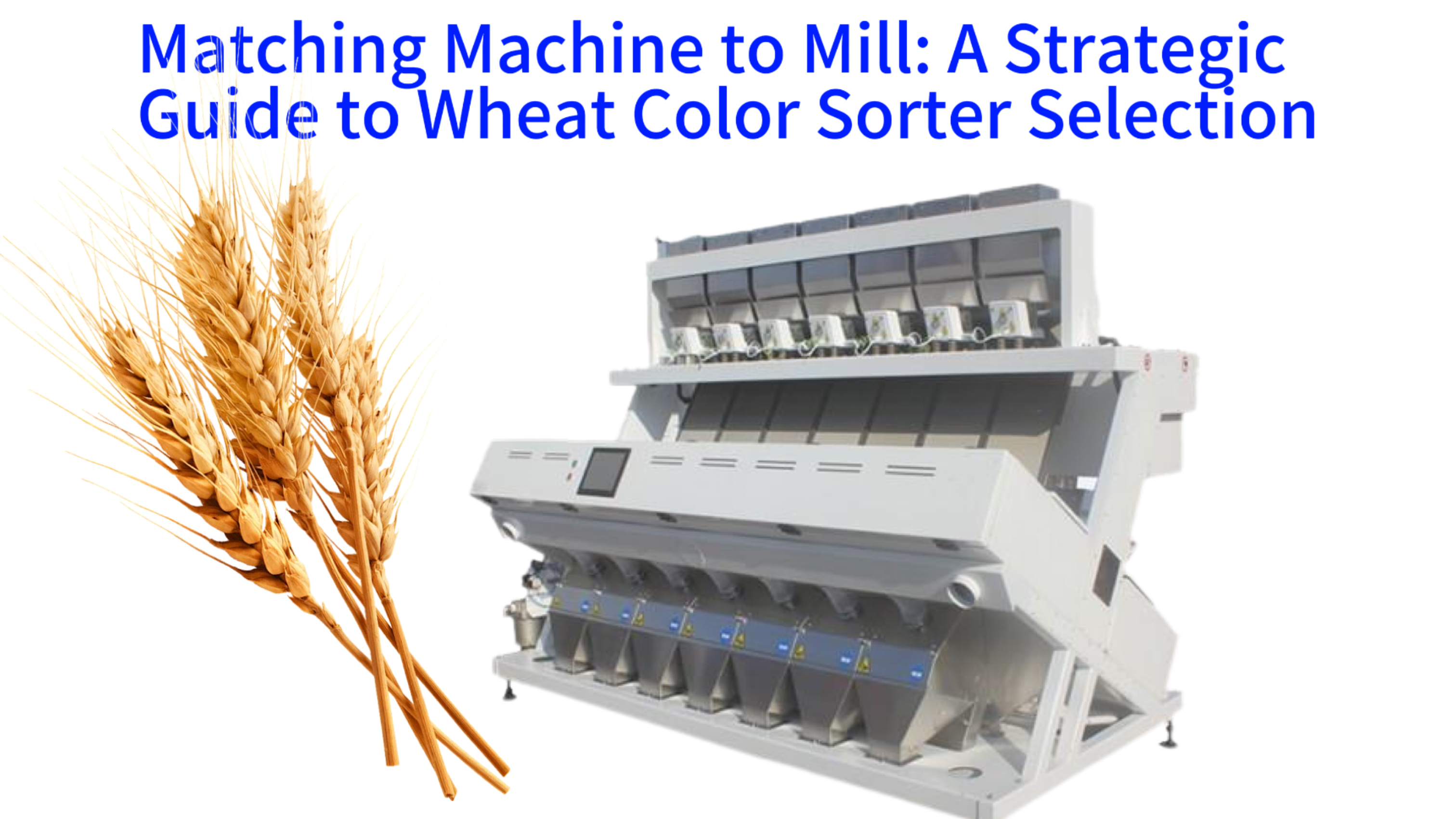
Strategic Selection Workflow for Wheat Color Sorters
The global wheat processing industry relies on color sorting technology to ensure product purity, meet food safety standards, and maximize economic return. Selecting the correct machine is not a one-size-fits-all decision but a strategic process directly tied to the scale of operations. An improperly sized sorter can create a bottleneck in a high-capacity flour mill or represent a wasteful over-investment for a small, specialty producer. This guide provides a structured framework for making this critical capital equipment decision. The process begins with a precise assessment of your current and future wheat processing volume. This quantitative foundation informs the required machine throughput, which then dictates the necessary physical configuration, such as the number of sorting channels and chutes. Beyond raw capacity, the specific quality challenges present in your wheat supply determine the optimal sensor and ejection technology. Furthermore, the operational environment and long-term financial planning, encompassing both upfront investment and running costs, must be evaluated to ensure a sustainable and profitable implementation. This analysis will help processors of all sizes, from local stone-grinding mills to industrial-scale facilities, align their technology investment with their business reality.
Quantifying Your Processing Scale: The Foundation of Selection
| Mill Type | Typical Throughput (t/h) | Peak Surge (%) | Required Sorter Capacity (t/h)* |
|---|---|---|---|
| Small Organic Mill | 0.5-1.0 | 20 | 0.6-1.2 |
| Medium Commercial Mill | 2.0-6.0 | 15 | 2.3-6.9 |
| Large Industrial Mill | 10.0-15.0 | 10 | 11.0-16.5 |
| * Calculated with safety margin + rejection rate (2%) | |||
The first and most critical step in selecting a wheat color sorter is conducting an honest and data-driven assessment of your processing scale. This involves moving beyond vague estimates to gather concrete figures on your annual, monthly, and hourly wheat intake. For an existing mill, historical production records provide the best data. You need to calculate the average volume of wheat processed per shift and identify peak processing periods, such as harvest seasons, when throughput may surge by 20% or more. It is essential to measure this in consistent units, typically metric tons per hour (t/h), as this is the standard language of equipment specifications. A small-scale organic mill might consistently process 0.5 to 1 ton per hour, while a large commercial flour mill could require lines capable of handling 10 to 15 tons per hour or higher.
This assessment must also be forward-looking. Consider your business growth plans over the next five to seven years, which is the typical lifespan of a well-maintained sorter. If you plan to expand your market, add new product lines like whole wheat or durum semolina, or increase your number of milling shifts, your future throughput requirements will be greater than your current needs. Purchasing a machine that matches only today's volume risks obsolescence and costly reinvestment later. Conversely, buying a vastly oversized machine for a small operation ties up capital and incurs higher operational costs for energy and compressed air without delivering proportional benefit. Therefore, defining your scale is not merely about measuring the present but about projecting a realistic future capacity, establishing a target throughput range that your chosen wheat color sorter must efficiently serve.
Calculating Required Sorter Throughput from Mill Capacity
Once the mill's total wheat intake is known, the required sorter throughput can be determined. This is not always a direct one-to-one relationship. The sorter is typically placed after initial cleaning, destoning, and sometimes after the first break in the milling process. The volume of material presented to the sorter may be less than the total intake if foreign material and large impurities are removed upstream. However, a key factor is the percentage of defective material expected in the feedstock. A wheat supply with a high incidence of fusarium-damaged kernels, ergot, or dark foreign seeds will require the sorter to inspect and potentially eject a larger proportion of the stream. This effectively reduces the net throughput of acceptable wheat.
A practical method is to use the formula: Required Sorter Capacity (t/h) = (Mill Intake t/h) / (1 - Expected Rejection Rate). For example, a mill processing 5 t/h of wheat with an expected rejection rate of 2% needs a sorter rated for at least 5.1 t/h to avoid becoming a bottleneck. It is standard practice to add a safety margin of 10-15% to this calculated figure to account for feed fluctuations and future increases in raw material impurity levels. This calculated throughput figure becomes the primary specification against which all potential sorter models are measured. It directly influences whether you need a machine with 128 channels or 640 channels, a single chute or multiple chutes operating in parallel, forming the bridge between your business metrics and the technical specifications of the available cereals color sorter equipment.
Defining Operational Shifts and Peak Load Demands
The temporal pattern of mill operation significantly impacts sorter selection. A mill running a single 8-hour shift, five days a week, has a very different operational profile than a facility operating 24 hours a day, seven days a week. For continuous operations, machine reliability and ease of maintenance are paramount, as downtime directly translates to lost production. The sorter must be designed for high uptime, with features like accessible cleaning points and durable components that can withstand constant use. For batch operations, the ability to start up and reach stable, accurate sorting quickly is more valuable.
Furthermore, peak load demands must be accommodated. During the post-harvest period, a mill may receive wheat with higher moisture content or greater variability in quality, which can challenge sorting algorithms. The sorter must have sufficient processing headroom to handle these temporary conditions without a drop in final product quality. A machine selected to run at 90% of its maximum rated capacity during normal periods will have the reserve to handle a 10-20% surge in feed rate or rejection rate during peak seasons. Ignoring these peaks can lead to a situation where the sorter becomes the limiting factor during the most crucial and profitable processing windows, forcing the mill to either bypass the sorter and compromise quality or slow down the entire production line.
Navigating Sorter Configurations: Chutes, Channels, and Throughput
| Configuration | Max Throughput (t/h) | Best For |
|---|---|---|
| 1 Chute (64 Channels) | 1.0 | Small Mills |
| 2 Chutes (128 Channels) | 2.0 | Pilot Plants |
| 6 Chutes (384 Channels) | 6.0 | Medium Mills |
| 10 Chutes (640 Channels) | 8.0+ | Large Mills |
With a target throughput established, the focus shifts to the physical configuration of the color sorter. The core determinant of a machine's capacity is its number of optical channels and sorting chutes. Each channel represents an independent inspection and ejection pathway. In a traditional chute-type sorter, wheat grains flow by gravity down an array of narrow, vertical lanes or chutes. Each chute is monitored by its own set of high-resolution cameras and sensors. A standard configuration might offer 64 channels per chute. Therefore, a machine with 2 chutes has 128 channels, and a machine with 10 chutes has 640 channels. More channels allow more grains to be inspected simultaneously, directly increasing maximum throughput.
The choice between a single-chute and a multi-chute system is fundamental. A 1-chute-64-channels color sorting machine is a compact, cost-effective solution ideal for low-volume processors, small seed companies, or pilot plants, with typical capacities up to 1 ton per hour. For medium-scale operations processing 2 to 6 tons per hour, machines with 2 to 6 chutes (128 to 384 channels) are common. Large-scale industrial mills require high-chute-count machines, such as those with 10-chutes-640-channels, to achieve capacities of 8 tons per hour and beyond. It is important to note that rated throughput is also influenced by grain size, desired purity level, and the specific type of defects being removed; manufacturers provide capacity charts that should be consulted with your specific wheat characteristics in mind.
Understanding the Throughput Implications of Channel Count
The relationship between channel count and throughput is not perfectly linear but is the primary scaling factor. Each channel can process a finite number of wheat kernels per second. This rate depends on the pixel resolution of the cameras and the processing speed of the computer system. A typical high-speed channel might handle 1,000 to 1,500 kernels per second. With 64 channels operating, the theoretical inspection rate is between 64,000 and 96,000 kernels per second. The actual throughput in tons per hour depends on the average weight of the wheat kernels. For a standard hard red wheat kernel weight, this translates to a practical capacity range.
Selecting a machine with too few channels for your required throughput forces one of two compromises. Either the feed rate to the sorter must be reduced, creating a bottleneck upstream, or the flow per channel becomes too dense. Excessive density causes kernels to overlap or move too quickly past the sensors, reducing inspection accuracy and allowing defective grains to pass through. Conversely, a machine with excessive channels for a small operation runs inefficiently, often at a lower feed rate that can cause grains to tumble erratically in the chutes, also harming accuracy. It also consumes more energy and compressed air per ton processed. Therefore, matching the channel and chute configuration to your calculated throughput is essential for achieving both the desired capacity and the guaranteed sorting accuracy promised by the manufacturer.
The Role of Machine Footprint and Plant Layout Integration
The physical size and layout of the sorter must fit within the existing or planned mill infrastructure. Chute-type sorters have a vertical profile, requiring adequate ceiling height for installation, maintenance access, and the flow of material from the feed hopper above to the discharge points below. The footprint on the factory floor must account not only for the machine itself but also for service aisles, control panel access, and connection points for power, compressed air, and dust extraction. For multi-chute machines, the width can become significant.
Integration into the material handling flow is another critical layout consideration. The sorter requires a consistent, regulated feed, usually provided by a vibrating feeder or a feeding hopper with a level control system. The accepted and rejected streams from the sorter must be directed to their respective collection points or downstream processes without cross-contamination. For facilities with space constraints, some manufacturers offer modular or more compact designs. Evaluating these spatial requirements early in the selection process prevents costly re-engineering of the production line later. The goal is to ensure the sorter enhances the flow of the mill, not complicates it, working seamlessly with equipment like cleaners, graders, and the milling machinery itself.
Evaluating Core Sorting Technology and Detection Capabilities
| Defect Type | RGB Cameras | NIR Sensors | AI-Enhanced Systems |
|---|---|---|---|
| Dark/Damaged Kernels | Excellent | Good | Exceptional |
| Ergot/Fusarium | Good | Excellent | Exceptional |
| Mycotoxin Risk (Invisible) | Poor | Excellent | Excellent |
| Foreign Material | Excellent | Good | Exceptional |
Beyond raw capacity, the technological heart of the sorter determines what defects it can reliably remove. The baseline technology for wheat sorting is full-color CCD or CMOS camera systems. These systems use high-speed cameras to capture images of each kernel under controlled LED lighting in the red, green, and blue (RGB) spectrum. The system's software then compares the color of each pixel in the image to user-defined acceptance thresholds. Kernels that fall outside the "good" color range—such as those that are blackened, reddened from smut, or green from immaturity—are identified for ejection. This technology is highly effective for removing distinctly off-color defects and foreign materials like stones, seeds, or husks that contrast with the wheat.
However, more subtle defects require advanced sensing. Near-Infrared (NIR) technology is increasingly important in wheat sorting. While a rice color sorter might prioritize shape, wheat sorting benefits from NIR's ability to detect biochemical differences. NIR sensors measure the light reflected off the kernel at wavelengths beyond human vision. This reflectance spectrum is influenced by the kernel's chemical composition, including moisture, protein, and starch content. It can therefore identify defects that have minimal visual color difference but critical quality implications, such as vitreous versus starchy kernels in durum wheat, or kernels with early signs of mold or mycotoxin risk that are not yet visibly apparent. For processors aiming for the highest purity or specific functional quality, a sorter combining RGB and NIR sensors provides a far more powerful tool than color cameras alone.
Assessing Defect Library Sophistication and AI Features
The hardware captures data, but the software defines the machine's intelligence. A critical selection factor is the sophistication of the sorter's defect recognition software. Modern machines come pre-loaded with extensive defect libraries tailored for wheat, containing spectral or color profiles for common issues like fusarium damage, ergot, insect-bored kernels, sprouted grains, and various foreign materials. The ease with which operators can adjust sensitivity for each defect type, or create custom definitions for new or regional quality problems, directly impacts the machine's versatility and long-term usefulness.
The advent of artificial intelligence marks a significant advancement. Traditional sorters use fixed algorithms. AI-powered sorters utilize machine learning models that can be trained on sample batches of wheat. By showing the machine examples of "good" and "bad" kernels, the AI learns to make finer distinctions, potentially identifying complex defect patterns that are difficult to codify with simple color rules. This is particularly valuable for handling wheat from new geographic origins with varying appearance, or for achieving ultra-high purity levels for specialty markets. An AI system also tends to be more adaptable over time, maintaining accuracy even as the visual characteristics of the wheat supply change slightly from season to season. When evaluating technology, understanding the software's capabilities for both immediate problem-solving and future adaptation is as important as reviewing the sensor specifications.
Ejection System Precision and Compressed Air Requirements
The final physical act of sorting is the ejection of defective material. This is almost universally achieved using high-speed solenoid valves that release precise bursts of compressed air. The precision of this system is measured by its ability to hit only the targeted defective kernel without disturbing adjacent good kernels. Valve response time, typically measured in milliseconds, and the arrangement of nozzles are key. A system with faster valves and more nozzles per channel allows for more accurate targeting, especially important when kernels are close together in the feed stream.
This ejection system has direct utility implications. It consumes compressed air, which is a significant operational cost. The air consumption rate, measured in normal cubic meters per hour (Nm³/h) or standard cubic feet per minute (SCFM), is a vital specification. A machine with high air consumption will require a larger, more expensive air compressor and will use more energy to run it. Some manufacturers design ejection systems that use lower air pressure or more efficient valve sequencing to reduce this cost. The reliability of the valve block is also crucial; valves must resist wear from continuous operation and be easy to clean or replace if they become clogged with dust. The balance between ejection accuracy, which protects yield, and air consumption, which affects running costs, is a key point of comparison between different sorter models.
Analyzing Operational Costs and Total Cost of Ownership
| Cost Component | % of TCO (7-Year Life) | Key Considerations |
|---|---|---|
| Capital Investment | 40% | Initial purchase + installation |
| Energy & Compressed Air | 25% | 24/7 operation = higher costs |
| Maintenance & Spare Parts | 15% | LEDs, valves, filters replacement |
| Downtime Losses | 20% | Most costly for large mills |
The purchase price of a wheat color sorter is only the initial component of its total financial impact. A comprehensive selection process requires a detailed analysis of the Total Cost of Ownership (TCO) over the machine's expected service life, typically 7 to 10 years. TCO includes capital expenditure, installation, energy consumption, compressed air generation, routine maintenance, spare parts, and potential costs associated with downtime. A machine with a lower upfront price but high energy consumption or frequent maintenance needs may ultimately be more expensive than a higher-priced, more efficient model. This analysis ensures the investment is sustainable and profitable for the specific scale of the processing operation.
Energy costs form a major part of operational expenditure. The sorter's main electrical loads are the computer system, the high-intensity LED lighting, the vibratory feeder, and the fans for internal cooling. Power ratings are provided in kilowatts (kW). By multiplying the kW rating by the number of operating hours per year and the local cost of electricity, an annual energy cost can be estimated. As mentioned, the compressed air system is another large energy consumer. The efficiency of the sorter's ejection valves directly influences the size and runtime of the air compressor. For a mill running 24/7, even a small reduction in air consumption can lead to thousands of dollars in annual savings. Therefore, evaluating the machine's stated power and air consumption specifications in the context of your own utility rates is a critical step in financial planning.
Projecting Maintenance, Spare Parts, and Downtime Economics
Regular maintenance is essential for sustained performance, but its cost and frequency vary. Key consumables include the LED light sources, which have a finite lifespan of thousands of hours; air filters for the internal cooling system; and the solenoid valves in the ejection system. The availability and cost of these spare parts of color sorter should be investigated. A manufacturer with a robust global supply network and reasonable part pricing reduces long-term operational risk. The design of the machine also affects maintenance costs. Features like slide-out chassis for easy access to optics, tool-less covers for cleaning, and self-diagnostic software can significantly reduce the labor time and skill level required for routine upkeep, minimizing expensive professional service calls.
Perhaps the most significant hidden cost is unplanned downtime. When a sorter fails, the entire milling line may need to stop or operate at a reduced capacity, incurring massive losses. Reliability is thus a paramount economic factor. It is influenced by the quality of components, the robustness of the software, and the protection of sensitive electronics from dust and vibration. Inquire about the machine's typical Mean Time Between Failures (MTBF) for critical components. Furthermore, the terms of the warranty time of color sorter and the quality of after-sales technical support are direct financial safeguards. A comprehensive warranty and responsive, knowledgeable support team can dramatically reduce the cost and duration of any operational interruptions, protecting the mill's productivity.
Calculating Return on Investment Based on Quality Premiums
The ultimate justification for the investment is a positive Return on Investment (ROI). This is calculated by weighing the total costs against the financial benefits the sorter generates. For a wheat processor, the primary benefits are value preservation and value addition. The sorter prevents quality downgrades by removing defects that would otherwise lower the market grade of the entire batch. It also reduces the risk of costly rejections by buyers or non-compliance with regulatory limits for contaminants like ergot. The monetary value of this preserved quality can be directly calculated based on the price differential between wheat grades.
In many cases, the sorter enables value addition. By consistently producing ultra-clean, high-purity wheat, a mill can access premium markets, command higher prices for its flour, or secure contracts with quality-sensitive customers like bakeries or baby food manufacturers. The sorter may also improve milling yield by ensuring only sound, healthy kernels enter the process, leading to better extraction rates. To perform an ROI analysis, estimate the annual financial gain from higher selling prices and/or reduced losses, then subtract the annualized TCO (purchase cost amortized over its life plus yearly operational costs). A sorter that pays for itself within two to three years through these quality-driven revenues is generally considered an excellent investment. This financial model clearly shows how the right machine, matched to scale, transforms from a cost center into a profit-generating asset.
Implementing a Structured Supplier Evaluation and Testing Protocol
| Test Metric | Acceptable Threshold | Measurement Method |
|---|---|---|
| Defect Removal Rate | >99% | Post-test sample analysis |
| Good Grain Loss | <0.5% | Weigh rejected material |
| Throughput Consistency | ±5% of rated capacity | Hourly weight measurement |
| Software Usability | Intuitive interface | Operator assessment |
The final stage of selection involves validating your choice through direct engagement with equipment suppliers. This process should be structured and evidence-based, moving beyond sales presentations to technical verification. Begin by shortlisting three to five reputable manufacturers whose standard model ranges encompass your required throughput and technology level. Request detailed technical specifications, total cost quotations that include ancillary equipment like air compressors and feeders, and documentation of compliance with relevant food safety and electrical standards. A crucial part of this evaluation is reviewing case studies or references from other wheat processors of a similar scale, which can provide real-world insights into reliability and performance.
However, specifications and testimonials are not substitutes for direct proof. The most reliable method to confirm a sorter's suitability is a product test. Reputable suppliers offer test facilities where you can send a representative sample of your wheat—typically 50 to 100 kilograms that includes the specific defects you struggle with. Their technicians will run this sample through the proposed machine under conditions simulating your required throughput. The test report should provide clear, quantitative results: the percentage of defective material removed, the percentage of good material accidentally ejected (the "good loss"), and the final purity of the accepted product. This hands-on test demonstrates the machine's actual capability with your unique material, reducing the risk of a performance shortfall after installation.
Conducting a Comprehensive Material Test with Your Wheat
A well-executed material test is a miniaturized simulation of your production process. When preparing your test sample, it must be genuinely representative. It should include the mix of wheat varieties you process and contain the full spectrum of defects at their typical concentration. Before sending the sample, it is wise to manually separate a small portion, weigh the defects, and establish a "ground truth" for comparison. During the test, you or your representative should be present to observe the machine's operation, the intuitiveness of its software interface, and the ease with which sorting parameters are adjusted to optimize the result.
The test data allows for an objective comparison between different sorter brands. Compare the key performance indicators: sorting accuracy (high defect removal), good product loss (should be very low, often below 0.5%), and throughput achieved during the test. Also, note operational aspects like noise level, dust containment, and the clarity of the rejection display showing what was removed. This test is also the perfect opportunity to assess the technical knowledge and supportiveness of the supplier's engineers. Their ability to understand your quality goals and fine-tune the machine to achieve them is a strong indicator of the post-sales support you can expect. This step transforms the selection from a theoretical exercise into a data-driven procurement decision.
Verifying After-Sales Support, Training, and Service Infrastructure
The relationship with the supplier does not end at the point of sale; it begins there. The quality of after-sales support is a critical determinant of long-term success. Investigate the supplier's support infrastructure. Do they have service engineers located within a reasonable distance or response time from your mill? What is their typical response time for technical support queries? Is remote diagnostics support available, where an engineer can connect to the machine's software online to diagnose issues? Clarify what is included in the standard installation of color sorter package—often it includes commissioning, basic operator training, and a initial performance check.
Operator and maintenance technician training is another vital component. The supplier should provide comprehensive training on how to operate the machine for daily production, how to perform routine cleaning and calibration, how to change basic spare parts like filters or lights, and how to use the software to adjust sorting programs. Well-trained local staff are the first line of defense against operational problems and can perform most preventative maintenance, minimizing dependence on external service. Finally, understand the logistics of the spare parts supply chain. Ensure that critical spare parts are stocked regionally or can be shipped express to avoid prolonged downtime. A supplier with a strong, proactive support culture effectively becomes a partner in your production quality, ensuring the sorter delivers its promised value throughout its operational life. This comprehensive evaluation framework, from scale assessment to hands-on testing and support verification, empowers any wheat processor to make a confident, optimized investment in color sorting technology.