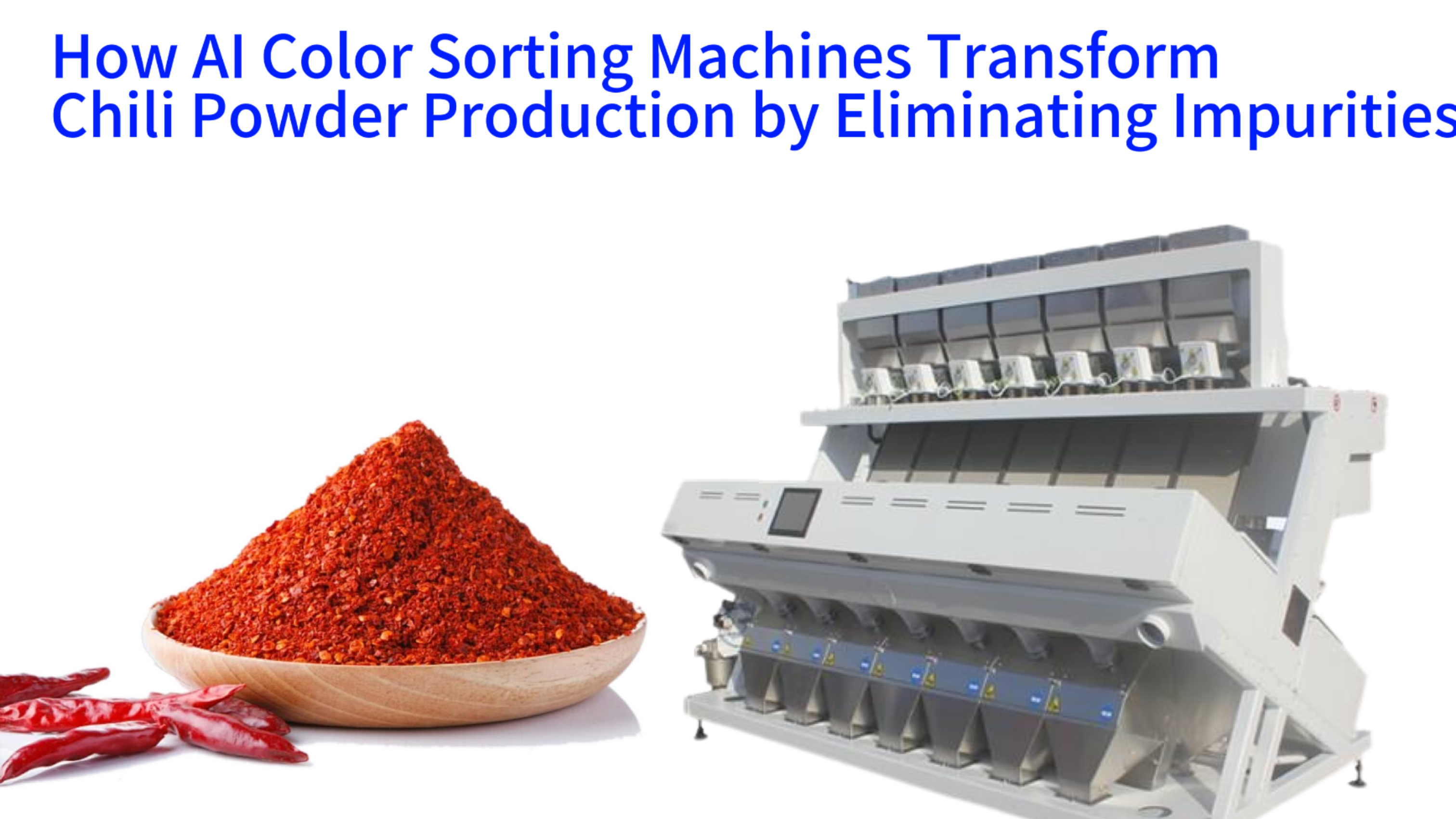
Producing high-quality chili powder demands the removal of unwanted materials such as stems, seeds, and discolored particles. Traditional manual sorting and basic sieving methods often fail to achieve the consistent purity required by modern food standards. This article provides a detailed examination of how Artificial Intelligence (AI) Color Sorting Machines address this critical challenge. The discussion covers the specific problems in spice processing, explains the sophisticated operational technology of these machines, and analyzes their substantial benefits for safety and efficiency. Further sections explore the broader applications of this technology and offer practical guidance for selecting and integrating the right system into a production line, presenting a complete overview of automated quality control in the spice industry.
AI Color Sorting Machine: Chili Powder Purification Workflow
Critical Quality Control Challenges in Chili Powder Production
Limitations of Traditional Sorting vs Modern Requirements
| Evaluation Criteria | Manual Sorting | Mechanical Sieving | Global Food Safety Standards |
|---|---|---|---|
| Accuracy (Defect Removal) | 60-75% (prone to fatigue) | 70-80% (size-only discrimination) | ≥99.9% (zero-tolerance for visible defects) |
| Throughput (kg/h) | 50-100 | 500-1000 | 1000-5000+ (high-volume production) |
| Compliance Documentation | None (subjective) | Limited (no defect tracking) | Mandatory (auditable data logs) |
Efficiency & Accuracy: Traditional vs AI Sorting
The manufacturing process for chili powder begins with dried peppers which are ground into a fine consistency. During initial harvesting and drying stages, various foreign materials inevitably mix with the pepper product. Common impurities include hard and inedible stems, bitter-tasting seeds, and pepper fragments that have undergone discoloration due to factors like mold growth or improper drying techniques. Relying on historical methods such as manual visual inspection or mechanical sieving presents significant limitations for modern high-volume production. These older approaches cannot reliably identify and remove impurities that share a similar size or color profile with the desirable powder, creating a persistent gap in quality assurance.
Consumer expectations and international food safety regulations now mandate exceptionally low tolerance levels for physical contaminants in spice products. The presence of a single visible stem or a cluster of seeds can trigger customer complaints and potentially lead to costly product recalls. Manual sorting is inherently slow and subject to human fatigue and error, resulting in inconsistent output. Basic sieving operates solely on particle size differentiation, rendering it useless against defects like discolored particles or seeds ground to a matching size. This situation creates a clear and pressing need for a technological solution capable of precise, high-speed, and consistent impurity removal to meet contemporary market and regulatory demands.
Specific Defects: Stems, Seeds, and Discolored Particles
The primary targets for removal in chili powder are stems, seeds, and off-color material. Stems are woody structures that do not grind effectively, potentially leaving hard, unpleasant fragments in the final product. Seeds contain different chemical compounds that can introduce a bitter, undesirable flavor note, altering the intended taste profile. Discolored particles, often appearing as black, brown, or white specks, typically indicate areas affected by mold, sunburn, or fermentation. These defective pieces not only diminish the visual appeal of the bright red powder but may also carry food safety risks, affecting the overall stability and shelf life of the product.
Limitations of Traditional Sieving and Manual Methods
Conventional sieving technology functions by separating particles based on physical dimensions. While effective for removing large debris, it cannot discriminate against defects that are similar in size to the ground pepper. Seeds broken during processing and small stem fragments easily pass through sieve meshes. Manual sorting, while offering some discrimination, is economically and practically unsustainable for large-scale operations. The task is monotonous, leading to operator fatigue and a consequent decline in inspection accuracy over time. The variability introduced by human judgment makes it impossible to guarantee a uniformly pure product batch after batch.
Economic and Reputational Risks of Impure Products
For food manufacturers, allowing contaminated products to reach the market carries severe consequences. A single consumer complaint about a foreign object can escalate into a full-scale product recall, involving significant logistical costs, destroyed inventory, and lost revenue. In the digital age, such incidents can rapidly damage a brand's reputation for quality and safety, with negative publicity spreading quickly through social media and review platforms. The financial impact extends beyond immediate recall costs to include long-term marketing expenses required to rebuild consumer trust, making investment in preventive quality control a strategically sound business decision.
Meeting Stringent Global Food Safety Standards
International trade and supply to major food brands require adherence to strict quality benchmarks. Regulatory bodies and private standards define maximum allowable levels for defects like foreign matter. Manual and sieve-based processes lack the consistent accuracy and documented proof of compliance needed for these markets. An automated AI sorting system, however, can be calibrated to a precise standard and will maintain that performance continuously. It provides auditable data and consistent results, enabling spice processors to reliably meet the rigorous requirements of global customers and export regulations.
Core Technology: How AI and Advanced Optical Systems Work
AI Color Sorter Technology Stack
RGB + NIR Sensors
1000+ fps Imaging
Defect Pattern Recognition
Millisecond Analysis
Solenoid Valves
Air Nozzle Ejection
| Technical Parameter | Specification |
|---|---|
| Camera Resolution | 12-24 MP (Full-Color CCD) |
| Imaging Speed | Up to 5000 frames per second |
| AI Processing Time | ≤2 milliseconds per particle |
| NIR Sensor Range | 700-1000 nm (chemical composition detection) |
| Ejection Response Time | ≤5 milliseconds |
An AI Color Sorting Machine operates through a coordinated system of advanced optics, processing software, and mechanical actuators. The primary detection component involves high-resolution, high-speed cameras equipped with full-color CCD sensors. These cameras capture thousands of images per second of the product stream as it flows through an inspection chamber. To ensure consistent analysis, the chamber is illuminated by a stable, uniform LED light source that eliminates shadows and variations. Some advanced systems also incorporate Near-Infrared (NIR) sensors, which detect differences in the chemical composition of materials that are not visible to standard RGB cameras, providing an additional layer of discrimination.
The captured image data is processed by a central computer running specialized AI software algorithms. These algorithms are based on deep learning models that have been trained on extensive libraries of images containing both acceptable chili powder and various defect types. Unlike older, rule-based software that relied on simple color thresholds, the AI learns to recognize defects by analyzing complex patterns, shapes, and textures. This allows it to identify a stem not just by its brown color, but by its elongated shape and fibrous texture, even if partially obscured or presented at an unusual angle. This sophisticated analysis happens in milliseconds, enabling real-time decision-making at production line speeds.
High-Speed Imaging and Multi-Spectral Analysis Capabilities
The imaging system is engineered for speed and clarity. As the chili powder forms a uniform curtain or layer, the cameras capture detailed snapshots. The use of multiple spectral bands, such as combining standard RGB with NIR, is a key advantage. Different materials reflect or absorb NIR light in unique ways. For instance, a stem and a red pepper particle may look similar in visible light but have distinctly different NIR signatures. By analyzing this multi-spectral data, the AI system gains a much more comprehensive understanding of the material in front of it, dramatically increasing its ability to correctly identify and target impurities with minimal error.
Deep Learning Algorithms for Intelligent Defect Recognition
The artificial intelligence at the core of the system utilizes deep learning, a subset of machine learning. During the training phase, the system is shown thousands of labeled images—"good powder," "stem," "seed," "discolored piece." It autonomously learns to identify the defining features of each category. This process enables the system to handle natural variations in raw material. For example, it learns that the acceptable color range for chili powder can vary slightly, while a specific type of brown indicates a stem. This adaptive intelligence allows the sorter to maintain high accuracy even when processing new batches or different pepper varieties, with only minimal recalibration needed.
Real-Time Data Processing and Ejection Commands
Following image capture and analysis, the system must act immediately. Once a defect is identified, the AI software calculates its precise location within the flowing stream. This coordinate data is instantly transmitted to an array of high-speed solenoid valves connected to air nozzles. The timing of this signal is critical, as it must account for the short delay between the camera seeing the particle and that particle reaching the ejection point. This entire sequence, from detection to command, is completed in a few milliseconds, ensuring that even at throughput rates exceeding several tons per hour, no defect passes through without inspection and potential removal.
Integration of Shape and Texture Analysis with Color Data
Modern AI sorters perform analysis that extends beyond simple color evaluation. The software examines the shape profile of individual particles. A seed typically has a round or oval contour, while a stem fragment appears as a slender, linear shape. Good chili powder consists of irregular flakes. By integrating shape and texture analysis with color data, the system makes more informed decisions. It can distinguish between a dark red pepper flake (good) and a small, dark seed (bad) even if their average color is similar, thereby reducing false rejects and maximizing the yield of saleable product.
The Operational Workflow: From Feeding to Final Separation
End-to-End Operational Workflow
(Monolayer Stream)
(Imaging & Analysis)
(Defect Removal)
(Accept/Reject)
| Machine Type | Throughput (tons/hour) | Ejection Accuracy |
|---|---|---|
| Single-Chute AI Sorter | 1-3 | 99.9% |
| Multi-Chute AI Sorter | 5-10 | 99.95% |
The sorting process is a continuous and automated cycle. It begins with a controlled feeding system that delivers chili powder into the machine at a consistent rate. This feeder is designed to spread the powder into a uniform, single-layer stream. Achieving this monolayer presentation is essential because overlapping particles can hide defects from the cameras, compromising the system's effectiveness. The feeding mechanism often employs vibration or precisely calibrated gates to ensure an even flow across the full width of the sorting machine's inspection path.
After inspection, the identified impurities are physically removed. The ejection system consists of a tightly spaced row of nozzles that emit brief, powerful bursts of compressed air. When the AI signals that a defect is passing, the corresponding nozzle fires, knocking the impurity out of the main product stream. The accuracy of this ejection relies on perfect synchronization between the detection software and the mechanical hardware. The purified chili powder continues its trajectory into an accept hopper, while the ejected waste material is diverted into a separate reject collection point, completing the sorting cycle.
Precise Material Feeding for Optimal Inspection Conditions
The initial feeding stage establishes the foundation for accurate sorting. An irregular or clumped feed causes particles to cluster and move at inconsistent velocities. This uneven presentation creates blind spots for the cameras and makes it difficult for the software to track individual particles. Advanced feeders are engineered to gently separate and distribute the powder, ensuring every particle is fully exposed to the camera's field of view. This meticulous preparation is a critical factor in achieving the high detection rates, often cited as exceeding 99.9%, that modern AI sorters are capable of delivering.
Synchronized Detection within the Inspection Chamber
Inside the enclosed inspection chamber, the evenly spread product passes through a zone of controlled lighting and high-speed imaging. The lighting is designed to be completely uniform to prevent any flicker or shadow that could be misinterpreted as a color defect. The cameras operate at a frame rate synchronized with the product's flow speed. This synchronization guarantees that each particle is captured in sharp detail, and its position is tracked accurately as it moves toward the ejection zone. Multiple cameras may be used to view the stream from different angles, providing a more complete three-dimensional assessment of each particle.
High-Speed Ejection Using Compressed Air Technology
The ejection mechanism represents a critical interface between digital decision and physical action. The air nozzles are controlled by ultrafast solenoid valves with response times measured in milliseconds. When activated, a nozzle releases a precise pulse of compressed air. This pulse is highly focused and of very short duration, designed to dislodge only the targeted defect without disturbing the surrounding good powder. The precision of this system allows the machine to remove very small, closely spaced impurities, ensuring thorough cleaning of the product stream while conserving compressed air and minimizing operational costs.
Continuous Separation of Accept and Reject Streams
The final phase involves cleanly separating the two material streams. The accept stream, now verified as free of targeted defects, is channeled to packaging or the next stage of processing. The reject stream, containing all ejected stems, seeds, and discolored particles, is collected for disposal or further analysis. This continuous separation happens seamlessly within the machine's housing. The process runs autonomously, requiring only periodic monitoring by an operator to check performance metrics and replenish the feed hopper, thereby enabling uninterrupted production cycles.
Measurable Benefits for Safety, Efficiency, and Profitability
Quantifiable Benefits of AI Color Sorting
| Benefit Category | Improvement Rate | Business Impact |
|---|---|---|
| Labor Cost Reduction | 60-80% | Reduced direct labor expenses; reallocation to skilled roles |
| Product Yield | 5-10% | Increased saleable product from raw materials |
| Throughput | 200-300% | Higher production capacity with consistent quality |
| Defect Rate | Reduction by 99% | Elimination of product recalls and reputational damage |
Implementing an AI color sorter delivers concrete advantages across several key areas of chili powder production. The most significant benefit is the enhancement of food safety. By systematically removing discolored particles that may indicate mold or microbial growth, the machine directly addresses a potential source of contamination. This proactive, full-inspection approach provides a stronger safety assurance compared to statistical sampling methods, aligning with modern preventive food safety frameworks like HACCP. It ensures that every gram of product shipped has passed a rigorous visual inspection barrier.
From an operational standpoint, the gains in efficiency are substantial. Automation eliminates the variability, cost, and management challenges associated with manual labor. The machine operates continuously at a predetermined and high throughput, increasing the overall capacity of the production line. Furthermore, the intelligent discrimination of AI minimizes the loss of good product, a common issue known as "false reject" in simpler optical sorters. This combination of higher speed, consistent operation, and improved yield directly translates to a lower cost per kilogram of finished, high-quality chili powder, offering a clear and calculable return on investment.
Guaranteed Product Consistency and Enhanced Brand Value
Brand reputation in the food industry is built on consistent quality. Consumers expect every purchase of a specific chili powder to have the same appearance, aroma, and flavor. AI sorting delivers this consistency by applying an unchanging, digital standard to every single particle throughout all production shifts. The output is a product of uniform vibrant color and guaranteed purity, free from the visual and textural flaws caused by stems and seeds. This unwavering quality strengthens brand loyalty and allows producers to command a premium price in the market, as seen in other sectors like rice sorting where purity is paramount.
Reduction in Labor Costs and Operational Overheads
Manual sorting of fine powders is a difficult, tedious, and ergonomically poor task. Automating this process with an AI sorter allows for the reallocation of personnel to more skilled roles such as machine supervision, maintenance, or quality data analysis. This reduces direct labor costs and associated expenses like training and absenteeism management. It also improves overall workforce satisfaction and safety by removing operators from a monotonous and visually straining job. The machine's reliability also reduces downtime and interruptions compared to manual lines, smoothing production flow.
Maximization of Product Yield Through Accurate Sorting
Yield, the amount of saleable product obtained from raw material, is a primary profitability metric. Basic sorters often have high false rejection rates, mistakenly ejecting good powder that is simply a darker shade of red. AI sorters, with their nuanced analysis of shape and texture, excel at discrimination. They correctly identify a desirable dark red pepper flake while rejecting a brown stem of similar hue. This accuracy ensures that a maximum amount of the valuable chili powder is preserved, directly increasing the final output from a given batch of raw peppers and boosting the operation's overall margin.
Compliance Documentation and Audit Readiness
Modern AI sorting systems generate valuable operational data. They can log processing rates, track rejection quantities categorized by defect type, and sometimes even store images of rejected materials. This digital record is a powerful tool for quality assurance and regulatory compliance. During a food safety audit, a producer can present documented evidence that every production batch has been processed through a validated system designed to remove physical hazards. This level of traceability and demonstrable due diligence is increasingly required by global retailers and is a key factor in securing and maintaining supply contracts.
Broader Applications in Spice, Food, and Industrial Processing
Application Distribution of AI Color Sorting Technology
| Industry Sector | Target Products | Key Defects Removed |
|---|---|---|
| Spices & Herbs | Chili powder, paprika, turmeric, oregano | Stems, seeds, discolored particles, foreign matter |
| Nuts & Seeds | Almonds, cashews, cumin seeds | Immature seeds, stones, insect-damaged pieces |
| Beverages | Tea leaves, coffee beans | Stalks, moldy beans, foreign debris |
| Industrial | Ore, recycled plastic | Impurities, low-grade material |
The technological principles perfected for chili powder sorting are directly applicable to a wide range of other dried spices and herbs. Common challenges such as stem removal, de-seeding, and elimination of foreign or discolored matter are universal in this category. For instance, the same machine can be reconfigured to separate tea leaves from stalks, remove black specks from turmeric or paprika powder, or purify green leafy herbs like oregano by removing yellowed leaves. The AI software can be retrained for different products, making a single sorter a highly versatile asset for processors handling diverse product lines.
This application flexibility extends far beyond the spice cabinet. The core technology of high-speed imaging and AI analysis is equally effective for sorting various granular foods and industrial materials. It is successfully used in cleaning and grading nuts and seeds, legumes and beans, and even in industrial realms like ore sorting and plastic recycling. The adaptive intelligence of the AI allows it to learn the specific quality parameters for different materials, establishing it as a foundational and flexible technology for modern processing plants aiming for excellence across multiple product types.
Quality Optimization for Other Powdered Spices
Spices like paprika, cumin, and turmeric are valued for their consistent color, which directly influences their market grade and price. Discolored or burnt particles from drying, or tiny foreign materials, can significantly lower the product's value. An AI color sorter excels at identifying these subtle off-color specks and foreign matter against the uniform background of the spice powder. By removing these defects, the processor can achieve a higher color purity score, allowing the product to qualify for premium market segments and increasing its overall economic value.
Processing of Leafy Herbs and Floral Products
Dried leafy herbs (e.g., basil, mint, parsley) and edible flowers require the removal of stems, foreign organic matter, and discolored leaves. The irregular shapes and similar green hues make this a difficult task for both humans and simple machines. AI sorters equipped with high-resolution cameras can analyze structural shapes. They learn to distinguish the slender, linear profile of a stem from the broader, more complex shape of a leaf fragment. This capability allows for the efficient purification of delicate herbs, preserving their flavor, color, and market appeal without the high labor cost of manual stemming.
Cleaning and Grading Whole Spices and Seeds
Prior to grinding or packaging, whole spices and seeds often require cleaning. AI sorters configured for larger particle sizes perform this task effectively. They can detect and remove stones, dirt clumps, and immature or insect-damaged seeds based on color and shape differences. For example, they can separate white peppercorns from black ones, or remove lightweight, hollow seeds from a batch of cumin. This pre-cleaning step ensures that only high-quality whole spices enter further processing, resulting in superior final products and protecting downstream equipment like grinders from damage caused by hard foreign materials.
Ensuring Final Blend Integrity in Seasoning Mixes
While primary sorting is best performed on individual ingredients, AI sorters can also provide a final quality check on blended seasoning mixes. The system can be trained to recognize the expected appearance of the uniform blend and to flag anomalies. This could include detecting an unusually large cluster of a single ingredient that indicates poor mixing or identifying a foreign material that was accidentally introduced during the blending process. This final inspection adds an additional layer of quality control, guaranteeing the consistency and integrity of the complex finished product before it is packaged for sale.
Selecting and Integrating an AI Sorter into a Production Line
Steps to Select and Integrate an AI Color Sorter
| Machine Model | Throughput (kg/h) | Best For |
|---|---|---|
| 1-Chute (64 Channels) | 1000-2000 | Small to medium-scale producers |
| 2-Chute (128 Channels) | 2000-4000 | Mid-scale production facilities |
| 4-Chute (256 Channels) | 4000-10000 | Large-scale industrial operations |
Choosing the correct AI color sorter requires a systematic evaluation of specific production requirements. The primary factor is throughput, measured in kilograms or tons per hour. This determines whether a system with a single processing channel is sufficient or if a multi-channel, high-capacity machine is necessary. The physical characteristics of the product, such as its particle size, flowability, and moisture content, also influence the choice between different machine types, such as chute-based or belt-based systems. Providing a detailed sample of the raw, unsorted chili powder to the equipment supplier is crucial for an accurate assessment and recommendation.
Successful integration into an existing production line demands careful planning. The sorter must be positioned at the correct point in the process, typically after grinding but before final packaging. It requires specific utilities: a reliable source of clean, dry compressed air for the ejectors and a stable power supply. The physical installation must account for material flow in and out, adequate space for maintenance access, and integration with conveyors or feeding systems. Partnering with a supplier that offers comprehensive support, including installation supervision, calibration, and operator training, is essential to minimize disruption and ensure the system achieves its promised performance from the outset.
Accurate Assessment of Required Throughput and Capacity
A thorough analysis of current and projected production volumes is the first step in machine selection. The required hourly sorting capacity must account for peak production times and potential future expansion. For lower to medium volumes, a single or dual-chute system may be appropriate. For large-scale, continuous operations, machines with four or more chutes operating in parallel are necessary to handle the mass flow. Underestimating capacity can create a bottleneck, while overestimating can lead to unnecessary capital expenditure. Precise data ensures the selected machine matches the operation's true needs.
Evaluation of Software Usability and AI Training Processes
The sophistication of the hardware must be matched by an intuitive and powerful software interface. Operators need to easily switch between product settings, view real-time performance dashboards, and adjust sensitivity parameters. The process of training the AI on new defects or different materials should be straightforward, ideally guided by the software itself. A system that allows in-house quality personnel to perform this training without always relying on external service technicians empowers the plant team and reduces downtime when adapting to new crop variations or quality standards.
Planning for Physical Installation and Utility Connections
Installation planning involves multiple practical considerations. The floor space must accommodate the machine's footprint and the height required for the product's free-fall trajectory. Access to a compressed air supply with adequate pressure, flow rate, and dryness is non-negotiable for reliable ejection. Electrical connections must meet the machine's specifications. The material handling interfaces—how the powder enters and exits the sorter—must be designed to connect smoothly with upstream and downstream equipment. Detailed pre-installation discussions between the plant engineers and the supplier's technical team can prevent costly delays and modifications.
Considering Long-Term Technical Support and Maintenance Needs
The initial purchase is just the beginning of the machine's lifecycle. Understanding the supplier's commitment to after-sales support is critical. Key questions include the length and scope of the warranty, the availability and response time of local service technicians, and the cost and supply chain for essential spare parts like air valves, LED light sources, and camera lenses. A clear preventive maintenance schedule should be established. Choosing a supplier with a strong reputation for reliable long-term support protects the investment and ensures the sorter continues to deliver optimal performance throughout its operational life, much like the support expected for other critical equipment such as an X-ray ore sorter.
```