Zero-Tolerance Color Sorting: Core Workflow for RTE Rice Production
Raw Rice Feeding
Monolayer Presentation
Multi-Spectral Inspection
CCD/CMOS Imaging
AI Defect Analysis
Real-Time Decision Making
Pneumatic Ejection
Microsecond Precision
Grain Separation
Accepted/Rejected Streams
Quality Validation
Zero-Defect Assurance
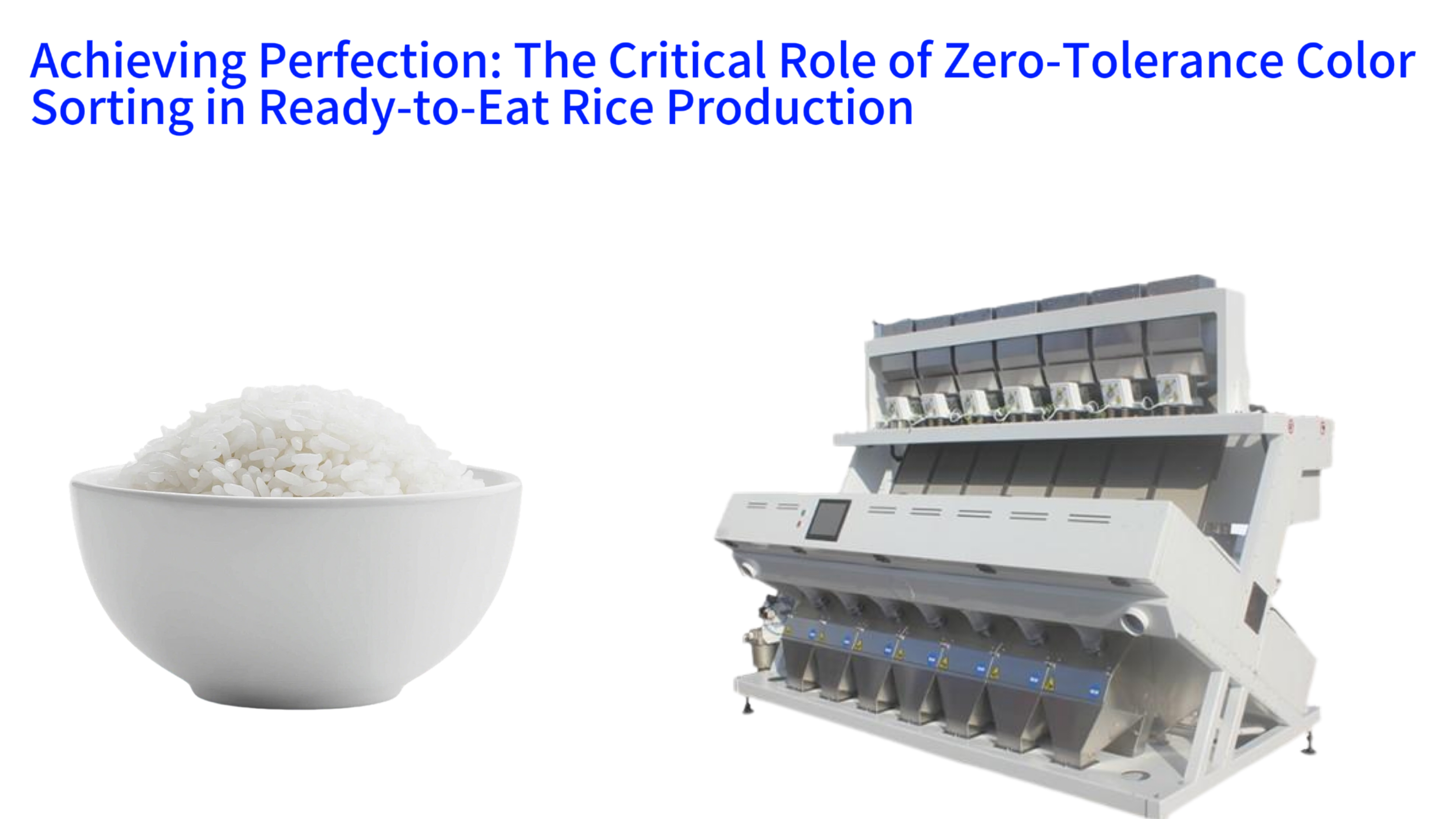
The production of Ready-to-Eat rice represents a pinnacle of modern food processing, demanding unprecedented levels of safety and visual quality. Consumers of instant rice, microwaveable pouches, and restaurant-grade pre-cooked rice expect a flawless product entirely free from visual defects. This expectation necessitates a zero-tolerance policy during preprocessing, where even a single off-color grain is unacceptable. This article explores the implementation of advanced optical sorting technology to meet this rigorous standard. We will examine the specific types of defects targeted, the precision engineering of modern sorters, and how this technology integrates into high-speed production lines to safeguard brand reputation and ensure absolute consumer confidence in every package.
The Uncompromising Quality Demands of the RTE Rice Market
The Ready-to-Eat rice sector operates under a different paradigm compared to bulk commodity rice. The end product is often consumed directly from the package with minimal additional preparation, placing every grain under direct visual scrutiny. Any defect present becomes immediately apparent to the consumer, directly linking perceived quality to brand loyalty and repeat purchase decisions. Furthermore, the value-added nature of RTE products means that the cost of a quality failure, including a potential recall or negative publicity, is significantly magnified. This economic reality justifies the investment in the most stringent quality control measures available at the preprocessing stage.
RTE Rice: Zero-Tolerance Defect Priority Matrix
Consumer Expectations and Brand Protection Imperatives
Modern consumers are highly discerning, associating visual perfection with safety and premium quality. A single discolored, black, or yellow grain in a portion of white RTE rice is not merely an aesthetic flaw; it can be interpreted as a sign of contamination, age, or poor handling. In an era of social media and online reviews, such incidents can quickly escalate, damaging a brand's image that took years to build. The business rationale for a zero-tolerance approach is therefore clear. It functions as a critical risk management strategy, transforming quality control from a cost center into a brand protection and value-preservation asset, ensuring that the substantial investment in marketing and product development is not undermined by preventable physical defects.
The operational shift towards zero-tolerance requires a fundamental change in quality assurance philosophy. Traditional sorting might aim for a defect rate measured in parts per thousand. For RTE rice, the target must be effectively zero. This goal cannot be achieved through manual inspection or basic sorting equipment. It demands technology capable of making millions of perfect decisions per hour, with a detection and rejection accuracy that approaches one hundred percent. The technical specifications for such equipment, including camera resolution, processing speed, and ejection precision, are consequently pushed to their highest practical limits to meet the commercial imperative of flawless output.
Defining the "Zero-Tolerance" Defect Profile for RTE Rice
Establishing a zero-tolerance standard first requires a precise definition of what constitutes a rejectable defect within the RTE context. The defect profile extends beyond common foreign materials like stones or husks. It primarily focuses on intrinsic rice grain defects that affect color and appearance. This includes yellow kernels, which indicate immaturity or storage issues; red-streaked rice, often caused by fungal staining; and black or dark-brown grains, which may signal heat damage, mold, or severe discoloration. Even grains with slight bran remnants or inconsistent polish can be deemed unacceptable as they disrupt the uniform, bright-white appearance expected in premium RTE products.
The challenge intensifies because many of these defects are spectral in nature, meaning their color difference from a sound white grain can be extremely subtle. Human eyes, especially under factory lighting and fatigue, are poor at consistently identifying these nuances at high speed. Therefore, the technical definition of a defect must be translated into digital parameters—specific ranges of red, green, and blue values, along with shape and texture analysis—that an optical sorter can reliably act upon. This digital standard forms the unvarying benchmark against which every single grain is judged, eliminating the subjectivity and inconsistency inherent in manual grading systems.
Core Technology Enabling Zero-Tolerance Precision
The technological backbone of zero-tolerance preprocessing is the high-performance optical sorter. This is not a standard machine but one engineered for exceptional sensitivity and speed. Its design integrates several advanced subsystems that work in concert to achieve the necessary level of discrimination. The machine must perceive minute color variations, process this visual data instantaneously, and physically remove targeted grains from a fast-moving stream without affecting adjacent, sound product. This entire cycle occurs within milliseconds, repeated billions of times during continuous operation.
Optical Sorter: Key Technical Specifications
| Component | Specification | Performance Metric |
|---|---|---|
| Imaging Sensor | High-Resolution CCD/CMOS | 12-20 Megapixels |
| Spectral Range | Visible + Specialized LEDs/Lasers | 400-1000 nm |
| Processing Speed | FPGA + AI Algorithms | < 1 ms per grain |
| Camera Angles | Multi-Angle Imaging | 3-6 Cameras per Channel |
| Detection Accuracy | Sub-pixel Color Differentiation | > 99.99% for Critical Defects |
Imaging System: Data Capture & Analysis Workflow
Uniform Illumination
High-Frequency LED/Strobe
Motion Freezing
Strobe Effect (μs Range)
Multi-Angle Capture
360° Grain Imaging
Pixel Data Analysis
RGB Value Comparison
Defect Classification
AI Pattern Recognition
High-Resolution, Multi-Spectral Imaging Systems
At the heart of the sorter is an imaging system of exceptional capability. Modern machines utilize high-resolution, full-color CCD or CMOS cameras with pixel densities that allow for the detailed inspection of individual rice grains. Crucially, these cameras operate across the visible light spectrum and are often supplemented by specialized lighting, such as lasers or LEDs at specific wavelengths, to enhance contrast for particular defect types. For instance, a certain wavelength might cause a yellow kernel to fluoresce or appear distinctly darker compared to a sound grain, making detection unequivocal even when the difference is imperceptible to the human eye under normal conditions.
This imaging process is supported by a sophisticated understanding of colour sorter working principle. The grains are presented in a monolayer on a vibrating tray or chute, passing through an inspection chamber where they are illuminated by a high-frequency, uniform light source. The strobe effect freezes the motion of each grain. Multiple cameras, positioned at different angles, capture comprehensive images from all sides. This multi-angle view is essential, as a defect might only be visible on one face of the grain. The captured image data, comprising millions of pixels per second, is then streamed to the system's processing brain for analysis.
Advanced Processing Algorithms and Real-Time Decision Making
The raw image data is meaningless without intelligent software to interpret it. This is where advanced algorithms, increasingly powered by artificial intelligence and deep learning, perform the critical task of classification. The system compares the color values, shape, and size of each imaged grain against a pre-defined "acceptance model" of a perfect RTE rice grain. This model is not static; it can be fine-tuned by operators to adjust sensitivity for specific defect types. For example, the threshold for rejecting a slightly yellow grain can be set to an extremely sensitive level, ensuring nothing but the whitest grains pass.
The processing speed is phenomenal. Dedicated digital signal processors and field-programmable gate arrays analyze each grain in real-time, making a binary "accept" or "reject" decision before the grain has traveled more than a few centimeters. This decision-making process, often involving complex pattern recognition that mimics human judgment but with far greater speed and consistency, is what transforms the machine from a simple camera into an intelligent inspection agent. The robustness of this how color sorter machine works determines the ultimate accuracy of the entire zero-tolerance system.
The Mechanics of Flawless Rejection in High-Speed Flow
Making a correct detection decision is only half the challenge. The physical act of removing the defective grain from the product stream with pinpoint accuracy at industrial throughputs is a feat of precision engineering. The ejection system must be perfectly synchronized with the detection system's commands. Any delay or misalignment results in a "miss," where a bad grain is not removed, or a "false ejection," where a good grain is wrongly discarded, impacting yield. For zero-tolerance operation, the miss rate must be infinitesimally small, demanding exceptional reliability from the ejection mechanism.
Synchronized High-Speed Pneumatic Ejection Technology
The most common and effective method for rejection is a precisely timed burst of compressed air. When the processing system identifies a defective grain, it calculates its exact position as it flies through the ejection zone. The coordinates are sent to a bank of microscopic solenoid valves, each controlling a single air nozzle. These valves are engineered for extreme speed and durability, capable of opening and closing in fractions of a millisecond and withstanding billions of cycles. At the precise microsecond the defective grain passes over the correct nozzle, a brief, focused jet of high-pressure air is fired, knocking the grain sideways out of the main product stream.
The accuracy of this system is paramount. The air pulse must be strong enough to deflect the target grain but brief enough not to disturb the grains immediately preceding or following it. This requires precise control over air pressure, valve timing, and nozzle alignment. The system's performance is often measured in pulses per minute, with high-end sorters capable of over 5,000 individual ejections per minute while maintaining separation accuracy above 99.99%. This level of performance is what makes the Rice Color Sorter Optical Sorting Machine indispensable for RTE preprocessing, as it provides the mechanical means to enforce the zero-tolerance digital decision.
Optimized Product Flow and Separation Architecture
The efficiency of the ejection process is heavily dependent on the initial presentation of the rice. The preprocessing line must feed rice into the sorter in a consistent, singular layer. This is achieved through specialized vibrating feeders or chutes that spread the grains out, preventing overlapping or clustering that could hide a defective grain from the cameras or make clean ejection impossible. The design of these feeding systems, often incorporating anti-static measures to prevent grain clinging, is a critical but sometimes overlooked component of the overall solution.
Following ejection, the product stream is cleanly divided. The accepted, high-quality rice continues its path to downstream packaging or further processing. The rejected material, containing the off-color grains, dust, and fragments, is directed to a separate collection bin. In some advanced setups, the rejection stream can even be further sorted to recover any good grains that were accidentally ejected, maximizing overall yield. The clean physical separation finalizes the quality guarantee, ensuring that only grains passing the zero-tolerance standard proceed to become part of the final RTE product.
Overcoming Specific Challenges in RTE Rice Preprocessing
Applying a zero-tolerance policy to RTE rice preprocessing introduces several distinct technical and operational challenges beyond standard rice sorting. The rice itself may undergo parboiling or other treatments that alter its color and texture, creating a new baseline for "normal." The preprocessing environment may involve steam or heat, and the required throughputs are exceptionally high to meet production volumes. Addressing these challenges requires tailored configurations and sometimes complementary technologies working alongside the core optical sorter.
Rice Type: Calibration & Defect Benchmark
| Rice Type | Base Color Profile | Target Defects | Spectral Calibration |
|---|---|---|---|
| White RTE Rice | Bright White (RGB: 255,255,255) | Yellow/Black/Red Grains | Visible Spectrum (400-700nm) |
| Parboiled Rice | Amber/Golden (RGB: 245,222,179) | Opaque Spots/Uneven Color | Enhanced 580-620nm Wavelength |
| Fortified/Infused Rice | Uniform Nutrient Hue | Scorching/Contamination | Custom Spectral Profiles |
RTE Rice Production Line: Technology Integration
Destoner
Inorganic Material Removal
Washer/Dryer
Moisture Control
Optical Color Sorter
Zero-Tolerance Defect Removal
Length Grader
Size Uniformity
Packaging
Final Product Preparation
Sorting Parboiled and Treated Rice Varieties
Parboiled rice, a staple in many RTE products due to its non-stick properties and nutritional benefits, presents a unique sorting challenge. The parboiling process gives the rice a distinctive amber or golden hue and a translucent appearance. This changes the fundamental color benchmark against which defects are judged. A yellow kernel defect in white rice is obvious, but in parboiled rice, the defect might manifest as an opaque white spot or an uneven color patch. The optical sorter must be calibrated with a specific "accept" profile for the parboiled rice's natural color range, teaching the system to recognize and reject grains that fall outside this defined spectrum of acceptable amber tones.
Similar calibration is needed for other treated rices, such as those infused with nutrients or herbs. The sorter's software must differentiate between the intended, uniform treatment color and an unintended discoloration caused by scorching, uneven processing, or contamination. This requires a deep understanding of the product's optical characteristics and close collaboration between the food technologist and the sorting engineer to establish the correct digital parameters that define perfection for that specific product line, a process supported by detailed technical parameters of color sorter analysis.
Integration with High-Speed Production and Complementary Technologies
A zero-tolerance sorter is a critical node, but it does not operate in isolation. It must be seamlessly integrated into a continuous, high-speed preprocessing line that may include washers, dryers, destoners, and graders. The feed rate to the sorter must be stable and matched to its optimal capacity. Any upstream fluctuation can cause overfeeding, overwhelming the sorter's cameras and reducing accuracy, or underfeeding, lowering production efficiency. Sophisticated feed control systems and buffer hoppers are used to ensure a consistent flow of material into the inspection chamber.
Furthermore, optical sorting is often layered with other technologies to achieve comprehensive quality control. For instance, a Industrial Color Sorter Optical Sorting Machine might be preceded by a high-capacity destoner to remove heavy inorganic materials and followed by a precision length grader to ensure size uniformity. In some advanced lines, near-infrared technology may be integrated to detect internal defects like hollow hearts or insect damage that are invisible to standard cameras. This multi-technology approach creates a defensive network, where the optical sorter acts as the final, highly sensitive gatekeeper for visual perfection, catching any defects that previous stages missed.
Economic and Operational Justification for the Investment
Implementing a zero-tolerance optical sorting system represents a significant capital investment. Justifying this expense requires a clear analysis that moves beyond simple cost-per-ton calculations. The rationale is built on a combination of risk mitigation, yield optimization, brand equity protection, and operational efficiency gains. When viewed through this broader lens, the technology transitions from an expensive machine to an essential component of a modern, competitive RTE rice production strategy.
Key ROI Drivers for Zero-Tolerance Sorting
| ROI Factor | Quantifiable Impact | Payback Period |
|---|---|---|
| Yield Optimization | 4-6% Increase in Saleable Product | 6-12 Months |
| Reduced Rework/Returns | 90% Cut in Quality-Related Waste | |
| Brand Protection | Elimination of Recall Costs (Avg. $1M+) | |
| Operational Efficiency | 15-20% Increase in Line Uptime |
Yield Optimization and Reduction of Product Giveaway
While the goal is zero defects, a perfectly tuned high-precision sorter also minimizes "good product loss," the inadvertent ejection of acceptable grains. Older or less precise sorters often operate with a wider safety margin, aggressively rejecting anything that looks remotely suspicious to ensure no defects get through. This conservative approach leads to higher yield loss. A modern zero-tolerance sorter, with its superior imaging and smarter algorithms, can make more nuanced decisions. It can confidently identify and reject only the true defects with extreme precision, thereby preserving more of the good rice. This direct improvement in yield, often a gain of several percentage points, provides a rapid and continuous return on investment by increasing the amount of saleable product from the same raw material input.
Furthermore, by ensuring that only perfect grains enter the final packaging line, downstream inefficiencies are reduced. There are fewer stoppages due to packaging machine jams caused by irregular grains, less rework of out-of-spec product, and a dramatic reduction in customer returns and complaints. The operational smoothness and predictability introduced by guaranteed input quality contribute significantly to overall plant efficiency and cost management, aligning with best practices for installation and commissioning of color sorter to maximize operational throughput.
Safeguarding Brand Value and Ensuring Regulatory Compliance
The most compelling argument for a zero-tolerance system is the protection of brand equity. In the competitive RTE market, a reputation for consistent, flawless quality is a powerful differentiator. A single quality incident can erode consumer trust built over years. The cost of a product recall, including logistics, destruction of inventory, regulatory fines, and public relations campaigns, can be catastrophic. The investment in prevention through absolute sorting is a fraction of the potential cost of failure. It acts as an insurance policy, providing documented, technology-driven proof of due diligence in quality assurance.
This documentation is also vital for regulatory compliance and meeting the stringent standards of global retailers and food service clients. Many require suppliers to demonstrate robust Hazard Analysis and Critical Control Point systems. A zero-tolerance optical sorter, with its data logging capabilities that record defect rates and machine performance, provides auditable proof that a critical control point for physical hazards is actively and effectively managed. This facilitates market access and strengthens business relationships by providing tangible evidence of a commitment to the highest safety and quality standards, a principle underscored in comprehensive After Sales Services Installation of Color Sorter programs that ensure ongoing compliance.
The Future of Precision Sorting in RTE Food Production
Precision Sorting: Technology Evolution Roadmap
Multi-Spectral Imaging
Color/Texture Analysis
Hyperspectral Imaging
Chemical Composition Analysis
Predictive AI Sorting
Functional Quality Prediction
Autonomous Smart Factory
Self-Optimizing Sorting Networks
Hyperspectral Imaging: Expanded Detection Capabilities
The pursuit of perfection in food processing is unending. The technology underpinning zero-tolerance sorting continues to evolve, driven by advancements in optics, computing, and data science. Future systems will likely move beyond the visible spectrum and two-dimensional analysis, delving deeper into the intrinsic properties of each food particle. This evolution promises even greater levels of safety, quality, and efficiency, further blurring the line between industrial processing and precision instrumentation.
Integration of Hyperspectral Imaging and Molecular Analysis
The next frontier involves seeing beyond color. Hyperspectral imaging cameras capture data across a vast range of wavelengths, creating a spectral fingerprint for each grain. This allows the sorter to identify defects based on chemical composition rather than just reflected light. For example, it could distinguish a grain discolored by a specific fungus from one with harmless surface staining, or detect the earliest molecular signs of rancidity or moisture damage long before they become visually apparent. This shift from sorting based on appearance to sorting based on inherent quality markers would represent a revolutionary leap in preprocessing assurance.
Coupling this with advanced AI models trained on massive datasets will enable predictive sorting. The system could learn to associate subtle spectral features with downstream performance issues, such as grains that will become excessively sticky when cooked or have a shorter shelf life. By removing these predictive defects, the sorter would not only ensure immediate visual perfection but also guarantee optimal functional performance of the final RTE product, enhancing consumer satisfaction on every dimension.
Smart Factory Integration and Autonomous Optimization
The future sorter will be a fully integrated node in the smart factory ecosystem. It will communicate in real-time with upstream and downstream equipment, automatically adjusting its parameters based on the incoming rice variety, moisture content, or flow rate. Using data from the packaging line, it could receive feedback on final product quality and use machine learning to continuously fine-tune its own detection algorithms for ever-greater accuracy. This closed-loop, self-optimizing system would maximize yield and quality autonomously.
Centralized cloud platforms will allow for the remote monitoring of entire networks of sorters across multiple production facilities. Performance data, defect trends, and maintenance needs can be analyzed on a global scale, enabling proactive interventions and the sharing of optimal sorting "recipes" for different products. This connectivity transforms the sorter from a standalone machine into a source of valuable operational intelligence, driving continuous improvement across the entire supply chain and ensuring that the zero-tolerance standard is maintained with maximum efficiency and reliability, a vision supported by ongoing Spare Parts of Color Sorter and support ecosystems designed for uptime.