Material Infeed
Plastic flakes enter the sorting chamber
Optical Scanning
Line-scan cameras capture color & shape data
Metal Detection
Electromagnetic coils identify metallic contaminants
Data Fusion
CPU/FPGA processes & combines sensor data
Ejection Command
High-speed valves fire targeted air blasts
Material Separation
Clean plastic & contaminants are separated
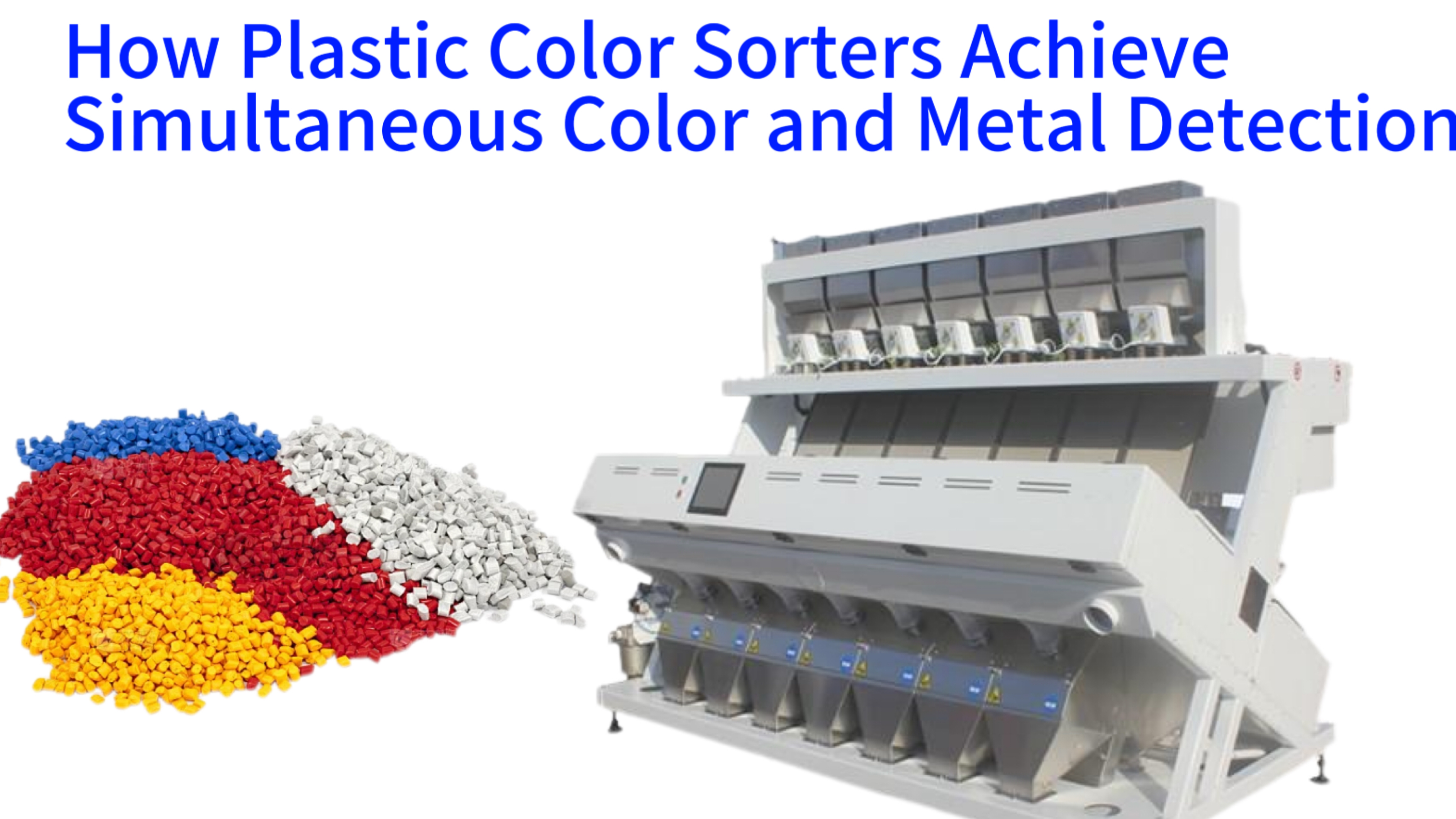
Modern plastic recycling operations face a critical challenge in producing high-purity material. The incoming stream often contains a mixture of differently colored plastic fragments alongside hazardous metallic impurities like screws, aluminum foil, or wire fragments. Traditional sorting methods require separate machines for color sorting and metal detection, leading to inefficient multi-stage processing, higher costs, and potential equipment damage. Advanced plastic color sorters now integrate dual-sensor technology to solve both problems in a single, streamlined pass. These machines combine high-resolution optical recognition with sensitive electromagnetic induction to identify and eject unwanted materials based on both their visible color and their metallic composition. This article explores the engineering behind this synchronize detection capability. We will examine the dual challenges posed by contaminants, the core framework of multi-sensor fusion, the detailed workings of the optical and electromagnetic subsystems, the intelligent data processing algorithms that make unified decisions, and the high-speed ejection system that executes them. Understanding this integrated technology is key to achieving the material purity required for high-value recycled plastic applications.
The Dual Challenge in Plastic Recycling: Color Variation and Metal Contamination
Recycled plastic feedstocks are inherently inconsistent. Post-consumer or industrial waste streams contain flakes and regrind of various polymer types, each in multiple colors. More critically, these streams are frequently contaminated with metallic objects. These range from ferrous items like nails and staples to non-ferrous metals such as aluminum bottle caps or copper wire fragments. These two issues, visual discoloration and hidden metallic contamination, degrade the final product in distinct but equally damaging ways. A sorting solution that addresses only one leaves the other to compromise quality, necessitating a technology that tackles both simultaneously for true efficiency.
Colored contaminants create an inconsistent, speckled appearance in reprocessed plastic pellets, limiting their use to low-value applications. Metallic impurities pose a severe physical threat to downstream manufacturing equipment. During melt processing in an extruder, even a small metal fragment can score barrels, damage screw flights, and clog filter screens, causing costly unplanned downtime and repairs. The industry's traditional answer involved sequential processing: passing material through a metal detector, then a plastic color sorter. This approach consumes more floor space, requires additional capital investment, and introduces multiple transfer points where material can be lost or contaminated. The market demands a consolidated solution that enhances final product purity while simplifying the recycling line and reducing total operational cost.
The Impact of Contaminants on Product Quality and Equipment
Heterogeneous color in recycled plastic directly translates to a product of lower market value. Manufacturers producing items where visual aesthetics are paramount, such as consumer packaging or automotive interior parts, require a consistent color base. The presence of off-color flakes forces the use of more masterbatch pigment to mask the inconsistency, increasing raw material costs. Metallic contaminants introduce risks beyond aesthetics. In a high-temperature, high-pressure extruder, a metal piece can cause significant abrasive wear. It may also create a localized hot spot or become lodged, leading to polymer degradation, production halts for screen changes, and in severe cases, catastrophic failure of the processing screw or barrel. The economic impact extends beyond the cost of the metal itself to encompass repair expenses, lost production time, and compromised product batches.
Limitations of Sequential and Single-Function Processing
A processing line relying on separate machines for metal detection and color sorting suffers from inherent inefficiencies. Each machine requires its own infeed and discharge system, material conveyors, and control panel. This configuration increases the plant's footprint, electrical consumption, and maintenance points. Material must be handled multiple times, increasing the chances of degradation or accidental mixing. Perhaps the most significant limitation is the creation of a process bottleneck. The throughput of the entire line is limited by the slower of the two machines. Furthermore, if the metal detector is placed after the color sorter, a piece of metal could damage the sensitive optical components or ejection valves of the sorter itself. An integrated system eliminates these transfer stages and synchronizes the inspection processes, allowing for a more compact, faster, and inherently safer material flow.
The Core Framework: Multi-Sensor Fusion Technology
The engineering achievement of simultaneous detection lies not in merely placing two sensors in one machine, but in fusing their data into a single, coherent analysis of each particle. This is a multi-sensor fusion system. Its architecture is designed for parallel data acquisition and centralized decision-making. As plastic particles travel through the inspection chamber, they pass through both the field of view of high-speed cameras and the electromagnetic field generated by a metal detection coil. The system's core processing unit must receive these two independent streams of data, correlate them to the exact same physical particle, analyze each signal, and decide on an action—all within a few milliseconds. This framework transforms raw sensor readings into intelligent, executable commands.
For this fusion to work, precise synchronization is paramount. The system employs high-speed timers and encoders to track the exact position of each particle as it moves. When the optical camera captures an image, it stamps the data with a precise time and position code. The metal detection sensor does the same when it registers a disturbance in its field. The central processing unit, often utilizing a combination of a fast CPU and a Field-Programmable Gate Array (FPGA) for real-time signal handling, uses these codes to match the optical image of a particle with its corresponding metal detection signal. This ensures that a metal reading is correctly associated with the visual identity of the fragment that caused it, preventing misidentification and erroneous ejection of valuable material.
Multi-Sensor Fusion System Architecture
Color & Shape Detection
Electromagnetic Sensing
Data Fusion & Decision Making
High-Speed Air Blasts
Synchronized data flow enables real-time decision making for each particle
Synchronized Data Acquisition and Material Tracking
Accurate particle tracking is the foundation of reliable fusion. The system monitors the speed of the conveyor belt or the flow rate of particles in a free-fall chute. Using this velocity data and the known physical distance between the optical scan line and the center of the metal detection aperture, the processor can predict exactly when a particle observed by the camera will enter the metal detector's field. This spatial-temporal mapping is continuously calibrated. Advanced systems may use multiple tracking points or image-based particle trajectory analysis to maintain accuracy even if particles bounce or rotate. This meticulous coordination guarantees that the two separate sensory judgments—one about color, the other about metallic content—are rendered about the identical piece of material, enabling a unified and confident sorting decision.
The Central Role of the Processing Unit (CPU/FPGA)
The computational hardware serves as the system's brain. The FPGA is particularly crucial for the initial stage of sensor signal processing. It handles the high-speed, repetitive tasks such as capturing raw image pixels from the camera, digitizing the analog signal from the metal detector, and applying initial filters. This preprocessing happens in real-time, with near-zero latency. The preprocessed data is then passed to the central CPU, which runs the sophisticated fusion algorithms. The CPU compares the optical data against a library of acceptable color and shape profiles while simultaneously evaluating the strength and character of the metal detection signal. It executes the decision logic, such as setting a higher priority for ejecting metal-contaminated pieces regardless of their color, ensuring the most critical purification goal is always met.
The Optical Eye: High-Resolution Color Recognition System
The optical subsystem is responsible for performing the traditional color sorting function with extreme precision. Its primary component is a high-resolution line-scan camera. Unlike area-scan cameras that capture a full frame, a line-scan camera captures a single, very narrow line of pixels across the width of the product stream. As particles move past, thousands of these lines are captured per second and digitally stitched together to form a complete, distortion-free image of each fragment. This technology is ideal for inspecting continuously moving materials, providing exceptionally detailed images that reveal subtle color differences, surface textures, and even translucent areas in clear plastics.
Consistent and specialized lighting is equally vital. The system employs an array of high-intensity, spectrally stable LED lights. The lighting geometry is carefully engineered. For opaque plastics, bright front lighting illuminates surface color. For transparent or semi-transparent materials like PET, a backlighting configuration may be used to reveal internal flaws or color density. The light source often emits a balanced full spectrum to ensure true color rendition, but specific wavelengths can be emphasized to enhance the contrast between certain polymer types that look similar under normal white light. This controlled illumination environment ensures the camera receives a clear, consistent signal from every particle, regardless of its position in the stream.
Line-Scan Camera Technology and Image Capture
Line-scan cameras offer distinct advantages for industrial sorting. They provide a much higher effective resolution across the width of the sorting belt compared to area-scan cameras. A typical system might achieve a pixel resolution smaller than 0.5 millimeters, allowing it to detect tiny specks of contamination. Because they image one line at a time in sync with the material's movement, there is no motion blur. The camera's high line-capture rate, often exceeding 10,000 lines per second, builds a precise two-dimensional image of each fast-moving particle. This image data is a rich source of information, containing not just color values (Red, Green, Blue) for each pixel, but also data on the particle's size, shape, and position within the product stream.
Advanced Image Processing and Classification Algorithms
Once captured, the raw image data undergoes rapid digital analysis. Sophisticated algorithms first segment the image, distinguishing individual particles from the background and from each other. For each identified particle, the software extracts a set of features. These include average color, color distribution, shape parameters like length and roundness, and surface texture metrics. This feature set is then compared in real-time to a user-defined acceptance model. The model can be as simple as "accept all blue fragments" or highly complex, defining acceptable ranges for multiple colors and shapes. Particles whose features fall outside the defined acceptance boundaries are flagged as impurities. The algorithm calculates the exact coordinates of these impurities, information that is later fused with metal detection data to guide the final ejection command.
The Electromagnetic Sense: Metal Detection Module
Operating in parallel with the optical system, the metal detection module identifies contaminants that are invisible to cameras. It operates on the principle of electromagnetic induction. The core of the detector is a balanced coil system, often housed in a "search head" through which the plastic stream passes. One coil generates a high-frequency radio wave field, creating a stable electromagnetic environment. When a particle containing metal enters this field, it disturbs the field's balance. The conductive metal induces small eddy currents within itself, which in turn generate a secondary magnetic field detectable by the system's receiver coils.
This technology is sensitive to all metal types, but in different ways. Ferrous metals (iron, steel) are both conductive and magnetic. Their magnetic permeability causes a large disturbance easily detected. Non-ferrous metals like aluminum, copper, or brass are not magnetic but are good conductors; they are detected through the eddy current effect. The system's electronics are tuned to recognize the specific "signature" of these disturbances against the background noise. The detector is strategically positioned in the material flow path. Its physical integration is designed so that its metallic housing and coils do not interfere with the optical path of the cameras, and its aperture size is matched to ensure every particle passes through its sensitive zone.
Balanced Coil Operation and Sensitivity to All Metals
The balanced, or differentially wound, coil design is key to high sensitivity. In its idle state, with no metal present, the output of the receiver coils is null due to careful balancing. Any intrusion of metal disrupts this equilibrium, producing a measurable signal. Modern digital signal processing allows the detector to be highly sensitive to very small metal fragments, sometimes as tiny as 0.3 millimeters in diameter, depending on the metal type. The system can be calibrated to establish detection thresholds, ignoring insignificant signals while reliably flagging hazardous metal pieces. This calibration is crucial because some non-metallic materials or moisture can produce minor "product effect" signals that must be distinguished from true metal contamination.
System Integration and Interference Rejection
Integrating a sensitive metal detector into a machine filled with other electronics and vibrating mechanics requires careful design to prevent false triggers. The search head and its connecting cables are heavily shielded to block external electromagnetic interference from motors, drives, or radio sources. The detector's operating frequency is selected to minimize interaction with the product being inspected; wet or salty materials can be more conductive and require specific frequency adjustments. Furthermore, the detector's signal processing includes advanced filtering algorithms. These algorithms can differentiate between the sharp, characteristic signal of a metal fragment and slower, broader signals caused by environmental noise or benign product effects, ensuring that the final metal detection output sent to the fusion processor is highly reliable.
The Decision Center: Data Fusion and Ejection Logic
This stage is the intellectual core where information from the eye and the electromagnetic sense converges. The data fusion algorithm receives two labeled signals for each tracked particle: an optical classification (e.g., "target blue," "red contaminant," "black unknown") and a metal status (e.g., "clean" or "metal present"). The algorithm's first task is to apply a set of rules to these combined inputs. The highest priority rule is typically safety-driven: any particle flagged as containing metal is marked for ejection, irrespective of its color. This prevents damaging metal from proceeding downstream. For particles free of metal, the decision relies solely on the optical classification.
Once the fate of a particle is decided, the system must execute the physical action with precision. The algorithm knows the particle's speed and its exact location when it was last scanned. It calculates the precise time it will take for that particle to travel from the inspection point to the ejection array. Accounting for this fixed delay, the system sends a firing command to a specific nozzle or set of nozzles at the exact millisecond the unwanted particle is passing in front of them. This command is not a simple on/off signal; it can modulate the duration of the air blast based on the size and weight of the particle to ensure clean deflection without wasting compressed air or disturbing adjacent good material.
Priority Logic and Conflict Resolution
The fusion logic is designed to resolve any ambiguity. Consider a particle that is both the correct target color and contains a tiny metal inclusion. The system will classify it as "metal-contaminated" and eject it. The logic prioritizes the protection of downstream equipment and the absolute purity of the non-metallic output over the recovery of that particular piece of material. The rules are user-configurable in some advanced systems. For instance, in applications where ferrous metals are the sole concern, the operator might instruct the system to ignore signals indicative of non-ferrous metals if they fall below a certain size threshold, allowing valuable non-ferrous-laden plastic to be recovered. This flexibility allows the machine to be optimized for different recycling goals and material streams.
Precise Ejection Command Generation
The translation from a logical decision to a physical action demands microsecond timing. The ejection array consists of a row of tightly spaced, high-speed solenoid valves. Each valve controls an air nozzle aimed at a specific zone of the product stream. The processing unit maps the predicted position of the contaminant to the specific nozzle that covers that zone. It then generates a timed pulse signal. The duration of this pulse can be as short as 5 to 10 milliseconds, enough for a focused blast of compressed air to knock the impurity off its trajectory and into the reject chute. The timing is so critical that variations in line voltage or air pressure are constantly monitored and compensated for to maintain ejection accuracy at throughput rates that can exceed several tons per hour.
The High-Speed Execution: Ejection and Separation System
The final component transforms electronic decisions into physical separation. The ejection system is a marvel of pneumatic engineering designed for speed, reliability, and precision. Its key elements are the high-speed valve blocks. These valves are engineered for tens of millions of cycles, featuring extremely fast response times where the valve opens and closes completely in less than one millisecond. They are arranged in a dense array across the full width of the sorting channel, ensuring no blind spots where a contaminant could slip through undeflected. When a valve fires, it releases a precisely metered burst of compressed air through a nozzle, creating a sharp, focused jet.
This system's performance is entirely dependent on the quality and stability of the compressed air supply. A dedicated air preparation unit is essential. It includes filters to remove oil and water, a pressure regulator to maintain a constant force, and a large reservoir or accumulator to ensure an instantaneous supply of air for rapid valve firing without a pressure drop. Consistent air pressure is crucial; a drop in pressure could result in a weak jet that fails to deflect a heavy contaminant, while a spike could cause excessive blast that disturbs nearby good product. The rejected materials, whether off-color plastic or metal-contaminated fragments, are blown into a sealed reject collection chamber, while the purified plastic stream continues on its path to collection hoppers or the next stage of processing.
High-Frequency Solenoid Valve Array and Nozzle Design
The solenoid valves operate as digital on/off switches for air. Their rapid cycling capability allows the machine to handle high throughputs, as they can fire for one contaminant and reset in time to fire for another following closely behind. The nozzles attached to these valves are not simple holes; they are engineered to shape the air blast. Their internal geometry creates a coherent, concentrated jet that travels several inches with minimal dispersion. This focus is vital for selectively targeting a single small contaminant in a stream of closely spaced particles without blowing the entire surrounding area. The alignment of each nozzle is calibrated during machine installation to ensure its jet impacts the correct point in the particle trajectory, a critical aspect covered in detailed installation guides.
Compressed Air System: Stability and Purity Requirements
The air system's role extends beyond providing force. Clean, dry air is mandatory. Any oil or water vapor in the lines can gradually coat the optical lenses or camera windows, degrading image quality and sorting accuracy over time. A typical setup includes a sequence of a coalescing filter to remove bulk liquids and aerosols, a desiccant dryer to remove water vapor, and a final particulate filter. A large air receiver tank acts as a buffer, smoothing out pressure fluctuations caused by the rapid firing of multiple valves. System pressure is usually maintained between 6 to 8 bar, with the exact setting optimized for the specific density and size range of the plastic flakes being sorted. This entire subsystem ensures that the "muscle" of the sorter performs reliably day after day.
Technical Advantages and Industrial Application Value
The integration of color and metal detection into a single machine delivers compelling advantages that translate directly to operational and financial benefits for recyclers. The most significant advantage is the dramatic improvement in output purity. By removing both visible and invisible contaminants in one pass, the machine produces a cleaned plastic stream that closely resembles virgin material in consistency. This high-purity output commands a premium price in the market and qualifies for use in more demanding, higher-value manufacturing applications, thereby expanding business opportunities for the recycler.
From a process economics standpoint, the integrated system offers substantial savings. It reduces the capital expenditure required for two separate machines and minimizes the factory footprint. Operational costs are lower due to reduced energy consumption, fewer spare parts to inventory, and less maintenance labor. Most importantly, it provides proactive protection for expensive downstream extrusion and molding equipment by ensuring no metal reaches them. This prevention of damage avoids the high costs of repair parts, production downtime, and lost output. The technology enables recyclers to process more challenging, lower-cost feedstocks with higher contamination levels, turning waste streams into profitable resources with greater efficiency and confidence.
Enhanced Product Purity and Market Value
The primary output of this technology is a superior product. Flake or pellet stock that is both color-sorted and guaranteed metal-free meets the stringent specifications of brand owners and manufacturers aiming for high recycled content in their products. This purity allows for more predictable coloring and processing behavior, reducing waste in the final manufacturing step. Recyclers can thus move beyond competing solely on price and instead compete on quality, securing longer-term contracts and healthier profit margins. The ability to reliably meet these higher standards is a direct result of the dual-sensor, single-pass sorting working principle.
Reduction in Operational Costs and Downtime
The economic argument extends beyond the sales price of the output. An integrated sorter simplifies the entire material handling line, reducing conveyor lengths, transfer points, and associated electrical drives. This simplification lowers daily energy consumption. More critically, by acting as an infallible gatekeeper against metal, it eliminates a major source of unplanned downtime in the processing plant. The cost of replacing a damaged extruder screw or barrel can run into tens of thousands of dollars, not including the value of lost production. The sorter pays for itself by preventing just a few such incidents, all while continuously improving the quality of the primary product stream. This makes the technology not just a purification tool, but a key component for risk management and operational stability in a modern recycling facility.
Key Performance Parameters of Integrated Plastic Color Sorter with Metal Detection