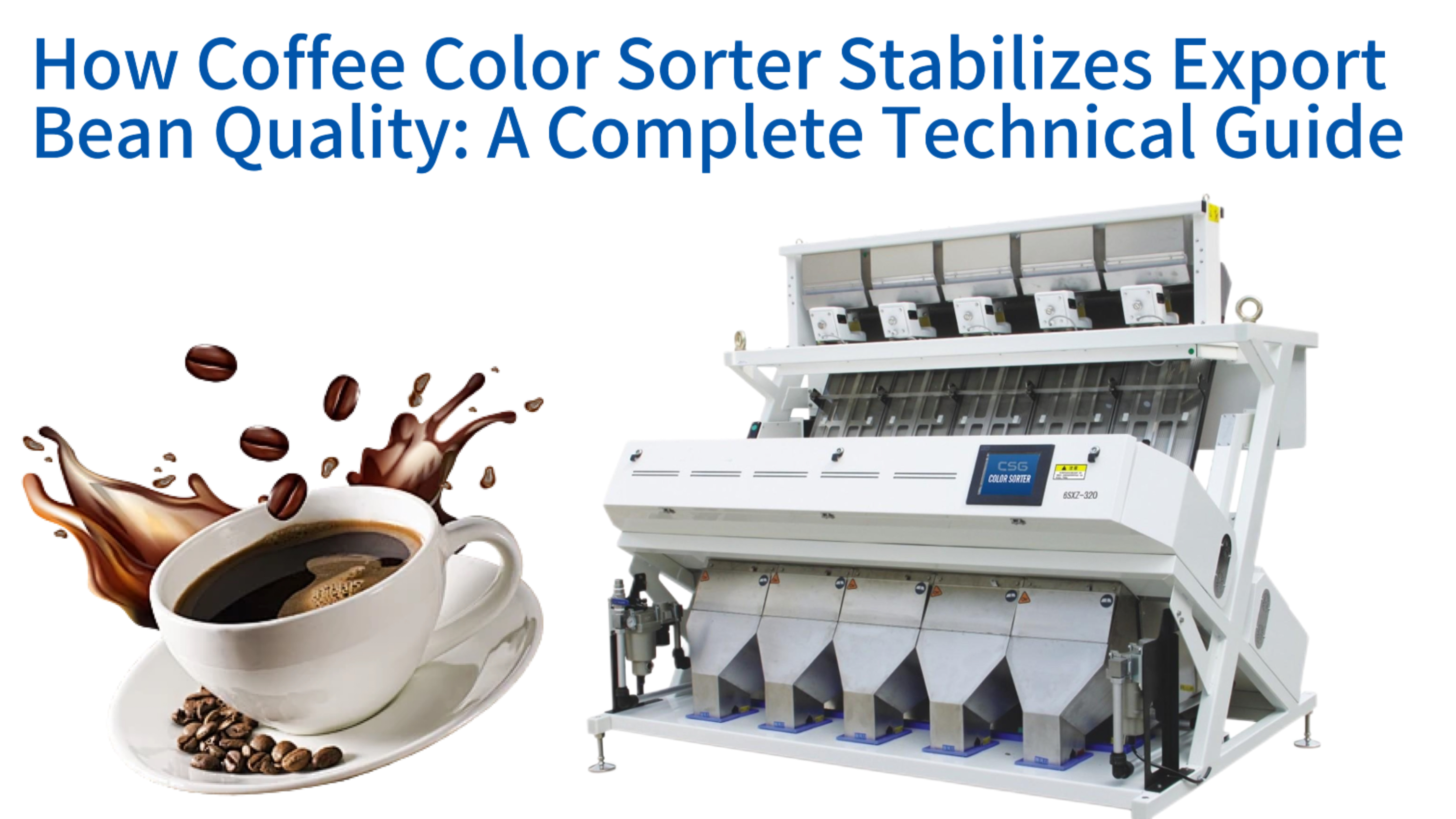
Coffee Color Sorter - Quality Control Workflow
1. Uniform Feeding
Vibratory feeders create monolayer bean flow
2. Optical Inspection
Multi-spectral LEDs + high-res line scan sensors
3. AI Defect Recognition
Color + shape + texture analysis (ms response)
4. Precision Ejection
1-2ms solenoid valves target defective beans
5. Quality Export Beans
Consistent defect-free batches for export
The stability of export-grade coffee quality directly determines its competitiveness and selling price in international markets. Optical sorters serve as core equipment in modern coffee processing lines, using high-speed vision detection and intelligent recognition technology to precisely remove defective beans, foreign materials, and fermented particles that negatively affect flavor profiles. This comprehensive guide explains how coffee color sorters help exporters establish reliable quality control systems through advanced operating principles, intelligent recognition logic, and adaptable configurations for different coffee varieties. The discussion covers the complete process from raw bean handling to pre-shipment sorting, analyzing how sorting technology addresses challenges including natural color variation, density differences, and internal defect detection. The content also examines how this equipment improves batch consistency and helps meet stringent international buyer requirements.
Export Coffee Quality Standards and the Role of Color Sorters
International Coffee Defect Tolerance Limits (300g Sample)
International coffee trade operates under strictly defined quality grades and inspection requirements that determine market access and pricing. Color sorters function as critical quality gatekeepers within this system, ensuring that exported beans meet the specific defect tolerances established by importing countries and specialty coffee associations. Understanding these standards provides the foundation for appreciating how sorting technology creates value for exporters.
The relationship between defect rates and coffee value follows precise mathematical formulas in international trade. Each defect type carries a specific weight in quality calculations, with some defects considered more serious than others. Black beans, for example, can ruin an entire cup of coffee and therefore have very low tolerance limits. Sour beans resulting from fermentation issues similarly receive strict scrutiny because they introduce unpleasant flavors. The visual identification of these defects requires consistent lighting and high-resolution imaging that human inspectors cannot maintain over long sorting periods.
Quality control in coffee export involves multiple inspection stages working together as an integrated system. Traditional approaches relied heavily on human visual inspection at various points throughout processing. Modern facilities integrate color sorters with destoners, gravity separators, and sizing equipment to create comprehensive cleaning lines. The color sorter typically operates after other equipment has removed lighter materials and stones, focusing specifically on color-based defects that remain in the cleaned stream. This positioning maximizes efficiency by allowing the sorter to concentrate on its specific strength rather than attempting to handle all separation tasks simultaneously.
The performance gap between manual sorting and optical sorting becomes apparent when examining production data over extended periods. A single experienced human inspector might effectively sort 50 to 100 kilograms of coffee per hour while maintaining reasonable accuracy. That same inspector's performance typically degrades significantly after two hours of continuous work due to visual fatigue and reduced concentration. Modern coffee color sorters process between two and five tons per hour while maintaining consistent inspection standards throughout multi-shift operations. The colour sorter working principle ensures this consistency through automated calibration and real-time performance monitoring.
Defect Tolerance Limits in International Coffee Trade
Specialty coffee associations and importing nations have established detailed classification systems that define acceptable defect levels for different quality grades. These systems typically separate defects into primary categories representing severe quality issues and secondary categories covering less serious problems. Primary defects include full black beans, full sour beans, insect-damaged beans with visible holes, and foreign materials such as stones or glass. Secondary defects encompass partial black or sour beans, broken or chipped beans, and immature beans that failed to develop properly during growth.
The mathematical calculation of defect percentages follows standardized procedures that ensure consistency across different testing laboratories. Inspectors take representative samples of specific sizes, typically 300 grams for specialty grade evaluations, and physically examine every bean in the sample. Each defect found receives a weighted score based on its severity, with primary defects counting more heavily than secondary ones. The total defect score determines the grade assignment and ultimately the price the coffee commands. Color sorters must achieve defect removal rates that reliably produce samples meeting these specifications consistently throughout each production batch.
Different markets maintain varying tolerance levels that exporters must understand and accommodate. Some European importers demand extremely strict standards with near-zero tolerance for certain defect types. Other markets may accept slightly higher defect levels at correspondingly lower prices. Successful exporters configure their sorting operations to meet the requirements of their target markets while minimizing the loss of good beans that might be rejected unnecessarily. This balancing act requires precise control over sorting sensitivity that only modern optical systems can provide.
Visual Characteristics of Coffee Defects Affecting Flavor
Black beans develop their dark coloration through over-fermentation or improper drying that allows microorganisms to break down bean structure. These beans impart bitter, tarry flavors to coffee that dominate all other taste characteristics even when present in very small quantities. The visual appearance of black beans ranges from completely dark surfaces to partial discoloration affecting only portions of the bean. Advanced sorting systems must detect both extremes while correctly accepting beans with naturally dark coloration characteristic of certain origins or roast levels.
Insect-damaged beans reveal their condition through small holes where beetles have entered and exited the bean during growth or storage. These holes provide entry points for mold and oxidation that degrade flavor quality beyond the direct damage from insect activity. The beans surrounding insect holes often develop off-flavors even if the visible damage appears minor. Detection requires imaging resolution sufficient to identify small holes while distinguishing them from natural surface variations. Texture analysis algorithms examine the patterns surrounding suspected defects to differentiate between insect damage and harmless surface irregularities.
Fermented beans result from excessive moisture during processing that allows uncontrolled microbial activity. These beans develop sour or winy flavors that some consumers might find acceptable in small quantities but become unpleasant when present at higher levels. The visual appearance of fermented beans varies widely depending on the specific microorganisms involved and the duration of fermentation. Some show distinct color changes while others appear nearly normal to casual inspection. Near-infrared analysis detects the chemical changes associated with fermentation, identifying affected beans even when surface appearance provides no clear indication.
Optical Detection and Recognition Principles in Coffee Sorting
The ability of coffee color sorters to see and identify defective beans depends on carefully engineered optical systems that illuminate, capture, and analyze bean appearance. These systems combine multiple technologies working together within milliseconds to extract meaningful information from each falling particle. Understanding how these components function helps operators appreciate both the capabilities and limitations of their sorting equipment.
Lighting design for coffee sorting presents unique challenges because acceptable beans naturally range from pale green through yellow to deep brown depending on origin and processing method. The illumination must reveal defects across this entire color range while maintaining consistent color rendering that allows accurate comparisons against reference standards. Modern LED arrays provide precisely controlled spectral output optimized for coffee applications, typically combining multiple wavelengths to highlight specific defect characteristics. The light distribution across the inspection width must remain uniform within very tight tolerances to ensure that beans receive identical illumination regardless of their lateral position.
The sensors capturing coffee bean images operate at speeds that seem almost impossible. Line scan cameras capture thousands of complete image lines every second as beans fall through the inspection zone. Each line contains thousands of individual pixels across the machine width, with each pixel measuring light intensity in multiple color channels simultaneously. The resulting data stream contains billions of individual measurements per minute, all of which must be processed in real-time to make sorting decisions. The resolution achieved allows detection of surface features measuring fractions of a millimeter, sufficient to identify small defects and early-stage damage.
Background systems play a surprisingly important role in detection accuracy. The area behind falling beans as they pass the cameras provides the reference against which bean color is measured. If this background varies in color or brightness, the apparent bean color changes even when the bean itself remains constant. Adjustable backgrounds allow operators to select optimal contrast for each coffee type, with dark backgrounds working best for light beans and light backgrounds suiting dark beans. Some advanced systems incorporate active backgrounds that automatically adjust to match the average bean color in real-time, maintaining optimal contrast despite batch-to-batch variation.
Specialized Light Sources for Coffee Bean Characteristics
The wavelength composition of illumination significantly affects which defect features become visible to cameras. Different materials reflect and absorb light differently at various wavelengths, creating contrast that may not exist under broad-spectrum white light. Engineers select LED wavelengths specifically to maximize the visibility of defects common in coffee while minimizing the visibility of harmless natural variation. This spectral optimization improves detection accuracy without requiring more complex analysis algorithms.
Light positioning relative to the cameras and beans determines which surface features become visible. Front lighting from the camera direction emphasizes color and surface texture, making defects visible through their color differences. Side lighting at shallow angles creates shadows that reveal surface topography, highlighting raised or depressed areas characteristic of certain defect types. Many sorters combine multiple lighting angles, switching between them electronically at high speeds to capture different views of each bean. The resulting multi-angle images provide far more information than any single lighting arrangement could achieve.
Light stability over time directly affects sorting consistency. LED output gradually decreases as the devices age, and temperature changes can shift both intensity and color. Modern sorters incorporate closed-loop light control systems that monitor illumination continuously and adjust drive currents to maintain constant output. Reference measurements taken during machine calibration provide the baseline against which current performance is compared. When sensors detect deviation beyond acceptable limits, the system alerts operators and may automatically compensate through software adjustments until maintenance can be performed.
High-Resolution Imaging of Coffee Bean Surfaces
The sensors used in coffee color sorters represent the same fundamental technology found in digital cameras but optimized for industrial speed and reliability. Line scan sensors read image data one line at a time as beans move past, building complete pictures through the combination of sensor readout and bean motion. This approach allows extremely high resolution across the machine width while maintaining the fast readout speeds necessary for real-time processing. Each line typically contains between two thousand and eight thousand individual sensing elements, each measuring light in multiple color bands.
The conversion of light to digital numbers involves multiple stages that affect final image quality. Light striking each sensor element generates a small electrical charge proportional to light intensity. This analog charge must be amplified, converted to a digital value, and corrected for variations in individual pixel sensitivity. Reference measurements taken during dark and bright calibration provide the correction factors applied to every subsequent reading. This calibration compensates for manufacturing variations between pixels and changes in sensitivity over time, ensuring consistent measurements across the entire sensor array.
Timing coordination between sensor readout and bean position requires extreme precision. The sensor reads lines at fixed intervals determined by expected bean speed through the inspection zone. If beans travel faster or slower than expected, their images become stretched or compressed vertically, potentially affecting defect detection. Many systems incorporate speed measurement that tracks actual bean velocity and adjusts line rate accordingly. This dynamic timing ensures that bean images maintain correct aspect ratios regardless of minor speed variations caused by bean size differences or feed rate changes.
Intelligent Recognition Logic for Coffee Defect Detection
Coffee Defect Recognition Accuracy by Algorithm Type
The recognition logic running inside coffee color sorters determines whether the system correctly distinguishes acceptable beans from defects despite natural color variation within coffee populations. This software represents the accumulated knowledge of coffee quality experts translated into mathematical operations that execute millions of times per second. The evolution from simple threshold comparisons to artificial intelligence has dramatically improved sorting capability for challenging coffee applications.
Traditional sorting approaches relied on setting acceptable color ranges based on measurements of good beans. Beans falling outside these ranges triggered rejection regardless of other characteristics. This method works effectively for removing grossly discolored beans but struggles with subtle defects or when acceptable beans naturally exhibit wide color variation. The fundamental limitation lies in treating color as the only decision factor while ignoring shape, texture, and other potentially valuable information that human inspectors naturally incorporate into their judgments.
Multi-dimensional classification represents a significant advance over simple threshold methods. Rather than evaluating single measurements, these systems consider multiple features simultaneously, creating decision boundaries in multi-dimensional space that better separate acceptable beans from defects. A bean might have color slightly outside the typical range yet be accepted if its shape and texture match acceptable patterns. Conversely, a bean with acceptable color might be rejected if its shape indicates insect damage or its texture suggests fermentation. This approach more closely mimics human decision-making while operating at electronic speeds.
The introduction of artificial intelligence has transformed sorting capability for the most challenging applications. Deep learning networks trained on thousands of labeled coffee bean images develop their own recognition criteria based on patterns they discover rather than following programmed rules. These networks identify subtle feature combinations that reliably distinguish defects from acceptable beans even when individual features appear similar. The training process continues throughout the machine's life, with operators able to correct mistakes and reinforce correct decisions, gradually improving performance over time. The technical development trend of color sorter continues moving toward greater AI integration across all applications.
Color-Based Threshold Screening for Obvious Defects
Initial defect removal in coffee sorting typically relies on straightforward color thresholds that capture beans clearly outside acceptable ranges. These thresholds define the outer boundaries of acceptable color variation, with beans exceeding these limits rejected immediately. The thresholds must be set wide enough to accept natural variation within coffee varieties while narrow enough to catch truly defective beans. Finding this balance requires understanding the color distribution of both good beans and defects for each specific coffee lot.
The setting of color thresholds involves statistical analysis of bean populations. Modern sorters display color histograms showing the distribution of measured colors across thousands of beans. Good beans typically form a cluster within a relatively narrow color range, with defects appearing as separate populations or tails extending beyond the main cluster. Operators select threshold positions based on where these defect populations separate from the main distribution, balancing the desire to remove defects against the risk of rejecting acceptable beans at the edges of natural variation.
Color-only sorting works best for defects that produce dramatic color changes such as full black beans, white beans from improper drying, and beans discolored by mold. These defects differ so significantly from normal beans that simple thresholds provide reliable identification with minimal risk of false rejects. The speed and simplicity of color threshold processing make it valuable as a first pass that removes the most obvious defects before more sophisticated analysis addresses subtle cases. This layered approach optimizes both processing speed and overall accuracy.
Shape and Size Recognition for Foreign Material Removal
Foreign materials entering the coffee stream present different identification challenges than defective beans because their appearance may bear no relation to coffee characteristics. Stones, wood fragments, metal pieces, and plastic contamination must be detected and removed regardless of their color. Shape analysis provides the primary means of identifying these materials, examining each particle's geometric properties to determine whether it matches expected coffee bean dimensions and proportions.
Coffee beans exhibit characteristic shapes that differ significantly from most foreign materials. Whole beans have length-to-width ratios falling within specific ranges depending on variety, with Arabica beans typically more elongated than Robusta. The aspect ratio, defined as length divided by width, provides a simple but effective metric for identifying materials with different proportions. Circular objects such as small stones or pellets are easily distinguished from beans using this measurement alone. Broken beans produce different shape characteristics that may require separate analysis to distinguish from foreign material.
Perimeter analysis adds another dimension to shape characterization. The ratio of actual perimeter to the perimeter of a smooth ellipse of the same dimensions reveals surface irregularity. Beans have characteristic surface textures with specific roughness patterns, while stones typically appear smoother or have different irregularity patterns. Combined measurements of multiple shape characteristics create robust identification that continues working even when colors coincidentally match coffee. This shape-based approach proves particularly valuable for detecting materials that have been painted or colored to resemble coffee in attempts to bypass inspection.
Material Handling and Precision Ejection Mechanisms
Coffee Sorter Ejection System Technical Specifications
The physical separation of identified defects from the main coffee stream requires mechanical systems operating with millisecond precision. After cameras detect a defective bean and calculate its position, air jets must strike that specific particle at exactly the right moment to deflect it into the reject collection area. The design and performance of these handling and ejection systems directly determine whether accurate identification translates into effective separation.
The journey through the sorter begins with vibration feeders that transform bulk coffee flow into organized streams suitable for individual inspection. These feeders use controlled oscillations to convey material forward while spreading it into a single layer of particles. The vibration frequency and amplitude must be adjusted for coffee's specific flow characteristics, with different settings required for beans of varying size and moisture content. Proper feeder adjustment ensures that beans enter the inspection zone with consistent spacing that prevents overlapping, which would hide defects beneath acceptable beans.
Chutes receiving beans from the feeder provide the final guidance before free fall through the inspection zone. These precision surfaces accelerate beans to consistent velocity while maintaining their orientation and spacing. The chute angle and surface finish are calculated based on coffee's coefficient of friction and desired inspection speed. Stainless steel construction with specific surface treatments minimizes static electricity that could cause beans to stick or behave unpredictably. The transition from chute to free fall must be smooth and consistent, with no bumps or edges that could disturb bean trajectory.
Air ejection systems transform electronic decisions into physical separation through precisely controlled compressed air pulses. High-speed solenoid valves open and close within one or two milliseconds, releasing air through nozzles aimed at the bean stream. The air jet must transfer sufficient momentum to deflect defective beans into the reject chute while having minimal effect on adjacent good beans. Valve placement across the machine width matches the imaging channel spacing, ensuring that each bean can be targeted by the nozzle nearest its lateral position. The CoffeeBean Color Sorter Optical Sorting Machine exemplifies this precise coordination between detection and ejection.
Vibratory Feed Systems for Uniform Bean Flow
The vibration characteristics required for coffee differ from those used for many other agricultural products due to coffee's specific density and surface properties. Coffee beans have relatively low density compared to grains, requiring gentler vibration to prevent bouncing or uncontrolled movement. The elliptical motion pattern typical of electromagnetic feeders must be tuned to create forward movement without excessive vertical lift that could disturb bean orientation. Modern feeders incorporate variable frequency drives that allow precise adjustment of both amplitude and frequency to match each coffee lot's characteristics.
Feed rate control directly affects sorting accuracy through its influence on bean spacing and velocity. Higher feed rates increase production but reduce the space between beans, potentially causing overlaps that hide defects. Lower feed rates improve inspection conditions but reduce throughput. Advanced systems incorporate automatic feed control that adjusts vibration intensity based on real-time measurement of bean flow, maintaining optimal conditions across varying upstream supply rates. This closed-loop control ensures consistent performance despite fluctuations in how beans flow from storage bins or preceding equipment.
The physical design of feeder troughs influences how beans spread across the machine width. Troughs typically incorporate features that encourage even distribution, such as stepped profiles or carefully shaped discharge edges that break up clumps. The width of the trough matches the inspection width of the optical system, ensuring that beans cover the entire camera view without leaving empty areas that waste capacity. Wear-resistant linings protect the trough surface from abrasion, maintaining consistent performance over years of operation with minimal maintenance.
High-Speed Valve Response for Precise Bean Rejection
The valves that control air ejection must operate with extraordinary speed and reliability to keep pace with bean flow. Each valve may need to fire hundreds of times per second, opening and closing completely within the brief window when a targeted bean passes the nozzle. This rapid cycling requires valve designs optimized for minimal moving mass and magnetic circuits that build force quickly. The valve materials must withstand millions of cycles without wear while maintaining consistent performance over wide temperature and pressure ranges.
Valve timing must account for the time between imaging and ejection, which depends on bean velocity and the distance from cameras to nozzles. This delay typically ranges from 10 to 30 milliseconds, during which the bean continues falling while the control system processes the image and makes a decision. The timing calculation must consider the exact vertical position where the bean was imaged and the precise moment when it will reach the ejection zone. Modern systems maintain timing accuracy within fractions of a millisecond despite variations in bean speed and environmental conditions.
Air pressure directly affects ejection force and must be carefully controlled for consistent performance. Higher pressure provides more force for moving beans but increases air consumption and may cause excessive deflection that ejects beans too forcefully. Lower pressure reduces air usage but may fail to deflect larger or denser beans sufficiently. Pressure regulators maintain constant delivery pressure despite fluctuations in plant compressed air systems, while local reservoirs provide immediate air volume for peak demands. Some systems incorporate pressure sensors that monitor actual delivery at each valve, compensating for minor variations through timing adjustments.
Configuration Adaptations for Different Coffee Varieties
Arabica vs Robusta Sorting Configuration
Arabica Coffee
- Narrower color acceptance range (high sensitivity)
- 3-4 mm nozzle spacing (smaller bean size)
- 0.4-0.5 MPa ejection pressure (lower force)
- Higher resolution imaging (subtle defects)
- 30-35 Hz feeder vibration (gentler handling)
- Target: Specialty grade (0 primary defects)
Robusta Coffee
- Wider color acceptance range (natural variation)
- 4-5 mm nozzle spacing (larger bean size)
- 0.5-0.6 MPa ejection pressure (higher force)
- Multi-feature analysis (color + texture + shape)
- 25-30 Hz feeder vibration (denser beans)
- Target: Commercial grade (2-3 primary defects)
Coffee varieties differ significantly in physical characteristics that affect how sorters must be configured for optimal performance. Arabica and Robusta beans vary in size, shape, density, and color distribution. Processing methods including washed, natural, and honey processing create additional variations in surface appearance and defect characteristics. Understanding these differences allows operators to adapt sorting parameters for each specific coffee type rather than using one-size-fits-all settings that compromise performance.
The natural color range of acceptable beans varies dramatically between coffee types and origins. Some high-altitude Arabicas exhibit bluish-green coloration that would appear unusual in other varieties. Robusta beans typically show wider color variation naturally, with yellower and browner tones considered normal. Sorting systems must learn the specific color distribution for each coffee lot, establishing acceptance boundaries that encompass natural variation while excluding truly defective beans. This learning process typically involves scanning representative samples and analyzing the resulting color statistics before production begins.
Bean density affects both handling characteristics and the presence of certain defect types. Denser beans travel through the sorter on slightly different trajectories and require more ejection force for successful removal. Density also correlates with quality in many cases, with denser beans generally commanding higher prices. Some sorters incorporate density measurement through indirect means such as analysis of bean trajectory or through dedicated sensors that respond to bean mass. This information can supplement optical data, providing additional criteria for quality classification beyond visible appearance.
Processing method significantly influences bean surface characteristics and defect presentation. Washed coffees have clean surfaces with relatively uniform coloration after the mucilage has been fully removed. Natural or dry-processed coffees retain their fruit during drying, resulting in beans with more variable surface appearance and occasional fruit fragments that must be removed. Honey-processed coffees occupy an intermediate position, with varying degrees of mucilage retention producing different surface characteristics. Sorting parameters must account for these processing-related variations to avoid rejecting acceptable beans while still removing defects.
Arabica and Robusta Parameter Differences
Arabica beans typically exhibit narrower color ranges than Robusta, with more consistent coloration within a given lot. This consistency allows tighter sorting windows that remove subtle defects more effectively, achieving the higher purity levels that specialty Arabica markets demand. The sorting system must be configured with higher sensitivity for Arabica applications, detecting smaller color deviations that would be considered normal variation in Robusta. This increased sensitivity requires corresponding attention to lighting stability and background control to prevent false rejects from harmless variations.
Robusta beans present the opposite challenge with their naturally wider color variation. Sorting systems must accommodate this variation while still removing truly defective beans, requiring more sophisticated analysis than simple color thresholds. Multi-dimensional approaches combining color with texture and shape prove particularly valuable for Robusta, allowing acceptance of beans across the full natural color range while identifying defects through their combined feature signatures. The training data for Robusta sorting must include sufficient examples of acceptable variation to prevent the system from learning overly narrow acceptance criteria.
Size differences between varieties affect both chute selection and ejection settings. Arabica beans typically measure smaller than Robusta, requiring finer-resolution imaging and denser nozzle spacing for precise targeting. The smaller mass of Arabica beans means less ejection force is required, allowing lower air pressures that reduce operating costs. Robusta's larger size may require wider chute spacing and more powerful air jets to achieve complete deflection. Some sorters incorporate adjustable components that can be reconfigured for different size ranges, allowing a single machine to handle both varieties with appropriate setup changes.
Natural Processed Coffee Sorting Challenges
Natural processed coffees present unique sorting difficulties because the beans retain their fruit during drying, leading to more variable surface appearance. The dried fruit remnants can range in color from pale tan to deep brown, overlapping significantly with defect colors. Sorting systems must distinguish between acceptable fruit remnants and defects such as over-fermented beans or foreign material. Texture analysis proves valuable here, as fruit remnants typically have different surface characteristics than bean surfaces or mold growth.
The presence of intact dried fruit on some beans creates additional sorting complexity because these beans may appear darker or more irregular than their hulled counterparts. The sorting system must recognize that this appearance results from processing method rather than defect condition, accepting beans that would be rejected in washed coffee applications. Training data for natural coffee sorting must include abundant examples of acceptable fruit-covered beans, teaching the system to recognize their characteristic appearance and distinguish it from defect patterns that may superficially resemble it.
Moisture content in natural processed coffees often varies more than in washed coffees due to uneven drying conditions within the fruit. This moisture variation affects both optical properties and bean density, potentially influencing sorting decisions. Near-infrared analysis provides valuable supplementary information by measuring moisture levels directly, allowing the system to accept beans with acceptable moisture while rejecting those with excessive moisture indicating inadequate drying or subsequent re-wetting. This multi-spectral approach overcomes limitations of visible-light-only inspection for natural coffee applications.
Economic Benefits for Coffee Exporters
Investment in color sorting technology delivers returns through multiple channels beyond simply meeting quality specifications. Understanding these economic benefits helps exporters justify equipment purchases and optimize their sorting operations for maximum financial return. The combination of improved product value, reduced labor costs, and minimized quality claims creates compelling financial justification for modern sorting equipment across a range of export volumes.
Price premiums for consistently high-quality coffee reflect the value that roasters place on reliable supply. Buyers facing their own quality commitments prefer suppliers with demonstrated ability to deliver defect-free coffee batch after batch. This preference translates into price advantages that accumulate over time, with premium-grade coffee commanding prices significantly above commodity levels. The price difference between specialty grade and standard grade often exceeds the entire cost of sorting equipment over reasonable payback periods, making quality investment self-funding through improved revenue.
Labor cost reduction provides immediate, quantifiable savings that appear directly on financial statements. Manual sorting requires teams of workers who must be paid, managed, and replaced as they leave. The direct wage costs represent only part of the total expense, with supervision, benefits, training, and quality monitoring adding substantial indirect costs. A single color sorter typically replaces between 20 and 50 hand sorters depending on the application, eliminating these ongoing costs while often improving consistency. The labor savings alone frequently justify equipment investment within one to two years of operation.
Quality claim avoidance protects both revenue and customer relationships. Shipments rejected at destination create enormous costs including replacement product, freight both ways, and often penalty payments to downstream customers whose own production was disrupted. Beyond the direct financial impact, quality failures damage exporter reputation, making future sales more difficult and potentially forcing acceptance of lower prices to maintain market access. Color sorting provides documented quality assurance that protects against these risks, with machine records providing evidence of inspection that can support quality claims if disputes arise.
Batch Consistency and Price Premium Achievement
Export buyers evaluate not only average quality but also consistency across shipments and within individual containers. A supplier delivering occasional premium lots mixed with variable quality creates supply chain uncertainty that buyers discount in their purchasing decisions. Consistent performance allows buyers to plan production with confidence, making them willing to pay premiums for reliable supply. Color sorters enable this consistency by maintaining the same inspection standards shift after shift, day after day, unaffected by human fatigue or attention variations.
The price difference between quality grades in international coffee trade follows well-established patterns that reward investment in quality improvement. The specialty coffee market has grown significantly faster than overall coffee consumption, with consumers increasingly willing to pay for verified quality. Exporters positioned to serve this market segment access prices substantially above commodity coffee rates. The incremental revenue from upgrading even a portion of production to specialty grade often provides attractive returns on sorting investment, with additional benefits from improved positioning in traditional markets.
Long-term buyer relationships develop when suppliers demonstrate reliable quality over multiple seasons. These relationships provide stability that reduces marketing costs and selling risk, with buyers returning season after season rather than requiring new sales efforts for each shipment. The trust built through consistent quality allows suppliers to plan production and financing with greater confidence, reducing business risk. Color sorting technology enables the consistency that builds this trust, making it a strategic investment in market position rather than merely an operational expense. The colour sorting machine price must be evaluated against these long-term strategic benefits rather than short-term cost alone.
Export Claim Reduction and Brand Protection
International coffee shipments involve complex logistics with multiple parties handling product between exporter and final buyer. Each handling stage creates opportunities for quality issues to develop or become apparent, with responsibility often difficult to assign clearly. Color sorting provides documented evidence that product met specifications when shipped, supporting exporter position in disputes. The machine records include images of rejected materials and quality statistics that demonstrate the effectiveness of inspection, providing objective data for claim resolution.
The cost of quality claims extends far beyond replacement product value. Affected shipments require investigation, sampling, and often third-party inspection that consumes management time and attention. Customer relationships suffer even when claims are resolved financially, with buyers questioning reliability and potentially seeking alternative suppliers. Repeated quality issues can exclude exporters from premium market segments entirely, forcing sale into lower-value commodity channels. Prevention through effective sorting costs far less than even occasional claims when all impacts are considered.
Brand reputation in international coffee trade builds slowly through consistent performance over years. Exporters with established reputations access better customers, better prices, and better payment terms than unknown suppliers. This reputational capital represents significant business value that must be protected through rigorous quality control. Color sorting provides the consistent quality foundation upon which reputation is built, ensuring that every shipment reinforces rather than damages hard-won market position. The investment in sorting technology thus protects the accumulated value of brand equity beyond its direct quality improvement benefits.