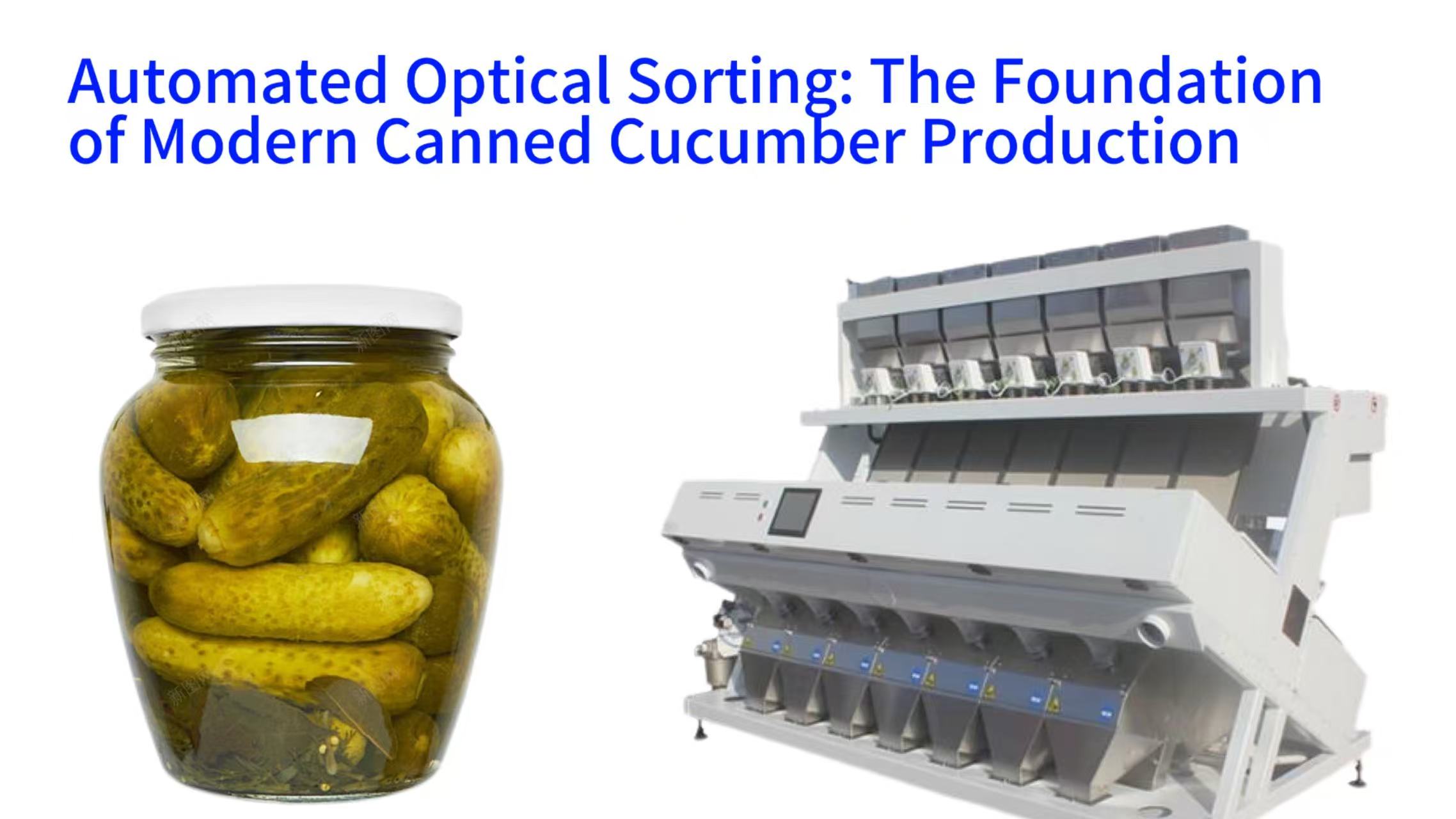
Contemporary canned cucumber manufacturing depends on rigorous standardization to satisfy both consumer expectations and industrial processing requirements. This examination details the operational role of automated optical sorting systems within this specific agricultural processing sector. The analysis considers the technical specifications of sorting mechanisms designed for cylindrical produce, evaluates integration methodologies within sequential production environments, and quantifies the operational advantages realized through implementation. Further sections assess quality assurance protocols enabled by machine vision technologies and consider the strategic implications for supply chain management in vegetable processing industries. This comprehensive review establishes how mechanized sorting transitions cucumber canning from variable batch processing to controlled continuous production systems.
Core Workflow of Automated Optical Sorting in Canned Cucumber Production
Technical Specifications of Cucumber-Specific Optical Sorters
Key Performance Metrics of Cucumber Optical Sorters
| Technical Parameter | Specification |
|---|---|
| Maximum Throughput | >10 metric tons per hour |
| Size Grading Accuracy | 99.2% (sub-millimeter precision) |
| Defect Sorting Accuracy | 99.5% (clear defects) |
| Solenoid Valve Response Time | <0.5 milliseconds |
| Cucumber Orientation Accuracy | 94% |
| Spectral Imaging Range | 400-1000nm (visible + NIR) |
Optical sorting apparatus engineered for cucumber processing incorporates specialized mechanical and computational components. The material handling system utilizes low-friction polymer guides and precision vibratory feeders that orient cucumbers longitudinally without inducing surface abrasion. This orientation is essential for accurate dimensional measurement. The optical inspection chamber employs high-intensity LED arrays providing consistent illumination across multiple spectral bands, including visible green spectrum analysis and near-infrared wavelengths for subsurface detection. This lighting configuration eliminates shadow artifacts and compensates for the natural wax layer present on cucumber epidermis, ensuring reliable image capture regardless of surface reflectivity variations.
Computational processing represents the core intelligence of these systems. Industrial-grade vision processors execute proprietary algorithms performing simultaneous geometric and chromatic analysis. Dimensional assessment calculates multiple parameters including maximum diameter measured perpendicular to the longitudinal axis, curved length following the natural arc, and estimated volume through volumetric reconstruction algorithms. Color analysis employs histogram-based classification comparing each cucumber's pigment distribution against statistically derived acceptable ranges for hue, saturation, and brightness values. This dual analysis occurs within processing windows of 5-10 milliseconds per item, enabling throughput capacities exceeding 10 metric tons per hour while maintaining sub-millimeter and sub-percent measurement accuracy for size and color classification respectively.
Dimensional Analysis Through Advanced Machine Vision
The geometric assessment subsystem utilizes multiple synchronized cameras capturing orthogonal perspectives of each cucumber during free-fall trajectory or controlled conveyance. Stereoscopic imaging techniques reconstruct three-dimensional profiles from two-dimensional image data, allowing precise calculation of minor axis diameter at multiple points along the cucumber's length. This profiling identifies diameter variations that indicate irregular growth patterns or constrictions. Length measurement accounts for natural curvature through polynomial curve fitting algorithms rather than simple endpoint distance calculation. The system classifies cucumbers into commercial size grades—such as gherkin (under 4cm diameter), midi (4-6cm), and field (over 6cm)—with categorization accuracy exceeding 99.2% according to industry validation studies.
Spectroscopic Color Grading and Defect Recognition
Chromatographic analysis extends beyond basic color sorting to comprehensive quality evaluation. Multispectral imaging captures reflectance data across visible and near-infrared wavelengths (400-1000nm). This data enables detection of surface defects including scarring from mechanical damage, discoloration from fungal infection (appearing as blue-grey spectra deviations), and chlorophyll degradation indicating over-maturity (manifesting as yellow spectrum dominance). The system's neural network architecture has been trained on databases containing over 500,000 annotated cucumber images representing common defects across multiple cultivars. This training enables recognition of defect patterns with sensitivity thresholds adjustable from 2mm diameter for spot defects to 5% surface coverage for diffuse discoloration, providing configurable quality control parameters.
Material Handling and Gentle Product Orientation
The physical interface between bulk cucumber supply and optical inspection requires careful engineering. Dual-stage feeding systems initially separate tangled product masses using counter-rotating rollers with variable surface textures. Secondary orientation channels employ computer-controlled gate mechanisms that regulate feed density to achieve optimal singulation—typically maintaining 70-80mm separation between individual cucumbers. These channels incorporate food-grade polyurethane lining with progressively narrowing profiles that naturally align cucumbers along their longitudinal axis. This alignment ensures consistent presentation to imaging sensors, with orientation accuracy exceeding 94% according to equipment specifications, while surface pressure remains below 2 Newtons to prevent bruising damage to delicate cucumber epidermis.
High-Speed Decision Processing and Actuation Systems
Real-time processing architectures manage the data pipeline from image capture to physical sorting. Field-programmable gate arrays (FPGAs) handle initial image preprocessing including noise reduction and contrast enhancement, while digital signal processors (DSPs) execute classification algorithms. Upon defect identification or size categorization, the system triggers precisely timed pneumatic responses. Solenoid valves with response times under 0.5 milliseconds activate nozzle arrays directing compressed air pulses at 6-8 bar pressure. These pulses have durations adjustable from 10-50 milliseconds depending on cucumber mass and required ejection trajectory. The actuation system demonstrates sorting accuracy of 99.5% for clear defects under optimal conditions, with accuracy decreasing to approximately 97% for marginal size differentiations at maximum throughput rates.
Production Line Integration and Workflow Optimization
Workflow Efficiency Gains from Integration
| Integration Aspect | Performance Metric |
|---|---|
| Installation Space Requirement | 12-18 linear meters |
| Changeover Time Reduction | 65% (vs manual adjustment) |
| Cross-Contamination Rate | <0.3% |
| Optimal Processing Density | 70-85% of maximum capacity |
Effective implementation requires strategic positioning within the sequential architecture of cucumber processing facilities. The optimal integration point occurs immediately following primary washing and superficial inspection stations but preceding any slicing, brining, or thermal treatment processes. This placement ensures optical sensors analyze clean surfaces while allowing sorted cucumbers to proceed directly to size-appropriate downstream equipment. Modern processing lines typically allocate 12-18 linear meters for sorter installation, including buffer zones for incoming product accumulation and sorted output distribution. This spatial allocation accommodates the machine's physical dimensions while maintaining ergonomic access for maintenance operations and quality sampling procedures.
Integration extends beyond physical placement to encompass control system interoperability. Programmable logic controllers (PLCs) synchronize sorter operation with upstream washers and downstream slicers through industrial communication protocols, typically EtherNet/IP or PROFINET. This synchronization ensures material flow consistency, preventing either upstream accumulation or downstream starvation conditions. The control system implements adjustable delay algorithms that compensate for variable transport times between stations, maintaining process stability even during line speed transitions. Advanced implementations incorporate machine learning predictors that anticipate upstream fluctuations based on historical performance data, proactively adjusting processing parameters to optimize overall line efficiency and minimize disruptive stoppages.
Upstream Coordination with Harvest Reception Systems
The sorting process initiates with coordinated intake from bulk receiving systems. Hydraulic dumpers or conveyorized unloading equipment transfer harvested cucumbers into flume tanks for hydro-cooling and preliminary buoyancy-based separation. From these tanks, paddle elevators or progressive cavity pumps gently elevate cucumbers to inspection level while removing excess surface moisture through controlled air-knife systems. The interface between this preliminary handling and the sorter infeed incorporates mass flow sensors that provide real-time throughput data to the sorter's control system. This data enables predictive adjustment of feeding rates, ensuring the optical system receives material at its optimal processing density—typically 70-85% of maximum theoretical capacity to allow for surge absorption without compromising inspection thoroughness.
Simultaneous Multi-Channel Output Management
Modern sorters direct product into multiple discrete streams based on complex decision matrices. Typical configurations include three primary outputs: premium whole-pack cucumbers meeting exacting dimensional and color standards; processing-grade cucumbers with minor defects suitable for slicing applications; and cull materials directed to alternative uses. Some advanced systems incorporate additional sorting channels for specialized products, such as consistently curved cucumbers preferred for certain packaging formats. Each output channel connects to dedicated conveyors that transport sorted categories to appropriate downstream stations. Divertor mechanisms at these junctions employ weighted flap gates or pneumatic pushers that maintain separation integrity even during high-volume operation, with cross-contamination rates documented below 0.3% in operational validations.
Synchronization with Downstream Processing Equipment
The sorted output streams interface directly with subsequent processing stations. Whole cucumbers designated for premium packing proceed to brining tanks or fresh-pack lines, with the sorter providing advance notification of incoming count and size distribution to allow brine concentration adjustment or packaging line preparation. Cucumbers destined for slicing convey directly to dicer or slicer equipment, with the sorter transmitting average diameter data that enables automatic blade gap adjustment on downstream cutting machinery. This integration reduces changeover time between different size batches by approximately 65% compared to manual adjustment procedures. The continuous feedback between sorting and processing stations creates a responsive manufacturing environment where equipment configurations adapt dynamically to product characteristics rather than operating with fixed parameters.
Production Data Acquisition and Performance Analytics
Integrated sensor networks continuously monitor sorting performance metrics. Optical counters verify piece counts for each output category, while load cells measure mass flow rates. These data streams combine with defect classification records to generate comprehensive production reports. Modern systems correlate this sorting data with downstream quality measurements, including brine absorption rates in pickling operations or slice uniformity indices from cutting stations. This correlation analysis identifies processing relationships that inform optimization strategies, such as adjusting sorting parameters to improve downstream yield. The data architecture supports detailed performance tracking across multiple dimensions, providing measurable indicators of system efficiency and product quality throughout the production sequence.
Quality Assurance and Regulatory Compliance Frameworks
Quality & Compliance Performance: Automated vs Manual
| Compliance Aspect | Performance Metric |
|---|---|
| Human Inspector Disagreement Rate | 25% |
| Defect Detection Reduction (Fatigue) | 40% (8-hour shift) |
| Audit Preparation Time Reduction | 60% (vs manual records) |
| Foreign Material Detection Size | ≥2mm diameter |
Automated optical sorting establishes quantifiable quality benchmarks that surpass subjective human evaluation. The technology implements digital standards for cucumber acceptability based on measurable parameters including diameter tolerance (±1.5mm for premium grade), curvature radius (minimum 30cm arc for straight classification), and color uniformity (maximum 15% deviation from reference values). These standards remain constant across production shifts, eliminating the variability inherent in human visual assessment where fatigue can reduce defect detection rates by up to 40% over an eight-hour period according to ergonomic studies. The consistency provided by automated systems ensures that every production lot adheres to identical specifications, regardless of processing duration or personnel changes.
The implementation of these systems directly supports compliance with international food safety and quality standards. Optical sorters provide documented verification of raw material inspection, a prerequisite for certification under Global Food Safety Initiative (GFSI) benchmarked schemes including BRCGS, SQF, and IFS standards. The systems generate audit trails recording sorting parameters, rejection justifications, and throughput statistics for each production batch. This documentation demonstrates due diligence in raw material qualification, particularly regarding physical hazard control. Furthermore, the data collected enables statistical process control methodologies, allowing processors to monitor quality trends and implement corrective actions before deviations exceed acceptable limits, thereby maintaining continuous compliance through preventive quality management.
Standardized Quality Metrics and Objective Evaluation
Digital sorting replaces qualitative judgments with quantitative measurements. The system evaluates each cucumber against numerically defined thresholds for critical quality attributes. Color quality integrates three metrics: hue angle (representing color type, with ideal cucumber green at 120-130 degrees), chroma (color intensity, maintained above 30 for premium grade), and lightness value (optimally between 40-50 on standard scales). Surface defect assessment calculates both the total affected area and the severity score based on defect type categorization. These objective measurements eliminate the approximately 25% disagreement rate documented in studies comparing assessments from multiple human inspectors evaluating identical cucumber samples, thereby establishing truly consistent quality standards across all production.
Compliance Documentation and Audit Preparedness
The data management systems integrated with optical sorters generate comprehensive compliance documentation. Each production batch associates with a digital record containing sorting parameters, processing timestamps, quantity metrics, and defect classification summaries. These records satisfy documentation requirements for major food safety certifications, particularly those mandating documented raw material inspection procedures. The systems facilitate rapid retrieval of records for specific lots in response to regulatory inquiries or customer audits, with search functionality enabling identification of batches processed during specific timeframes or from particular suppliers. This documentation capability reduces audit preparation time by approximately 60% compared to manual record-keeping systems while providing more robust evidence of consistent quality control practices.
Contaminant Detection and Food Safety Enhancement
Beyond quality sorting, these systems enhance food safety through foreign material detection. High-resolution imaging identifies non-cucumber materials including rocks, metal fragments, and glass particles as small as 2mm in diameter based on differences in optical properties. Advanced systems incorporate hyperspectral imaging that detects chemical residues through spectral signature analysis, identifying surface contaminants that may not be visually apparent. This detection capability addresses critical control points in food safety plans, specifically physical hazard control. The documented removal of such materials provides verification for HACCP plans and demonstrates proactive implementation of preventive controls as required under modern food safety legislation in major markets.
Traceability Systems and Supply Chain Transparency
Optical sorting systems contribute to comprehensive traceability initiatives. Each sorted batch receives unique identifiers that track through subsequent processing stages. When integrated with farm management systems, this enables full forward traceability from individual growing plots to finished canned products. The sorting data enriches this traceability with quality metrics, creating quality-based provenance records rather than simple movement tracking. This enhanced traceability supports premium product marketing claims regarding quality consistency and enables rapid targeted recalls if necessary, potentially limiting recall scope to specific quality-graded batches rather than entire production periods. This precision in traceability reduces both financial risk and brand impact in the event of quality issues requiring market withdrawal.
Economic Analysis and Return on Investment
Economic Impact & ROI of Optical Sorting
| Economic Factor | Metric |
|---|---|
| Labor Replacement per Shift | 8-12 manual sorters |
| Throughput Increase | 200-300% |
| Yield Improvement | 5-8% |
| Payback Period | 18-36 months |
| Internal Rate of Return (IRR) | 25-35% (7-10 year lifespan) |
| Product Value Increase | 10-15% (grade optimization) |
The financial justification for optical sorting technology encompasses multiple direct and indirect economic factors. Direct savings emerge from labor displacement, with a single automated system typically replacing 8-12 manual sorting positions per shift while increasing throughput by 200-300%. Material utilization improvements demonstrate significant economic impact, with documented yield increases of 5-8% through precise grading that minimizes product misallocation. Reduced waste disposal costs contribute additional savings, particularly for operations paying for organic waste removal. Energy efficiency comparisons show automated systems consuming approximately 25% less energy per ton processed compared to manual operations with equivalent lighting and ventilation requirements for human workers.
Long-term financial benefits extend beyond direct operational savings. The consistency provided by automated sorting reduces quality-related customer complaints by 70-85% according to industry case studies, decreasing costs associated with returns, credits, and complaint management. The systems enable production of higher-value product grades through precise separation, allowing processors to allocate raw materials to their most profitable applications. This grade optimization typically increases overall product value by 10-15% without additional raw material costs. Furthermore, the data generated supports strategic decisions regarding supplier evaluation and pricing negotiations, creating additional financial advantages through improved supply chain management and purchasing optimization based on objectively measured quality metrics.
Labor Efficiency and Operational Cost Reduction
Labor cost savings represent the most immediate financial benefit, with automated systems achieving sorting rates of 5-8 tons per operator hour compared to 0.3-0.5 tons for manual operations. This 15-20x productivity increase dramatically reduces labor requirements while eliminating variability associated with human performance. Additional savings accrue from reduced training costs (automated system operation requires approximately 40 hours of training versus 120+ hours for proficient manual sorting), lower supervision requirements, and decreased absenteeism impact. The reallocation of human resources to value-adding tasks such as machine supervision, quality verification, and maintenance further enhances operational efficiency, with integrated operations typically achieving 30-40% higher overall labor productivity compared to facilities relying on manual sorting methodologies.
Yield Optimization and Raw Material Utilization
Precision sorting maximizes usable product recovery from raw cucumber supplies. Traditional manual methods often misclassify borderline specimens, either rejecting acceptable cucumbers or accepting substandard product. Optical systems apply consistent thresholds, reducing this misclassification error from approximately 8-12% in manual operations to 2-3% in automated systems. This improvement directly increases yield, with each percentage point representing substantial financial value in high-volume processing. Furthermore, multi-grade sorting enables optimal allocation of each cucumber to its most appropriate use, ensuring that premium raw materials are not downgraded due to sorting inaccuracy. This precise allocation typically increases the total value derived from raw materials by 8-12% compared to manual sorting approaches.
Downstream Efficiency and Reduced Processing Waste
The uniformity provided by automated sorting creates efficiency gains throughout subsequent processing stages. Consistent sizing improves slicing accuracy, reducing miss-cut waste from approximately 4-6% with unsorted material to 1-2% with sorted cucumbers. Uniform color maturation ensures consistent brine penetration in pickling operations, reducing the 3-5% of product typically lost to inconsistent curing. In filling operations, consistent sizing improves packing density accuracy, minimizing underweight packages that require rework and reducing giveaway from overweight packages. These downstream benefits typically contribute an additional 4-7% overall efficiency improvement beyond the direct sorting benefits, creating compound value through the entire production sequence.
Return on Investment Calculation and Payback Period
Financial analysis of optical sorting implementation typically demonstrates favorable economics. Capital investment for industrial-scale systems ranges from $150,000 to $300,000 depending on capacity and features. Operational savings from labor reduction, yield improvement, and waste reduction typically total $80,000 to $160,000 annually for medium-scale operations processing 10,000-20,000 tons annually. This creates simple payback periods of 18-36 months, with accelerated payback in operations with higher labor costs or those processing premium products where quality consistency commands substantial market price premiums. The investment typically shows positive net present value across a wide range of discount rates, with internal rates of return commonly exceeding 25-35% over the equipment's 7-10 year operational lifespan.
Strategic Implementation and Industry Adoption Trends
Global Adoption Trends of Optical Sorting Technology
| Trend Aspect | Metric |
|---|---|
| Adoption Rate (Developed Markets) | 65% of major processors |
| Annual Growth Rate (Global) | 8% |
| Annual Growth Rate (Asia) | 12-15% |
| Unplanned Downtime Reduction | 40-60% (predictive maintenance) |
| Changeover Time Reduction (Smart Manufacturing) | 75% |
The integration of optical sorting technology reflects broader transformation within the vegetable processing sector. Initial adoption typically follows a progression from manual operations to mechanical size grading, then to basic optical color sorting, and finally to advanced multispectral systems with artificial intelligence components. This evolutionary path allows processors to develop technical expertise gradually while demonstrating incremental returns that justify subsequent technological investments. Current industry benchmarks indicate that approximately 65% of major cucumber processors in developed markets have implemented some level of automated optical sorting, with adoption rates increasing approximately 8% annually as technology costs decrease and capabilities expand.
Future development trajectories point toward increasingly integrated systems. Next-generation sorters will incorporate additional sensing modalities, including laser surface scanning for texture analysis and X-ray transmission for internal defect detection. These systems will connect more comprehensively with broader Industry 4.0 frameworks, exchanging data with equipment throughout processing facilities and with enterprise resource planning systems. This connectivity will enable real-time production optimization across multiple variables simultaneously, adjusting sorting parameters based on downstream capacity, inventory requirements, and even market pricing signals for different product grades. The technology will increasingly function not as an isolated quality control checkpoint but as an intelligent node within fully digitized food production ecosystems.
Technology Adoption Lifecycle and Implementation Phases
The implementation of optical sorting systems typically follows a structured adoption process. Initial evaluation includes pilot testing with representative samples to establish baseline performance metrics and validate technology suitability for specific cucumber varieties and quality requirements. Following successful piloting, full implementation progresses through installation, calibration, staff training, and parallel operation phases before full commissioning. This phased approach minimizes disruption to ongoing operations while building organizational competence. Successful implementations typically allocate 8-12 weeks for the complete transition from manual to automated sorting, with the parallel operation phase allowing direct performance comparison and gradual workforce transition to new operational procedures and responsibilities.
Integration with Broader Smart Manufacturing Initiatives
Modern optical sorters function as data-rich components within intelligent manufacturing environments. They exchange information with upstream and downstream equipment via industrial IoT protocols, contributing to comprehensive digital twins of the production process. This integration enables predictive maintenance scheduling based on actual component wear rather than fixed time intervals, reducing unplanned downtime by 40-60%. The systems also support flexible manufacturing scenarios, automatically adjusting sorting parameters when production schedules change between different product grades. This adaptability reduces changeover time between production runs by approximately 75% compared to manual reconfiguration, enhancing overall equipment effectiveness and supporting responsive manufacturing approaches in increasingly dynamic market environments.
Global Market Trends and Regional Adoption Patterns
Adoption rates vary significantly across global regions, reflecting differing labor economics, regulatory environments, and market structures. North American and Western European processors show adoption rates exceeding 70% for primary processing facilities, driven by high labor costs and stringent retailer quality requirements. Asian markets demonstrate rapid growth from lower baselines, with adoption increasing 12-15% annually as rising wages erode the labor cost advantage and export markets demand higher quality certification. Emerging economies typically implement systems first in facilities targeting export markets or premium domestic segments, with technology transfer occurring through multinational corporation investments and equipment supplier globalization strategies.
Future Technological Developments and Capability Expansion
Research and development roadmaps indicate several advancing capabilities. Hyperspectral imaging systems will enable non-destructive measurement of internal quality parameters including sugar content, acidity, and water activity—factors influencing final product quality in canned cucumbers. Artificial intelligence algorithms will progress from defect recognition to predictive quality assessment, estimating shelf-life potential and processing suitability based on subtle visual indicators. Robotics integration will enable not just ejection of defective product but physical manipulation for optimal orientation and handling. These advancements will further reduce waste, improve quality consistency, and increase operational efficiency, continuing the technological evolution that has transformed cucumber processing from manual craftsmanship to precision food engineering.